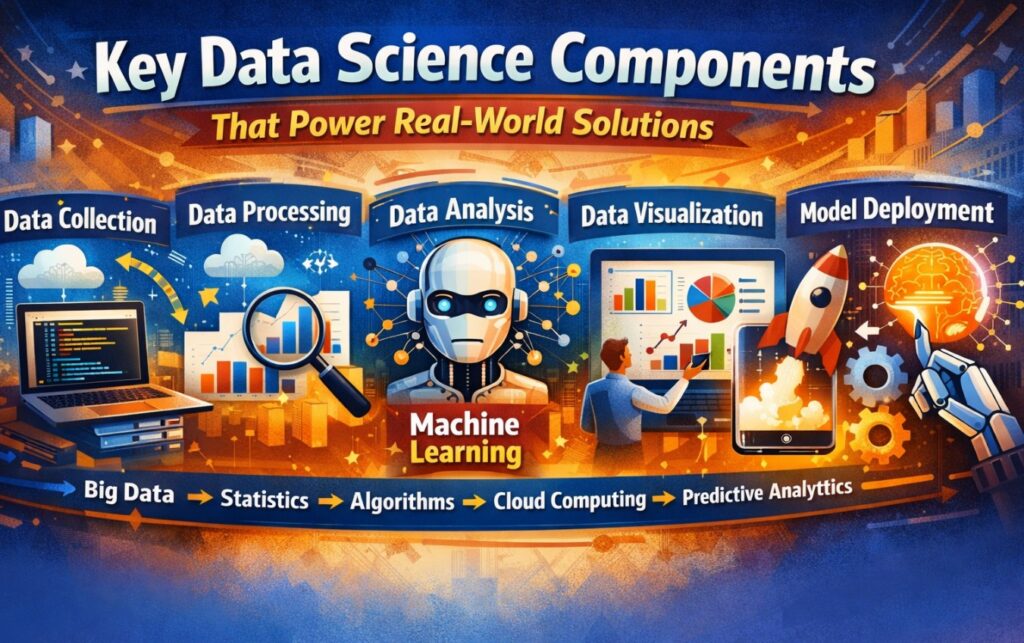
In the modern world, any business requires intelligent choices based on powerful and clear insights. Thus, data science is now an influential tool that promotes numerous real-life requirements. It assists companies in quicker problem-solving, enhanced systems, and analytics of user behavior. Besides, it enables professionals to transform raw information into meaningful actions. Consequently, data science is the source of innovation in virtually all areas.
This blog discusses the key building blocks that create this field and demonstrates their influence on real solutions. These are fundamental building blocks that lead contemporary teams and assist in advancement in the future across industries. This consists of the essential components of Data Science that reinforce problem-solving initiatives.
Understanding the Core of Data Science
Data science is the combination of technology, logic, and creativity. Hence, its parts collaborate to comprehend patterns and assist in making smarter judgments. Every segment has a definite role and is value-added.
You will find how data science depends on:
- Clear data collection
- Strong analysis
- Modern tools
- Practical decision-making procedures.
These modules assist businesses in applying information prudently. Therefore, they create a sense of confidence, mitigate risks, and enhance outcomes.
What Are the Main Components of Data Science?
Data science operates under a number of well-organized aspects that aid in converting raw data into insights. Moreover, every component is essential, and in combination with others, they make an entire problem-solving framework. It is necessary to note that although most individuals are more interested in tools, what is truly valuable is understanding the whole pipeline. To establish this base, we will deconstruct the Components of Data Science in an easy and viable manner.
- Data Collection and Gathering
The first stage in any data science project is data collection. As such, teams need to acquire accurate and full information using credible sources. These include surveys, sensors, websites, and internal systems. Besides, your results are determined by the quality of your data. Clean data support clear and powerful insights. Consequently, your project will be accurate and reliable. When it is appropriately collected, teams are able to learn patterns and find significant ideas. The step, therefore, aids all the processes that are going to be made in the future and gives a smooth decision.
- Data Cleaning and Preparation
Raw data usually is full of errors and omissions. As such, it is crucial to clean thoroughly to obtain accurate results. Data preparation eliminates repetition and corrects incorrect formats. Additionally, this step will systematize the information. Consequently, the machines can perceive the patterns. Clean data also enhances the performance of models. Therefore, this step develops confidence in your knowledge. Even the advanced tools give poor results without preparation. As such, data preparation remains a crucial foundation.
- Exploratory Data Analysis (EDA)
EDA assists teams in gaining insight into data. Thus, they explore significant insights with the help of charts, patterns, and summaries. In addition, EDA presents relationships that lead to further analysis. Consequently, teams discover concealed problems or good opportunities. EDA is also used to select the appropriate models and tools. Therefore, high EDA assuages the risks and enhances precision. Professionals clearly present complex concepts with the aid of simplified graphics. It, thus, improves communication and decision-making.
EDA usually includes:
Pattern detection
Outlier identification
Visual comparisons
Trend analysis
- Statistical Methods and Probability
Statistics constitutes the head of data science. Thus, it assists in quantifying trends and anticipating results. Probability helps teams to know risks and upcoming events. Additionally, statistical procedures facilitate superior decision-making in various industries. This has led to companies being confident when strategizing on new strategies. Regression, distribution, and hypothesis testing tools can be used to make clear insights. Therefore, statistics guarantees accuracy and stability in the majority of data projects. In the absence of these techniques, findings would not be rich and valid.
- Machine Learning Models
Machine learning assists systems to learn through information and enhancing performance. Thus, groups rely on models to make predictions, categorize, and prescribe their actions. ML favours companies in the fields of healthcare, finance, retailing, and transport. Additionally, the ML algorithms can assist in fraud detection, product recommendations, and predictions. Subsequently, machine learning becomes a potent technology that defines contemporary solutions. Such models as decision trees, neural networks, and clustering help with numerous real-world requirements. Therefore, ML is still among the most powerful data science components in the digital world.
- Programming Skills
Data scientists have various languages that they utilize in order to work with information effectively. Thus, they use the instruments that facilitate automation, modeling, and visualization. These languages allow professionals to write clear and clean code. Besides, they enhance the accuracy and speed of the project. Consequently, coding will be indispensable in any data position. The most used choices include Python, R, and SQL. Therefore, data scientists have complete control over their tasks because of programming. This section is the strength of programming languages in Data science, which influences numerous strong workflows.
- Data Visualization and Storytelling
Visualization makes the explanation of insights simple and interesting. Thus, charts, dashboards, and reports are used by teams to communicate the results clearly. Such images enable superior decision-making and enhance clarity among non-technical groups. Furthermore, visual storytelling is effective in pointing out essential patterns in a short time. Consequently, leaders have an idea of the way forward. Tableau, Power BI, and Python libraries are some of the tools that facilitate easy and robust visuals. Therefore, information and action are connected through the use of data visualization.
Strong visual tools include:
Bar charts
Heatmaps
Pie charts
Trend lines
Interactive dashboards
- Model Evaluation and Optimization
All models must be well tested prior to actual application. Thus, assessment can be used to gauge performance and accuracy. Precision, recall, and confusion matrices are metrics used by teams to evaluate their performance. In addition, assessment unravels errors in the initial stages. Consequently, models would become more helpful and valid. Systems are then optimized to achieve improved results. Thus, it is a step that guarantees good and reliable outcomes. Companies have faith in machine decisions and predictions, provided they are adequately assessed.
- Deployment and Real-World Integration
The models are deployed into real systems, which they help support day-to-day operations. Hence, this step relates findings to actual users. Companies incorporate solutions into websites, applications, and internal systems. Besides, implementation guarantees ongoing learning and development. Consequently, data science becomes a long-term asset. Teams work on monitoring model behavior and update it when necessary. Therefore, deployment will provide a smooth working of insights in actual conditions.
- Ethical and Responsible Data Use
Ethics largely influences the contemporary data world. Consequently, teams have rules of strictness to ensure that data is safe and fair. The responsible use safeguards the user’s privacy and ensures that no biased decisions are made. Besides, ethical management develops trust in customers. This makes businesses develop better and more significant solutions that are safe. Moral controls enhance transparency and promote long-term trustworthiness. Therefore, responsible practices make data science stronger.
Conclusion
The field of data science is still transforming how businesses comprehend data. Thus, these elements combine to form powerful and valuable solutions. Their respective parts are value-adding, and they maintain a smooth flow of the project. In addition, these tools are relied upon in real-world industries in order to make improved planning and decisions.
Consequently, businesses are becoming quicker and smarter in a data-driven approach. Data science is an engine of growth with appropriate practices and ethics. Therefore, by acquiring these elements, you will be ready to take up thrilling opportunities in the digital world.