Nestled in the Garhwal Himalayas, the Bali Pass Trek is a formidable and breathtaking journey that connects the verdant Har Ki Dun valley with the sacred Yamunotri region. Revered by seasoned trekkers, it offers an unfiltered encounter with the raw, high-altitude wilderness. This guide delves into the key aspects of the trek—its difficulty, length, starting point, and a detailed itinerary—to help you prepare for this extraordinary challenge.
1. How Difficult is the Bali Pass Trek?
The Bali Pass Trek is unequivocally graded as a difficult to strenuous expedition, suitable primarily for experienced trekkers with prior high-altitude exposure. It is not recommended for absolute beginners. The challenge stems from a combination of three critical factors:
- Extreme Altitude: The pass itself sits at a dizzying 4,940 meters (16,207 feet). Trekking above 4,000 meters poses a significant risk of Acute Mountain Sickness (AMS). The body must be given time to acclimatize to the thin air, making a slow, measured ascent with scheduled rest days non-negotiable for safety.
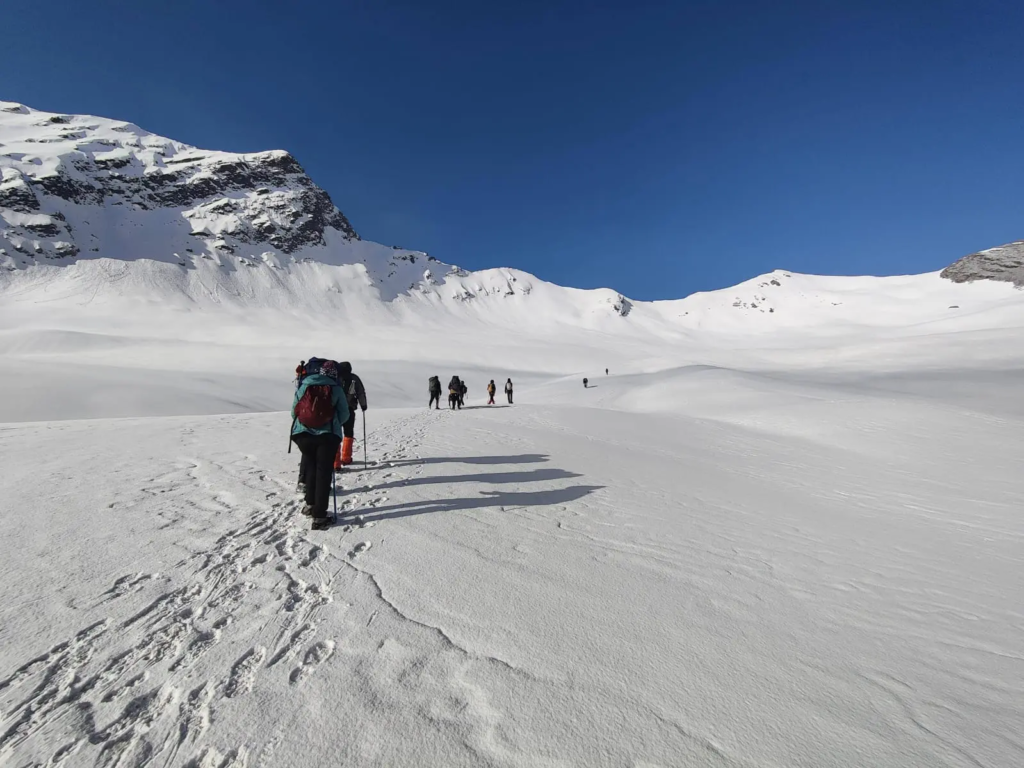
- Demanding Terrain: The trail is a mosaic of challenging landscapes. It begins with serene meadows but quickly transitions into steep, relentless ascents and descents. Trekkers must navigate rocky moraines, glacial sections, sharp mountain ridges, and often deep snow (even in early summer). The final summit push and the subsequent descent are particularly technical, potentially requiring the use of an ice axe and crampons.
- Unpredictable Weather: The Himalayan weather is notoriously fickle. Sunshine can swiftly turn into snowfall, rain, or dense fog. Rain can transform trails into slippery, slushy paths, while heavy snow can obscure tracks and increase avalanche risk. Being equipped with high-quality, waterproof gear and being prepared for sudden temperature drops is crucial.
In essence, this trek demands excellent physical fitness, mental fortitude, proper technical gear, and should ideally be undertaken with an experienced guiding agency for navigation and safety.
2. How Long is the Bali Pass Trek?
The Bali Pass Trek spans approximately 55 to 66 kilometers from the base village to the exit point. However, the true measure of this trek is in its vertical gain and the days required to complete it safely.
- Duration: It is typically completed in 8 to 9 days, including travel from and to Dehradun.
- Daily Trekking: Daily hiking distances vary from a moderate 4-5 km on acclimatization days to a grueling 14 km on the summit day (crossing the pass and descending). The summit day often involves 10-12 hours of continuous trekking over technical terrain.
- Total Ascent: The trek involves a cumulative ascent of nearly 3,000 meters from the starting point at Sankri.
3. Where is the Starting Point of the Bali Pass Trek?
The gateway for the Bali Pass Trek is the picturesque village of Sankri, located in the Uttarkashi district of Uttarakhand.
- About Sankri: Perched at an elevation of 1,920 meters (6,300 feet), Sankri acts as a bustling hub for several Himalayan treks. It lies on the fringe of the Govind Ballabh Pant National Park, offering a tranquil setting with basic homestays and guesthouses.
- How to Reach: The journey begins from Dehradun, the major transport hub. From Dehradun, it’s a 200-220 km drive (8-10 hours) to Sankri via Mussoorie and the beautiful Tons River valley. The road is scenic but winding, passing through dense pine forests and mountain hamlets.
Detailed Brief Itinerary
Here’s a snapshot of a standard 8-day trekking itinerary:
- Day 1: Dehradun to Sankri (Drive) | 10-hour scenic drive to the base village.
- Day 2: Sankri to Seema via Taluka | Drive to Taluka, then trek to Seema, entering the Supin River valley.
- Day 3: Seema to Rainbasera | Trek along the Supin River with views of Kala Nag peak.
- Day 4: Rainbasera to Ruinsara Tal | Ascend to the stunning alpine Ruinsara Lake, a major highlight.
- Day 5: Ruinsara Tal to Odari | Short, steep climb for crucial acclimatization; first views of Bali Pass.
- Day 6: Odari to Bali Pass Base Camp (Bali Col) | A challenging walk on a steep ridge to the high camp.
- Day 7: Base Camp to Lower Dhamni via Bali Pass (Summit Day) | The most demanding day. Pre-dawn start to summit the pass (16,207 ft) for panoramic views of Bandarpoonch and Swargarohini peaks, followed by a long, technical descent to Lower Dhamni.
- Day 8: Lower Dhamni to Janki Chatti via Yamunotri & Drive to Dehradun | Descend to the Yamunotri temple, then drive to Janki Chatti and onward to Dehradun.
Conclusion: Preparation is Key
The Bali Pass Trek is a rewarding test of endurance that leads through emerald meadows, past glacial rivers, and over majestic snow-clad passes. Its difficulty, however, cannot be overstated. Success hinges on rigorous physical preparation, investing in quality mountaineering gear, respecting the acclimatization process, and choosing a reputable outfitter. Agencies like Himalayan Daredevils provide the essential expertise, safety protocols, and logistical support, allowing you to focus on the sheer grandeur of the journey. If you are up for the challenge, Bali Pass promises an unforgettable saga of adventure in the heart of the Himalayas.
FAQs: Bali Pass Trek
- What is the best time to do the Bali Pass Trek?
The ideal window for the Bali Pass Trek is from mid-May to June (post-winter) and September to mid-October (post-monsoon). During these periods, the weather is relatively stable, with clear skies and manageable snow conditions. The monsoon season (July-August) is dangerous due to landslides, and winter makes the pass inaccessible due to extreme snow. - What kind of physical fitness is required?
Trekkers must have excellent cardiovascular endurance and leg strength. Prior experience of a high-altitude trek (above 13,000 ft) is highly recommended. A routine of running, stair climbing, squats, and lunges with a loaded backpack for 2-3 months prior is essential to prepare for the long, strenuous days. - Is it safe to do the Bali Pass Trek without a guide?
No, it is not recommended. The trek involves route finding through unmarked, technical sections, glacier travel, and potential avalanche terrain. The risk of AMS is high, and the weather is unpredictable. A certified guide or reputable agency ensures safety, proper acclimatization, navigation, and emergency support. - What is the accommodation like on the trek?
The Bali Pass Trek is a complete camping expedition. Accommodation consists of twin-sharing tents at designated campsites. You will sleep on sleeping pads inside quality sleeping bags (often provided by operators). All meals are prepared by the support team. - What are the permits required?
The trek passes through the Govind Wildlife Sanctuary & National Park. Permits are mandatory and are typically arranged by your trekking operator. You will need to provide ID proof (Passport for foreigners, Aadhar/Voter ID for Indians). Carrying physical and digital copies is advised.