Heart disease, especially coronary artery disease (CAD), is one of the leading causes of death worldwide. CAD is often caused by the accumulation of plaque within the coronary arteries, leading to blockages that restrict blood flow to the heart muscle. If untreated, this can result in chest pain, heart attacks, and even death. Fortunately, advances in heart procedures, such as IVUS Angioplasty and Rotational Atherectomy, have transformed the way we treat these conditions, providing more accurate and effective treatment options. These minimally invasive procedures offer a precise and tailored approach to opening blocked arteries, improving patient outcomes, and ensuring faster recovery.
Introduction to Heart Disease and Advanced Treatment Options
Coronary artery disease develops when the arteries that supply the heart with oxygen-rich blood become narrowed or blocked due to the buildup of fatty deposits or plaques. When these plaques harden and form calcified lesions, they become harder to treat, requiring more specialized procedures.
For years, coronary angioplasty (or percutaneous coronary intervention) has been the standard procedure to clear these blockages. However, as heart disease cases have become more complex, especially with heavily calcified blockages, new technologies have emerged. IVUS Angioplasty and Rotational Atherectomy are two such advancements that provide higher precision and better patient outcomes.
What is IVUS (Intravascular Ultrasound)?
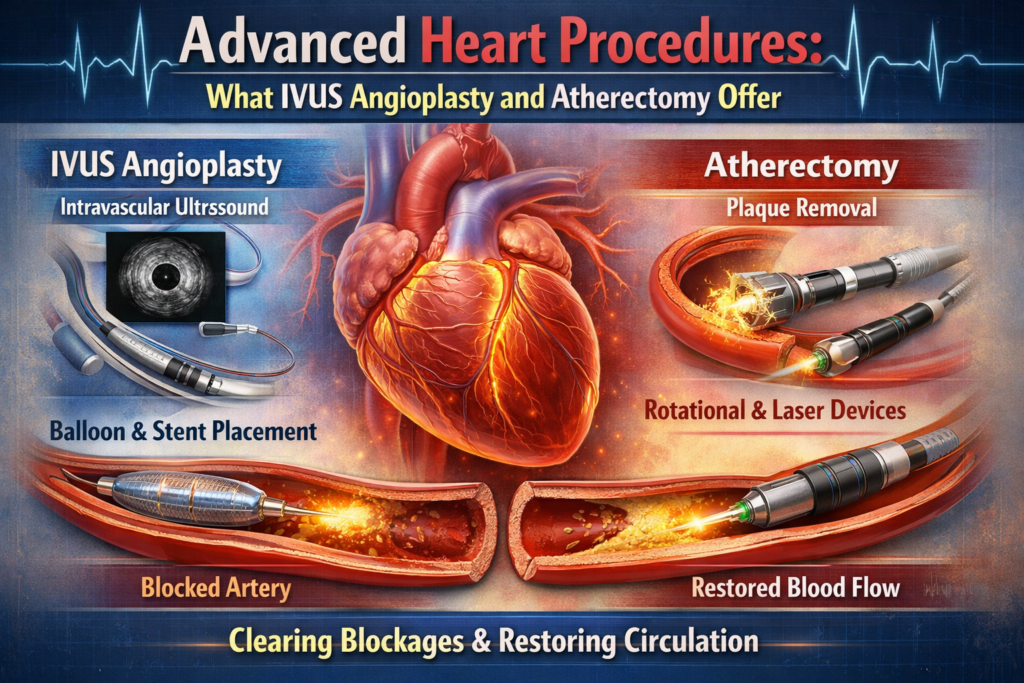
IVUS Angioplasty involves using a small ultrasound probe inserted into the coronary arteries to produce real-time images of the inside of the blood vessels. This allows doctors to see the artery walls, measure blockages, and assess the severity of the condition. Traditional angiograms, which only show the outside of the vessels, can sometimes fail to identify small blockages or plaque distribution inside the arteries. IVUS offers a more comprehensive view, allowing for precise measurements that guide treatment decisions.
This technique is invaluable in complex cases where the location, size, and extent of blockages are difficult to determine with standard imaging. IVUS Angioplasty provides physicians with the information necessary to choose the best course of action, whether that involves balloon angioplasty, stenting, or other interventions.
How IVUS Angioplasty Works?
During an IVUS Angioplasty procedure, a catheter with an ultrasound probe is carefully inserted through a small incision in the groin or wrist and guided to the affected artery. Once the probe reaches the site of the blockage, it emits high-frequency sound waves that bounce off the artery walls, creating a detailed image of the artery’s interior. These images are displayed on a screen, allowing the doctor to assess the plaque buildup, identify any narrowing or abnormalities, and determine the best treatment approach.
When combined with angioplasty, the IVUS Angioplasty procedure allows doctors to inflate a balloon catheter at the site of the blockage. This opens the artery and improves blood flow, often followed by the placement of a stent to maintain the artery’s patency. The use of IVUS ensures the balloon is inflated at the right location, with the correct pressure, reducing the risk of complications like vessel rupture or restenosis (re-narrowing of the artery).
What is Atherectomy?
Atherectomy is a procedure designed to remove plaque buildup from the inside of the arteries, helping to restore blood flow. While IVUS Angioplasty addresses the blockage by expanding the artery, atherectomy physically removes the obstructive material, making it a useful treatment for certain types of blockages that may be resistant to balloon angioplasty alone.
There are several types of atherectomy, but Rotational Atherectomy is one of the most widely used techniques. In this procedure, a special catheter with a rotating diamond-coated burr is inserted into the artery. The burr spins at high speeds and grinds away the plaque, reducing the size of the blockage and preparing the artery for balloon angioplasty or stenting. Rotational Atherectomy is particularly effective for calcified plaques that are too hard to treat with traditional angioplasty techniques.
How Atherectomy Complements Angioplasty?
Rotational Atherectomy is often used in combination with IVUS Angioplasty to achieve optimal results. In cases where the plaque is heavily calcified and resistant to balloon dilation, Rotational Atherectomy helps to break up the hardened plaque, making it easier to expand the artery with a balloon catheter. The ability to remove plaque before balloon angioplasty improves the chances of achieving a successful outcome, particularly in patients with complex coronary lesions.
The combination of IVUS Angioplasty and Rotational Atherectomy offers a more precise, effective, and safer approach to treating patients with difficult blockages. By addressing both the plaque and the blockage with these advanced techniques, doctors can significantly improve blood flow and reduce the risk of recurrence.
Benefits of IVUS Angioplasty and Atherectomy
One of the primary benefits of IVUS Angioplasty is its ability to provide real-time imaging, ensuring that physicians can assess the artery more accurately. This reduces the likelihood of complications, such as overinflation of the balloon, incorrect stent placement, or insufficient plaque removal. Moreover, the enhanced precision of IVUS Angioplasty allows doctors to better manage complex cases and reduce the need for repeated interventions.
Rotational Atherectomy also provides significant advantages, especially in cases involving calcified plaques. By effectively removing hardened deposits, it improves the effectiveness of balloon angioplasty, ensuring a better and more durable result. The combined use of IVUS Angioplasty and Rotational Atherectomy can help patients achieve optimal results with minimal invasiveness and faster recovery times.
When are IVUS and Atherectomy Indicated?
These advanced techniques are typically indicated in patients with coronary artery disease that involves heavily calcified plaques, long lesions, or complex blockages. IVUS Angioplasty is particularly useful when the precise assessment of the blockage is crucial, such as in patients with multiple blockages or those who have had previous failed interventions.
Rotational Atherectomy is often used in cases where the blockage is made up of hard, calcified plaque that does not respond well to traditional balloon angioplasty. By removing the tough deposits before ballooning, Rotational Atherectomy allows for more effective treatment and less risk of complications during the procedure.
Patient Outcomes: What Can Be Expected After IVUS Angioplasty and Atherectomy?
The combination of IVUS Angioplasty and Rotational Atherectomy has been shown to significantly improve patient outcomes. Studies have demonstrated that patients who undergo these advanced treatments experience better blood flow, fewer complications, and a lower incidence of restenosis compared to those treated with traditional angioplasty alone.
Life After Angioplasty can be much improved when these advanced procedures are used. Patients can often resume normal activities faster and enjoy a better quality of life due to reduced chest pain and a lower risk of heart attack. These procedures help to clear arteries more thoroughly, leading to longer-lasting results and a reduced need for future interventions.
Risks and Considerations
While IVUS Angioplasty and Rotational Atherectomy are highly effective, they are not without risks. Possible complications include bleeding, infection, artery damage, and restenosis. However, the risk of these complications can be minimized with careful patient selection, accurate imaging, and skilled technique. It is important to discuss these risks with a healthcare provider before deciding on the most appropriate treatment.
Future Trends and Innovations in Heart Treatment
As heart disease continues to evolve, so do the treatments for it. The future of IVUS Angioplasty and Rotational Atherectomy looks promising, with innovations in imaging technologies, catheter designs, and minimally invasive techniques. Advancements in IVUS Angioplasty may lead to even more precise imaging and better patient outcomes, while improvements in Rotational Atherectomy may make plaque removal even more effective for complex cases.
Conclusion
IVUS Angioplasty and Rotational Atherectomy represent significant advances in the treatment of coronary artery disease, offering a more accurate and effective approach to treating complex blockages. By combining real-time imaging with plaque removal, these procedures improve the chances of successful outcomes and reduce the risk of complications. With the benefits of enhanced precision, fewer complications, and quicker recovery times, IVUS Angioplasty and Rotational Atherectomy offer hope for patients with difficult coronary lesions, improving Life After Angioplasty and offering a brighter future for heart health.