Top Safe Investment Options in India During Market Volatility
Top Safe Investment Options in India During Market Volatility
Market ups and downs are a natural part of investing. But when volatility rises sharply, fear often replaces logic. For Indian investors looking to protect their capital, understanding the top safe investment options in India during market volatility becomes critical.
Whether you’re a conservative investor, a retiree, or someone worried about economic uncertainty, this guide will help you identify stable, low-risk avenues that can protect wealth and generate reasonable returns.
Let’s break it down step by step.
What Does Market Volatility Really Mean?
Market volatility refers to rapid and unpredictable price movements in financial markets. It usually happens due to:
-
Global economic uncertainty
-
Inflation concerns
-
Interest rate hikes
-
Geopolitical tensions
-
Banking or liquidity crises
When markets fall sharply, investors panic and sell in fear. This selling pressure further drags prices down, creating a cycle of anxiety and poor financial decisions.
But volatility is not the enemy. Lack of preparation is.
Why Investors Panic During Market Crashes
Understanding investor psychology is important.
During market crashes:
-
Portfolio values fall rapidly
-
Media amplifies negative news
-
Investors compare losses with others
-
Fear of losing more money increases
Instead of focusing on long-term goals, many investors ask:
“Where to invest during market crash?”
The answer lies in identifying safe investment options in India that focus on capital protection rather than aggressive growth.
Top Safe Investment Options in India During Market Volatility
Here are the most reliable and practical investment choices when markets turn unstable.
1. Fixed Deposits (FDs)
Fixed deposits remain one of the best low risk investments in India, especially during uncertain times.
Why FDs Work in Volatility:
-
Guaranteed returns
-
Capital protection
-
No market risk
-
Predictable income
Banks and NBFCs offer FDs with tenure flexibility ranging from 7 days to 10 years.
Who Should Choose FDs?
-
Retirees
-
Conservative investors
-
Emergency fund allocation
-
Short-term goals (1–3 years)
However, returns may barely beat inflation. So FDs are ideal for safety, not wealth creation.
2. Government Bonds in India
When uncertainty rises, investors often move toward government bonds India.
These include:
-
RBI Floating Rate Bonds
-
Sovereign Gold Bonds
-
Treasury Bills
-
G-Secs
Since they are backed by the Government of India, default risk is extremely low.
Benefits:
-
Stable income
-
Higher safety
-
Suitable for conservative portfolios
Government bonds are considered capital protection investments, especially for medium to long-term stability.
3. Public Provident Fund (PPF)
PPF is one of the safest long-term investment options in India.
PPF Investment Benefits:
-
Government-backed
-
Tax-free returns
-
15-year lock-in ensures discipline
-
Compounding advantage
For investors planning retirement or long-term wealth stability, PPF is among the safest investment options in India 2026 and beyond.
Ideal for:
-
Salaried professionals
-
Long-term planners
-
Tax-saving investors
4. Gold – The Traditional Safe Haven
Gold has historically performed well during crises. It is considered one of the strongest safe haven investments in India.
During market crashes:
-
Investors shift money from equities to gold
-
Gold prices often rise when markets fall
-
It protects against currency depreciation
You can invest in gold through:
-
Physical gold
-
Gold ETFs
-
Sovereign Gold Bonds
Gold acts as portfolio insurance.
5. Silver Investment in India
Silver is gaining popularity as an alternative safe asset.
Compared to gold:
-
Silver is more affordable
-
Has both industrial and investment demand
-
Can outperform gold in certain recovery cycles
If you’re evaluating gold vs silver during market volatility, silver may offer higher upside but slightly higher price swings.
Investors who track regional trends often monitor city-specific rates like:
Tracking these rates helps investors time entries better and understand local demand patterns.
Gold vs Silver During Market Volatility
| Factor | Gold | Silver |
|---|---|---|
| Stability | More stable | Slightly volatile |
| Industrial Use | Limited | High |
| Affordability | Expensive | More affordable |
| Crisis Performance | Strong hedge | Can outperform later |
Gold is better for capital safety.
Silver suits investors willing to take moderate risk for higher potential gains.
6. Debt Mutual Funds
Debt funds invest in:
-
Government securities
-
Corporate bonds
-
Money market instruments
They offer better liquidity than FDs and potentially higher returns.
However, risk depends on:
-
Credit quality
-
Interest rate movements
-
Duration
For short-term parking, liquid funds and ultra-short duration funds can be practical.
Debt funds fit investors asking, “How to invest during stock market volatility without exiting markets completely?”
7. Diversified Portfolio Strategy
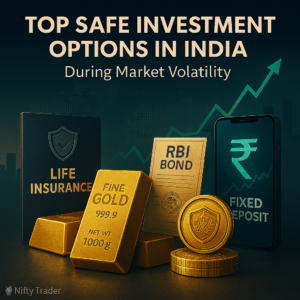
No single asset guarantees complete safety.
That’s why an asset allocation strategy is critical.
A simple defensive portfolio during volatility could look like:
-
30% Fixed Deposits
-
20% Government Bonds
-
20% Gold/Silver
-
20% Debt Funds
-
10% Equity (large-cap, stable companies)
Diversification reduces concentration risk and smoothens overall returns.
How Asset Allocation Reduces Risk
When equities fall:
-
Gold may rise
-
Bonds may remain stable
-
FDs remain unaffected
This balance protects your overall portfolio from sharp declines.
The key principle:
Don’t try to predict markets. Prepare for them.
Best Investment During Economic Uncertainty
There is no universal answer.
Your choice depends on:
1. Risk Appetite
-
Low risk → FDs, PPF, Bonds
-
Moderate risk → Gold, Silver, Debt Funds
2. Time Horizon
-
Short-term → FDs, Liquid Funds
-
Long-term → PPF, Gold, Government Bonds
3. Liquidity Needs
-
Immediate access → Liquid funds
-
Locked savings → PPF
Realistic Return Expectations
Safe investments focus on stability, not high returns.
Expected range:
-
Fixed Deposits: 6–8%
-
PPF: 7–8% (government declared)
-
Government Bonds: 6–7.5%
-
Gold: Varies (hedge asset)
-
Silver: Cyclical returns
If someone promises double-digit guaranteed returns during a market crash, it’s a red flag.
Safety and modest returns go hand in hand.
Where to Invest During Market Crash – Practical Framework
Instead of reacting emotionally, follow this 5-step approach:
-
Assess emergency fund (6 months expenses)
-
Shift some equity exposure to gold or bonds
-
Increase allocation to fixed-income assets
-
Avoid panic selling
-
Review asset allocation annually
Volatility creates fear, but it also creates opportunities for disciplined investors.
Who Should Choose Which Investment?
| Investor Type | Best Option |
|---|---|
| Retirees | FDs, Government Bonds |
| Young Professionals | PPF + Gold + Some Equity |
| Conservative Investors | PPF + Bonds |
| Moderate Risk Investors | Gold + Silver + Debt Funds |
| Short-Term Goal Investors | Fixed Deposits |
Final Thoughts
Market volatility is temporary. Financial discipline is permanent.
The top safe investment options in India during market volatility are not about chasing returns. They are about protecting capital, maintaining liquidity, and staying emotionally balanced.
A mix of:
-
Fixed deposits
-
Government bonds
-
PPF
-
Gold
-
Silver
-
Debt funds
combined with a proper asset allocation strategy can help investors navigate uncertain markets confidently.
Instead of asking, “How do I avoid volatility?”
Ask, “Is my portfolio prepared for it?”
Because in investing, preparation always beats prediction.