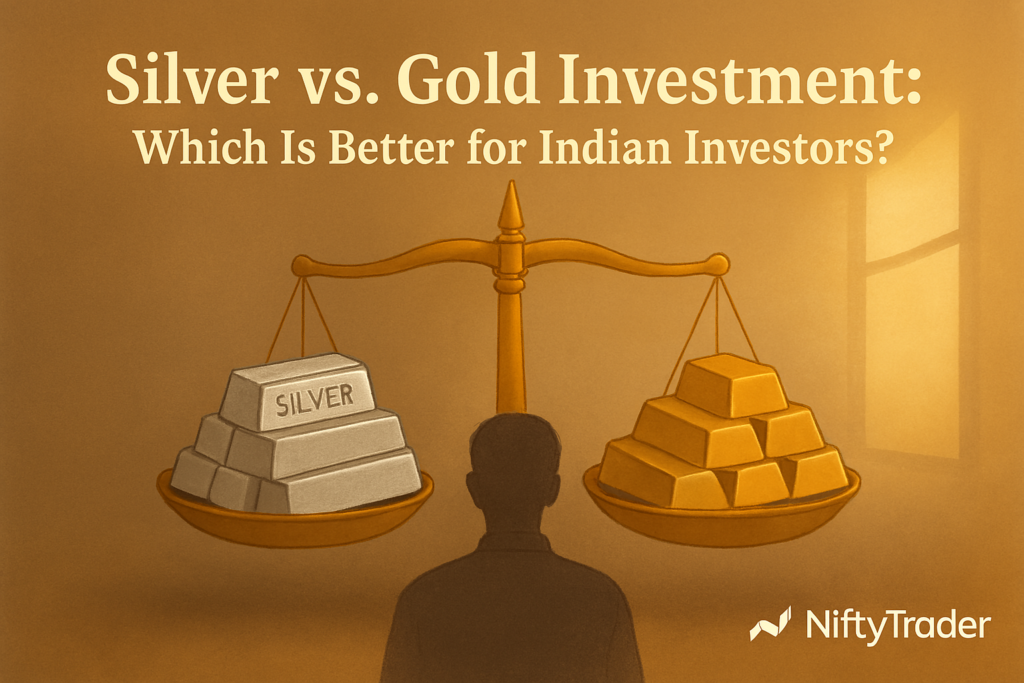
Gold is legacy. Silver is leverage. For Indian investors, choosing between them means balancing tradition with opportunity. This visual explores the strengths of each metal—and what they mean for your financial future.
Introduction
For generations, Indians have trusted gold and silver not just as ornaments but as reliable stores of value. From wedding jewelry to festive coin purchases during Diwali and Akshaya Tritiya, precious metals hold both emotional and financial significance in India.
But when it comes to investing, the big question remains: Silver vs Gold Investment – which is better for Indian investors?
Both metals are considered safe-haven assets. They tend to perform well during:
High inflation
Economic slowdowns
Stock market volatility
Currency depreciation
However, they differ significantly in terms of returns, volatility, affordability, liquidity, and long-term potential.
In this detailed guide, we’ll compare:
Historical performance
Risk and volatility
Investment entry barrier
Liquidity and demand
Taxation and storage
2026 outlook
By the end, you’ll clearly understand whether gold, silver, or a mix of both suits your investment strategy.
Historical Performance Comparison
Long-Term Returns: Gold vs Silver in India
When we compare Gold vs Silver returns in India, gold has historically delivered more stable and consistent growth over the long term.
Gold has compounded steadily over decades.
It has acted as a hedge against inflation and currency depreciation.
During crises (2008 financial crisis, COVID-19 pandemic), gold prices surged sharply.
Silver, on the other hand:
Often outperforms gold during strong economic cycles.
Shows higher percentage gains during bull markets.
But also falls faster during downturns.
In many periods, silver has delivered higher short-term returns compared to gold. However, over long investment horizons, gold has shown more consistent wealth preservation.
Why Silver Is More Volatile
Silver has a dual nature:
Precious metal (like gold)
Industrial metal (used in manufacturing)
Because of this, silver prices are influenced not just by investment demand but also by industrial demand from:
Solar panel manufacturing
Electronics
Electric vehicles (EVs)
Medical equipment
When industrial demand rises, silver prices can rally sharply. But during economic slowdowns, industrial demand weakens, causing sharp price corrections.
Gold, in contrast, is primarily driven by investment demand and central bank reserves, making it relatively stable.
Volatility & Risk Factor
Why Silver Sees Sharper Price Swings
In the Silver vs Gold Investment debate, volatility is one of the biggest differences.
Silver:
Has lower market size than gold
Reacts quickly to economic data
Experiences sharper price spikes and crashes
For example, during commodity bull runs, silver often outperforms gold by a wide margin. But during market panic, it also falls more aggressively.
Gold:
Is considered a global safe-haven asset
Held by central banks worldwide
Attracts capital during uncertainty
Conservative vs Aggressive Investors
Conservative investors: Gold is more suitable due to stability.
Aggressive investors: Silver offers higher growth potential but with higher risk.
Balanced investors: A combination of both can reduce overall portfolio risk.
If you’re asking, Is silver better than gold investment? — the answer depends on your risk appetite.
Affordability & Entry Barrier
One major advantage of silver is affordability.
Investment Ticket Size
Gold:
Higher price per gram
Larger capital required for meaningful investment
Silver:
Much lower price per gram
Easy entry for small retail investors
For young investors or those starting their investment journey, silver provides a low-cost entry into precious metals.
For example, investors often check regional prices such as Silver Rate Today in Delhi before making small periodic purchases.
This affordability makes silver attractive for SIP-style investing in physical metal.
Liquidity & Demand in India
Gold: Unmatched Liquidity
Gold enjoys extremely high liquidity in India due to:
Strong jewelry demand
Investment demand (coins, bars, ETFs)
Cultural importance
RBI reserves
Gold can be sold almost anywhere in India with minimal price discrepancy.
Silver: Growing Industrial Demand
Silver’s demand is increasingly driven by industrial growth:
Solar energy expansion
EV battery components
Electronics manufacturing
Cities with strong industrial and technology sectors often show higher retail activity. Investors regularly track updates like Silver Rate Today in Bangalore and Silver Rate Today in Hyderabad to time their purchases effectively.
In western India, traders and investors also monitor Silver Rate Today in Ahmedabad and Silver Rate Today in Pune to compare regional price trends before bulk buying.
Silver’s industrial linkage gives it strong long-term growth potential, especially as India pushes renewable energy and manufacturing under government initiatives.
Taxation & Storage Comparison
Capital Gains Tax
For physical gold and silver in India:
Short-term capital gains (held under 3 years): Taxed as per income slab
Long-term capital gains (held over 3 years): 20% with indexation benefit
This taxation rule applies similarly to both gold and silver.
For ETFs:
Tax treatment is largely similar (subject to prevailing tax laws).
Storage Options
Physical Metal
Pros:
Tangible asset
No counterparty risk
Cons:
Storage risk
Locker cost
Making charges (for jewelry)
Digital Gold
Convenient
Backed by physical gold
Easy small-ticket investment
Gold & Silver ETFs
No storage hassle
High liquidity
Transparent pricing
Gold ETFs are more popular and liquid compared to silver ETFs in India.
2026 Outlook: Gold or Silver Which Is Better in 2026?
Looking ahead to 2026, performance may depend on macroeconomic conditions.
1. Inflation Scenario
If inflation remains high:
Gold may perform better due to its safe-haven appeal.
2. Global Recession
During recession fears:
Gold generally outperforms silver.
Investors shift to safety assets.
3. Industrial Growth Boom
If India and global economies see:
Strong manufacturing growth
EV adoption surge
Solar energy expansion
Silver could outperform gold significantly.
4. RBI Policy & Rupee Movement
Weak rupee → Both metals may rise.
Rate cuts → Precious metals benefit.
Strong dollar → Short-term pressure possible.
In 2026, a diversified approach may be more practical rather than choosing only one.
Silver vs Gold Investment: Quick Comparison Table
Factor
Gold
Silver
Stability
High
Moderate
Volatility
Low to Moderate
High
Affordability
Expensive
Affordable
Industrial Demand
Low
High
Liquidity
Very High
High
Best For
Conservative investors
Aggressive growth seekers
Final Verdict
So, in the debate of Silver vs Gold Investment, which should you choose?
Choose Gold If:
You want stability
You prefer low volatility
You are a conservative investor
You want crisis protection
Choose Silver If:
You seek higher growth potential
You can handle price swings
You believe in industrial expansion
Best Strategy for Indian Investors
A combination of both metals offers:
Stability (Gold)
Growth potential (Silver)
Better diversification
Instead of asking only Is silver better than gold investment?, the smarter question may be:
How much allocation should I give to each?
For many retail investors:
70% Gold
30% Silver
can create a balanced precious metal portfolio.
FAQs
1. Is silver better than gold investment in India?
Silver can generate higher short-term returns but is more volatile. Gold is better for long-term stability and wealth preservation.
2. What are Gold vs Silver returns in India historically?
Gold has delivered more consistent long-term returns, while silver has shown sharper but inconsistent performance cycles.
3. Gold or silver which is better in 2026?
If global growth accelerates, silver may outperform. If uncertainty rises, gold may be safer.
4. Should I invest in both gold and silver?
Yes, diversification across both metals reduces risk and balances growth with stability.
Conclusion
Precious metals remain an essential part of Indian investment culture. Both gold and silver have their unique strengths.
Gold protects wealth.
Silver amplifies growth potential.
In the long run, a strategic combination aligned with your risk profile and financial goals is likely the smartest approach.
Before investing, always track real-time prices, evaluate your risk appetite, and consider your investment horizon carefully.
Because in investing, balance often beats extremes.