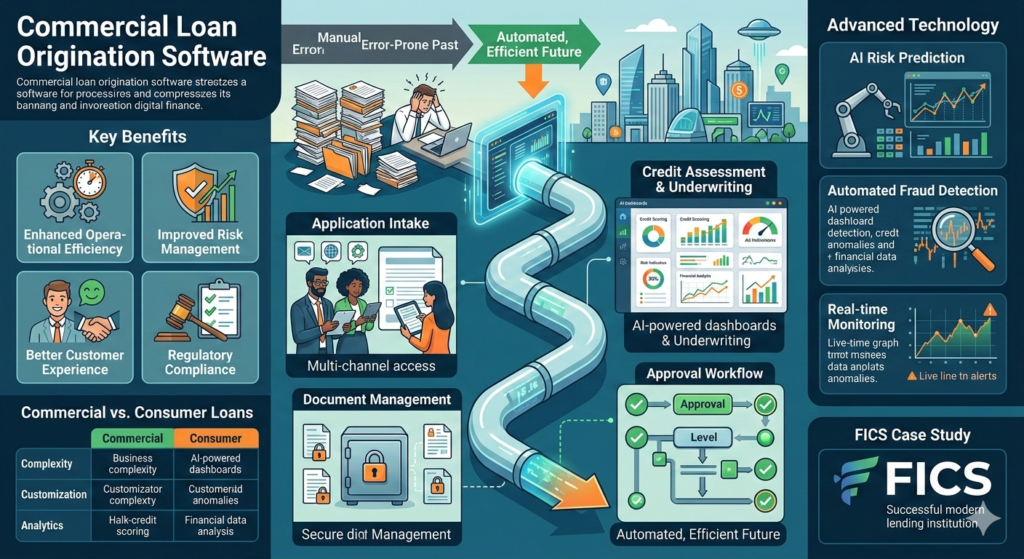
commercial loan origination software
In the evolving world of finance, business lending has become increasingly complex. Commercial loans require careful assessment, robust risk management, and efficient processing to meet both regulatory standards and client expectations. To address these challenges, financial institutions are turning to commercial loan origination software, a powerful tool that streamlines the lending process, reduces errors, and accelerates approval times.
Gone are the days when processing commercial loans relied on manual paperwork, time-consuming verification, and multiple levels of approval. Modern software solutions now offer automated workflows, secure document management, and advanced analytics, allowing banks and credit unions to operate with greater efficiency and accuracy.
Understanding Commercial Loan Origination Software
At its core, commercial loan origination software is designed to manage the complete lifecycle of a commercial loan. This includes application intake, documentation, credit assessment, underwriting, approval, and post-approval management. Unlike consumer loan software, commercial loan solutions handle larger, more complex financial transactions, often with multiple stakeholders, collateral requirements, and regulatory compliance considerations.
The software typically offers a centralized platform where all loan-related activities can be monitored and executed. This allows lenders to:
-
Track applications in real-time
-
Assess borrower risk using integrated credit scoring models
-
Ensure compliance with local, regional, and national regulations
-
Automate repetitive processes, reducing human errors
By consolidating these functions, lenders can focus more on strategic decision-making rather than administrative tasks.
Key Features of Commercial Loan Origination Software
When choosing a solution, it’s important to consider features that directly impact efficiency, accuracy, and customer satisfaction. Common capabilities include:
-
Automated credit analysis: Evaluate borrower financials and creditworthiness quickly
-
Document management: Secure storage, version control, and easy retrieval of collateral and loan documents
-
Customizable workflows: Adapt processes to fit institutional policies and regulatory requirements
-
Integrated analytics and reporting: Gain insights into loan performance, default risks, and operational efficiency
-
Multi-channel access: Enable team collaboration across departments or remote locations
These features help financial institutions process loans faster, minimize risk, and maintain high levels of transparency and compliance.
Benefits of Implementing Commercial Loan Origination Software
Enhanced Operational Efficiency
Manual loan processing is labor-intensive and prone to delays. Commercial loan origination software automates key workflows, reducing the time required for approval from weeks to days, or even hours. Automated checks, notifications, and approvals ensure smooth operations and timely decision-making.
Improved Accuracy and Risk Management
Errors in data entry, document handling, or credit evaluation can lead to financial loss or compliance issues. Automated software mitigates these risks by performing validations, highlighting discrepancies, and providing audit trails. Lenders gain confidence that all critical steps have been completed accurately.
Better Customer Experience
Businesses applying for loans often face strict deadlines and need quick responses. With streamlined processes, clients experience faster approvals, clear communication, and enhanced transparency throughout the loan lifecycle. This contributes to stronger client relationships and brand loyalty.
Compliance and Regulatory Adherence
Financial regulations are constantly evolving, making compliance a top priority for lenders. Commercial loan origination systems integrate compliance checks, ensure proper documentation, and maintain detailed records, helping institutions meet legal requirements while avoiding penalties.
Cost Savings
By reducing manual labor, minimizing errors, and accelerating approvals, institutions can achieve substantial cost savings. These savings can be reinvested in strategic initiatives, staff training, or expanding lending services.
Commercial vs. Consumer Loan Software
While both commercial and consumer loan software manage loan lifecycles, there are critical differences:
-
Complexity: Commercial loans involve larger amounts, collateral evaluation, and multiple signatories, requiring more sophisticated software capabilities.
-
Customization: Commercial loan software often supports highly customizable workflows to meet the specific needs of corporate lending.
-
Analytics: Detailed reporting on risk, loan performance, and industry-specific metrics is essential for commercial lending.
Understanding these differences ensures that financial institutions implement software suited to their unique requirements rather than using consumer-focused solutions that may lack necessary features.
Integration and Scalability
Modern financial institutions rely on multiple digital systems for core banking, customer relationship management (CRM), accounting, and risk management. Commercial loan origination software must integrate seamlessly with these systems to ensure data consistency and efficiency.
Scalability is equally important. Whether processing a few loans per month or hundreds, the software should accommodate growth without requiring significant infrastructure changes. Cloud-based platforms are increasingly popular because they offer flexibility, security, and ease of access.
The Role of Advanced Technology
Artificial intelligence (AI), machine learning (ML), and predictive analytics are transforming commercial lending. Many modern loan originating software solutions now include features such as:
-
Predictive risk assessment based on historical borrower data
-
Automated fraud detection
-
Personalized loan offers using AI-driven insights
-
Real-time monitoring of loan portfolio performance
These technological advancements enable lenders to make smarter decisions, reduce defaults, and improve overall portfolio health.
Case Study: FICS
One leading provider of commercial loan solutions is FICS, which offers a robust platform combining automation, analytics, and compliance tools. Financial institutions using FICS benefit from enhanced efficiency, reduced errors, and improved client satisfaction. The platform is scalable, customizable, and integrates seamlessly with existing banking systems, making it ideal for both small and large lenders.
By leveraging FICS’ expertise, institutions can implement modern lending practices while maintaining regulatory compliance and operational excellence.
Challenges and Considerations
While the advantages of commercial loan origination software are clear, institutions must also be mindful of potential challenges:
-
Data Security: Protecting sensitive borrower information is paramount. Strong encryption, access controls, and monitoring are essential.
-
User Training: Employees need training to adapt to new software and workflows.
-
Change Management: Shifting from manual processes to automated systems requires careful planning and communication.
-
Regulatory Updates: The software must be regularly updated to comply with changing regulations.
Addressing these challenges ensures that the software implementation delivers maximum benefits.
Future Trends in Commercial Loan Origination
The future of commercial lending is increasingly digital, with trends including:
-
AI-powered decision-making: Smarter risk assessment and faster approvals
-
Blockchain integration: Secure, transparent, and immutable transaction records
-
Cloud adoption: Enhanced flexibility, scalability, and remote access
-
Enhanced customer portals: Allowing clients to track applications, submit documents, and communicate with lenders seamlessly
-
Data-driven lending: Using advanced analytics to identify opportunities and mitigate risk
Adopting these trends early can provide a competitive advantage to forward-thinking financial institutions.
Conclusion: Embracing Digital Transformation in Lending
In today’s competitive banking landscape, commercial loan origination software has become a strategic necessity. It streamlines operations, enhances accuracy, improves compliance, and delivers superior customer experiences. While challenges like data security, integration, and training exist, the long-term benefits far outweigh the obstacles.
By implementing modern solutions like FICS, financial institutions can optimize their lending processes, reduce operational costs, and position themselves as leaders in corporate lending. As technology continues to evolve, commercial loan origination software will play a critical role in shaping the future of business finance.
Institutions that embrace these innovations today will not only improve operational efficiency but also strengthen client relationships, mitigate risk, and ensure sustainable growth in the ever-changing financial sector.