Every great app idea eventually hits the exact same roadblock. You have a smart business plan, you know your target audience, and you are ready to change the market. But before a single line of code is written, you must answer one huge question: how will you actually build this app? When it comes to Native vs. Cross-Platform Mobile Development, the debate is older than most smartphones. Yet, it remains the absolute most important choice you will make today. Making the wrong choice here can ruin your budget. It can cause long delays. Worst of all, it can lead to an app that your customers hate using.
We live in a fast-paced tech world. User expectations are higher than ever before. Whether you want to launch a simple daily tool or a massive online store, your tech choices matter. For example, you might want to add smart, predictive features to your app. If you use AI Development Services to create a highly personal user experience, your underlying code decides how well those smart features run. If the code is weak, the smart features will lag. So, picking how to build your app is not just a minor tech detail. It is a major business choice that affects your entire future.
To help you make the best choice, we need to drop the confusing tech jargon. We will explain exactly what each approach means in plain English. We will look at their unique pros and cons. Finally, we will look at real-world examples to help you pick the perfect path for your specific project.
Understanding the Two Different Paths
Before we compare the two choices, you need to understand how they work. The main difference is the “language” the software uses to speak to the mobile phone. Think of it like real-world languages. If you speak the local language perfectly, everything is fast and easy. If you need a translator, things might slow down a bit.
What is Native Development?
Native app development means building software specifically for one type of phone. Apple and Google each have their own operating systems (iOS and Android). They also have their own official coding languages.
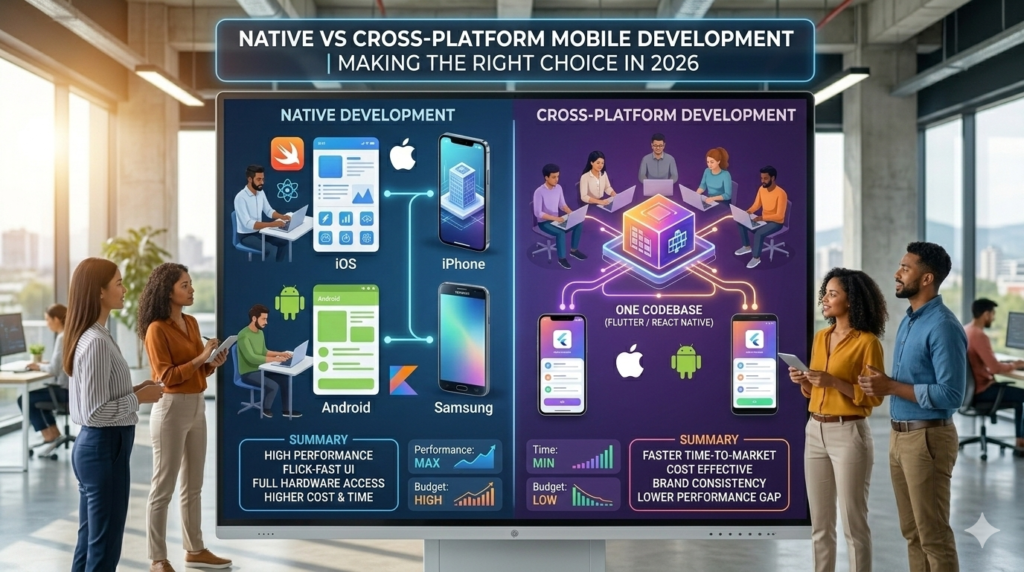
If you want to build an app for Apple iPhones, your developers will write code using a language called Swift. If you want an app for Android phones, a completely different team of developers will write code using Kotlin or Java. Because these apps are built using the official languages, they speak directly to the phone. There is no middleman. There is no translator.
What is Cross-Platform Development?
Cross-platform development takes a totally different approach. Instead of writing two separate sets of code, developers write one single, universal set of code. They use modern tools like React Native (made by Meta) or Flutter (made by Google).
Once this single set of code is written, the tool translates it. It makes the code run on both Apple and Android phones at the same time. It is basically a “write once, use everywhere” method. You only need one team of developers, and you only manage one central piece of software.
The Strong Case for Going Native
For many years, native development was the only way to build a great app. While cross-platform tools have gotten much better, there are still huge reasons why top brands choose to build native apps.
Unmatched Speed and Performance
Because native apps speak directly to the phone, they offer the highest possible speed. They load faster. They handle complex animations much more smoothly. They process heavy data without breaking a sweat. If your app relies on quick actions—like a heavy mobile game or a complex video editor—native development is usually the only way to guarantee a smooth, lag-free experience.
Direct Access to Phone Features
Smartphones are packed with cool hardware. They have cameras, GPS trackers, microphones, and fingerprint scanners. Native apps have direct, instant access to all of these features. If your target audience loves Apple products, you want a flawless iOS experience. Partnering with an expert iphone app development company ensures your software perfectly uses native Apple tools. You get perfect access to FaceID, ARKit for augmented reality, and Apple Health. There are no software bridges or extra plugins required. This means fewer crashes and a much safer app.
A Better User Experience (UX)
Every phone system has its own unique design style. iPhone users expect buttons, menus, and swipes to act a certain way. Android users expect something slightly different. Native apps naturally copy the default rules of their specific phone. This makes the app feel instantly familiar to the user. When an app feels natural, people use it longer and leave better reviews.
The Downsides of Native Development
The biggest problem with native development is the cost. Because you have to build two completely separate apps from scratch, you need two separate teams of developers. This effectively doubles your exact budget. It also takes much longer to get your product to the market. Plus, every time you want to release a new update or fix a bug, your teams have to do the work twice.
The Strong Case for Cross-Platform Development
Over the last few years, cross-platform tools have grown up fast. They are no longer slow, clunky alternatives. Today, they are powerful systems used by some of the biggest global companies in the world.
Launching Your App Faster
In the business world, speed is everything. Cross-platform development lets you launch your app on both the Apple App Store and the Google Play Store at the exact same time. Because your team is only writing one set of code, the total project time is much shorter. You can test your app idea, get feedback from real users, and start making money much faster than a competitor who is building two native apps.
Saving Money on Development
Saving money is the biggest reason why companies choose cross-platform apps. By keeping a single set of code, you only need to hire one team of developers. This drastically cuts your starting costs. It also makes long-term updates much cheaper. When you need to add a new feature or fix a security issue, your developers only have to update the central code. The changes instantly show up on both Apple and Android phones.
Keeping Everything Consistent
With cross-platform development, you guarantee that your app looks exactly the same for everyone. Your app will look the same on an iPhone 15 as it does on a Samsung Galaxy. Sometimes, native apps have slight visual differences between the two phone versions. Cross-platform tools ensure your brand looks perfectly consistent across the entire mobile world.
The Downsides of Cross-Platform Development
The trade-off for saving time and money is sometimes a slight drop in performance. Because the code has to be translated to talk to the phone, extremely heavy tasks might lag just a tiny bit. Also, when Apple or Google release brand new features for their phones, you cannot use them right away. You have to wait for your cross-platform tool (like Flutter or React Native) to update its own system first.
Real-World Scenarios: Making the Right Call
Sometimes, the best way to understand these tech concepts is to look at practical examples. Let’s look at two very different app projects. We will figure out which approach fits best for each one.
Scenario A: The High-End Fitness Tracker
Imagine a startup launching a premium fitness app. The app needs to record real-time heart rates from smartwatches. It needs to use the phone’s camera to watch your workout form and correct your posture. It also needs to track precise GPS maps for marathon runners.
The Best Choice: Native Development. Why? Because this app relies heavily on the phone’s internal hardware. It processes intense, real-time data. It needs maximum performance to work right. A cross-platform app might struggle to keep the camera, GPS, and Bluetooth sensors working perfectly together without draining the phone battery quickly. Building separate native apps ensures the safest and smoothest user experience.
Scenario B: The Corporate Event App
Now, imagine a business looking to launch an app for large corporate events. The app will allow guests to view the daily schedule. They can read speaker bios, send basic text messages to other guests, and get push alerts about room changes.
The Best Choice: Cross-Platform Development. Why? This app relies on basic text and simple pictures. There are no heavy graphics. There are no complex hardware needs. Using a cross-platform approach lets the company build the app very fast. It keeps their costs low. Most importantly, it ensures that every single guest at the event gets the exact same app experience, no matter what phone is in their pocket.
Key Factors to Help You Decide in 2026
If you are still weighing your options, stop looking at the tech details for a minute. Look closely at your own business goals. Here are the core factors that should drive your final choice:
- Your Timeline: Do you need to launch in three months to beat a competitor? Do you need to show an app to investors quickly? If so, cross-platform is the clear winner.
- Your Budget: Are you paying for this app with your own savings? Are you working with limited startup funds? If so, writing a single set of code will save you from major financial stress.
- Your App’s Complexity: Are you building a fast-paced mobile game? Are you building a heavy video editing tool? Do you need deep hardware access? If so, native is the absolute safest route.
- Your Maintenance Plan: Remember, building the app is only step one. You have to run it for years. If you want to keep update costs low and push out bug fixes easily, cross-platform is a great long-term choice.
Conclusion
The great debate between these two styles of app building will likely continue for years. But the honest truth is that neither approach is naturally “better” than the other. They are simply different tools designed to solve different business problems. Native development offers top-level power, perfect hardware connections, and a premium feel. Cross-platform development provides fast launches, massive cost savings, and simple long-term updates.
Ultimately, the right choice depends totally on your specific business goals, your available budget, and your target audience. If you are still stuck, you do not have to guess. Teaming up with a top Mobile App Development Company can give you the exact clarity you need. They will look at your software needs and guide you toward the best choice. Take the time to plan your foundation correctly today. If you choose the right path now, your new digital product will be set up to grow and succeed for many years to come.
Frequently Ask Questions
1. Is cross-platform development cheaper than native development?
Ans: Yes, in almost all cases. Because cross-platform tools let developers write one set of code for both Apple and Android, you only pay one team. This greatly lowers your starting costs and makes monthly maintenance much cheaper.
2. Can a cross-platform app be as fast as a native app?
Ans: For most normal apps—like online stores, social media feeds, and business tools—modern cross-platform apps are very fast. Users will not notice a difference. However, for heavy apps like 3D gaming, native apps are noticeably faster.
3. Do large, famous companies use cross-platform tools?
Ans: Yes, absolutely. Some of the most popular apps in the world are built using cross-platform code. For example, huge apps like Instagram, Discord, and Uber Eats use these tools to keep their apps working perfectly across all phones.
4. What happens when Apple or Google updates their phone software?
Ans: When major phone updates happen, native apps can use the fresh features on day one. Cross-platform apps sometimes have a slight delay. Developers must wait for their main tool (like React Native) to update before they can use the new phone features.
5. Can I easily switch my app from cross-platform to native later?
Ans: While it is technically possible to change later, it is very expensive and takes a long time. Switching your app type means throwing away all your old code and starting over from zero. It is much better to choose the right foundation from the very first day.