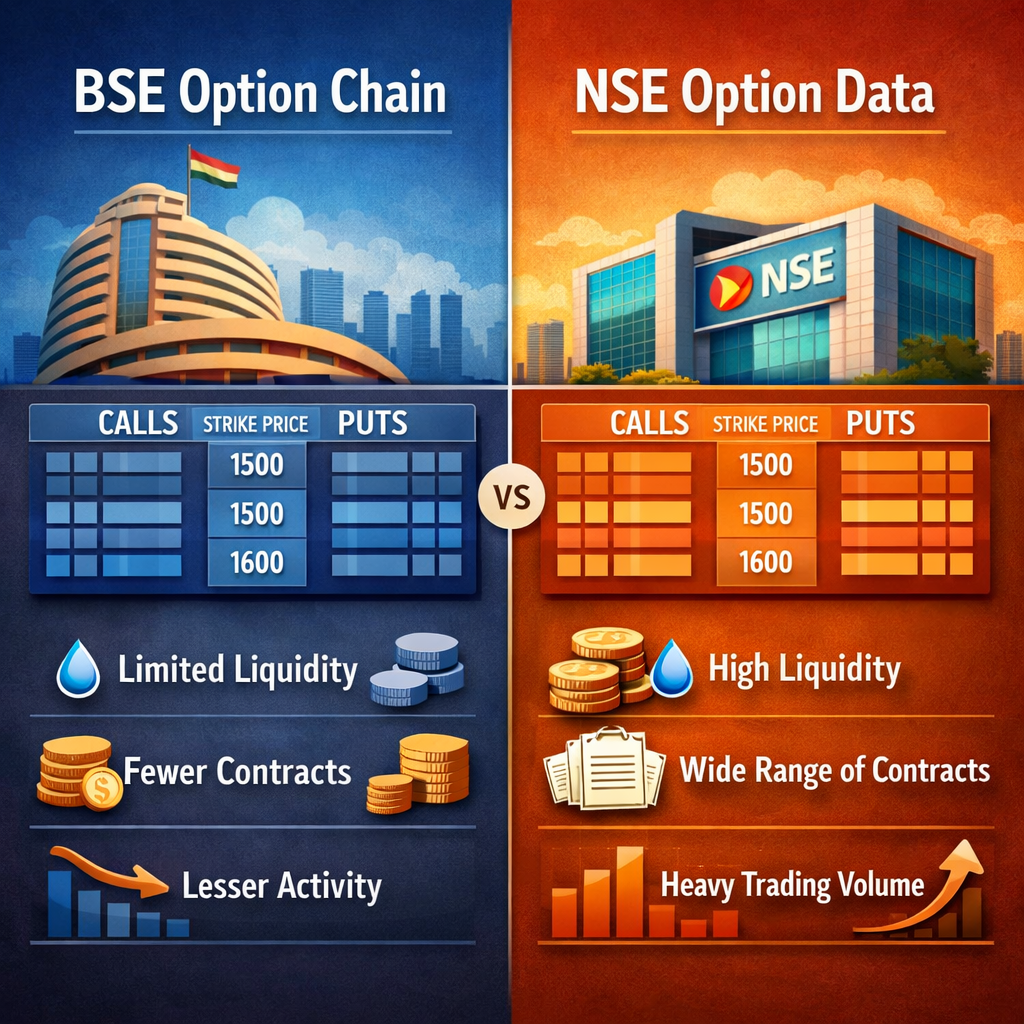
A visual breakdown of how BSE and NSE option chains differ in terms of market activity, liquidity, and contract offerings.
1. Introduction
In the world of stock market derivatives, option chain data plays a crucial role in understanding market behavior. Both the Bombay Stock Exchange (BSE) and the National Stock Exchange (NSE) provide option chain data that traders use for decision-making.
When comparing BSE option chain vs NSE option chain, traders often notice differences in liquidity, participation, and data depth. While NSE dominates the derivatives space, BSE is gradually gaining attention with its Sensex-based derivatives.
This article will help you understand how both option chains differ and how you can use them effectively in option chain analysis India.
2. What Is Option Chain Data?
Option chain data is a structured table that shows all available options contracts for a particular index or stock.
Key Components:
- Call Options (CE): Indicate bullish expectations
- Put Options (PE): Indicate bearish expectations
- Strike Price: Price at which the contract can be exercised
- Open Interest (OI): Total number of outstanding contracts
- Volume: Number of contracts traded
Why It Matters
Option chain data helps traders in:
- Identifying support and resistance
- Understanding trader sentiment indicators
- Performing open interest analysis
- Planning entry and exit strategies
3. Overview of NSE Option Chain
The NSE option chain data is the most widely used in India due to its high liquidity and active participation.
Key Features:
- High Liquidity: Large number of buyers and sellers
- Popular Indices: Nifty 50 and Bank Nifty dominate
- Reliable Data: Real-time and widely tracked
- Better Price Discovery: Due to heavy trading volume
Why Traders Prefer NSE
Most traders in derivatives trading India prefer NSE because:
- Tight bid-ask spreads
- Easier execution
- More accurate signals
4. Overview of BSE Option Chain
The BSE has introduced derivatives on Sensex, offering a new dimension to traders.
The bse sensex option chain provides insights into Sensex-based contracts, which are slowly gaining traction among market participants.
Key Features:
- Sensex-Based Contracts: Focus on 30 major companies
- Growing Participation: Increasing trader interest
- Alternative Market View: Different data patterns compared to NSE
Why It Matters
The Sensex option chain data gives traders another perspective on market sentiment, especially useful for those who want to diversify beyond NSE.
5. Key Differences Between BSE and NSE Option Data
| Factor | NSE Option Chain | BSE Option Chain |
| Liquidity | High | Lower |
| Popularity | Very High | Growing |
| Index Focus | Nifty / Bank Nifty | Sensex |
| Data Reliability | Strong | Improving |
| Trader Participation | Large | Limited but rising |
Key Insight
While comparing BSE option chain vs NSE option chain, the biggest difference lies in options market liquidity. NSE provides deeper liquidity, while BSE is still developing.
6. Role of PCR in Option Chain Analysis
The pcr ratio (Put-Call Ratio) is one of the most important indicators in option chain analysis.
What Is PCR?
PCR = Total Put Open Interest / Total Call Open Interest
How It Helps
- PCR > 1: Market may be bearish
- PCR < 1: Market may be bullish
- Extreme Values: Possible reversal signals
Usage in Both Exchanges
Traders use PCR in both NSE and BSE to:
- Identify overbought or oversold conditions
- Understand crowd positioning
- Combine with open interest analysis
However, PCR is more reliable on NSE due to higher participation.
7. Impact of Market Sentiment & Grey Market
Market sentiment plays a critical role in interpreting option chain data.
The grey market often provides early signals about investor sentiment, especially during IPOs or major events.
How Sentiment Affects Option Chain
- High call writing → Resistance levels
- High put writing → Support levels
- Sudden OI shifts → Possible breakout
Role of Retail Psychology
In option chain analysis India, retail traders often follow herd behavior, which can distort signals temporarily.
8. Which One Should Traders Use?
For Beginners
- NSE is more suitable due to:
- Better liquidity
- Clear signals
- Easier understanding
For Advanced Traders
- Use both NSE and BSE to:
- Compare data
- Identify arbitrage opportunities
- Get a broader market view
Strategy-Based Approach
- Intraday → NSE preferred
- Positional → Both can be used
- Experimental strategies → BSE can offer new opportunities
9. Limitations of Option Chain Data
Even though option chains are powerful, they have limitations:
1. Misinterpretation
Wrong reading of OI can lead to incorrect conclusions
2. Sudden Market Moves
News or global events can invalidate data instantly
3. Data Lag
Sometimes there is a delay in updating real-time data
10. Practical Tips for Traders
To use option chain effectively:
✔ Combine with Technical Analysis
Use charts along with option data
✔ Track Open Interest Changes
Focus on OI build-up and unwinding
✔ Avoid Overtrading
Do not rely solely on option chain signals
✔ Focus on Liquidity
Prefer contracts with high volume
✔ Stay Updated
Track news, global cues, and sentiment
11. FAQ Section
1. What is difference between BSE and NSE option chain?
The main difference lies in liquidity and participation. NSE has higher trading volume, while BSE is still growing.
2. Is BSE option chain reliable?
Yes, but it is less liquid compared to NSE. Reliability is improving with increased participation.
3. How to use pcr ratio in trading?
PCR helps identify market sentiment. Extreme values may संकेत potential reversals.
4. What is role of grey market in sentiment?
Grey market gives early hints about investor sentiment, especially before official listings.
5. Which option chain is better for beginners?
NSE option chain is better due to higher liquidity and clearer signals.