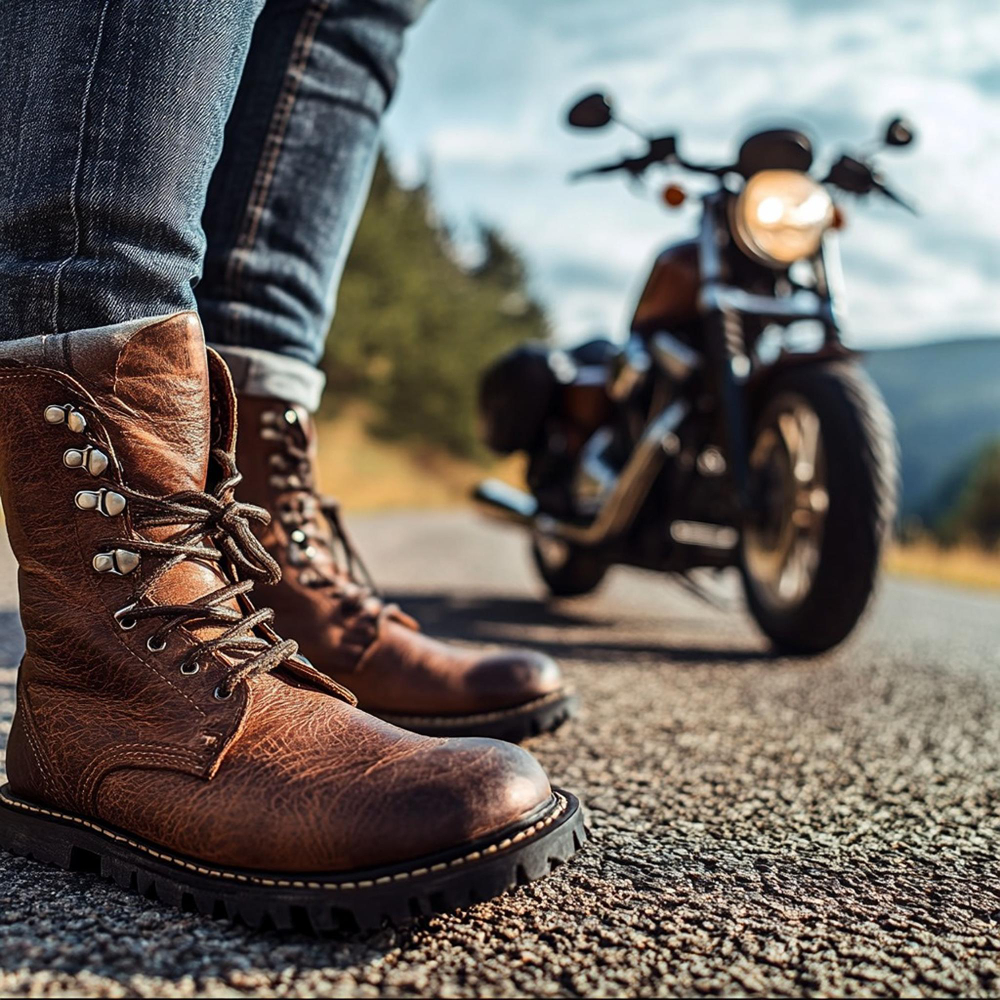
A motorcycle boot is part of how the machine responds to you. Every shift, every stop, every lean into a turn depends on how well your foot connects with the bike. That connection is mechanical, not just physical.
This is exactly where regular work boots fall apart. They’re not built to handle the constant exposure to heat, the need for precise grip on unpredictable roads, or the kind of ankle stability required at higher speeds. On the highway, small inefficiencies compound quickly, and your footwear plays a bigger role than most riders realize.
At the core choice between lace-up and pull-on motorcycle boots comes down to this:
Do you want something that adapts to your foot or something that stands firm no matter what?
Lace-Up Boots: For Precision Lock
Lace-up boots are built around the idea of control through adjustment. When you tighten the laces, you’re not just securing the boot; you’re actively shaping how your foot sits inside it.
This creates what riders often refer to as a heel-lock. Your foot is pulled back into the heel cup, reducing any internal movement. The result is a more stable base when shifting gears, especially in situations where timing and accuracy matter.
There’s also an added layer of support here. A properly laced boot acts almost like a brace, limiting excessive side-to-side motion. That kind of stability becomes important when you’re dealing with sudden stops or uneven terrain at speed.
From a safety standpoint, modern lace-up boots address common risks:
- Laces can be tucked away using lace garages, preventing snagging
- Speed-lacing systems make it easier to remove boots quickly if needed
Pull-On Boots: For Plated Protection
Pull-on boots focus on eliminating weak points altogether. With no laces or hardware, there’s nothing to snap under pressure, melt near engine heat, or get caught while riding. What you get instead is a solid, uninterrupted structure made from thick leather that wraps around the foot like a protective shell.
This design has a clear advantage in harsh conditions. The absence of openings or gaps means the boot can act as a continuous barrier, offering better resistance during slides and prolonged exposure to friction.
You’ll also notice how these boots handle external stress:
- The taller shaft helps shield your lower leg from engine and exhaust heat
- The overall stiffness provides a kind of crush resistance, helping the boot hold its shape under pressure
Test Your Motocycle Boot’s
When you look at both styles under real riding conditions, the differences become more practical than theoretical.
Lace-up boots offer a more adaptive structure. They allow controlled movement while still supporting the ankle, which can be useful when you need quick, precise adjustments. Pull-on boots, on the other hand, lean towards rigidity. They don’t adapt as much, but they compensate with a stronger, more stable form.
The contract is in:
- Torsional control: Lace-ups allow flexibility with support, while pull-ons resist twisting through stiffness
- Vibration handling: Pull-ons tend to absorb more road vibration, whereas lace-ups transmit more feedback from the bike
- Ease of use: Pull-ons are quick and effortless; lace-ups require time but offer a more dialed-in fit
What Actually Matters: Non-Negotiable Features
Regardless of style, certain features define whether a motorcycle boot is truly road-ready.
A solid shank, whether steel or composite, acts as the internal backbone of the boot. It keeps your foot stable on the peg and prevents strain during long rides. Without it, even a well-built boot can feel unstable over time.
Grip is another critical factor. Roads aren’t always clean, and at intersections, oil or fuel residue can make surfaces unpredictable. That’s where oil-resistant soles, made from nitrile or Vibram® compounds, make a real difference. They provide the kind of traction that standard rubber simply can’t.
Then there’s the inner ankle the part most exposed during impact. A good boot includes medial protection, often in the form of an internal disc or reinforced padding. It’s not always visible, but it plays a key role in reducing injury risk.
Conclusion: Find The Right Motorcycle Boot
In the end, choosing between lace-up and pull-on motorcycle boot comes down to how each style supports your riding experience on the road.
If your rides demand precision, responsiveness, and a closer connection to the machine, lace-ups deliver that control. If you lean toward long-distance comfort, durability, and a design that performs without constant adjustment, pull-ons are built for that purpose.
Put simply:
- Lace-ups align with agility and control
- Pull-ons align with endurance and protection
Before making your choice, take a moment to check the fit. The right pair of men’s motorcycle boots should feel secure without restricting movement firm enough to stay in place, yet comfortable enough to support you through every mile.