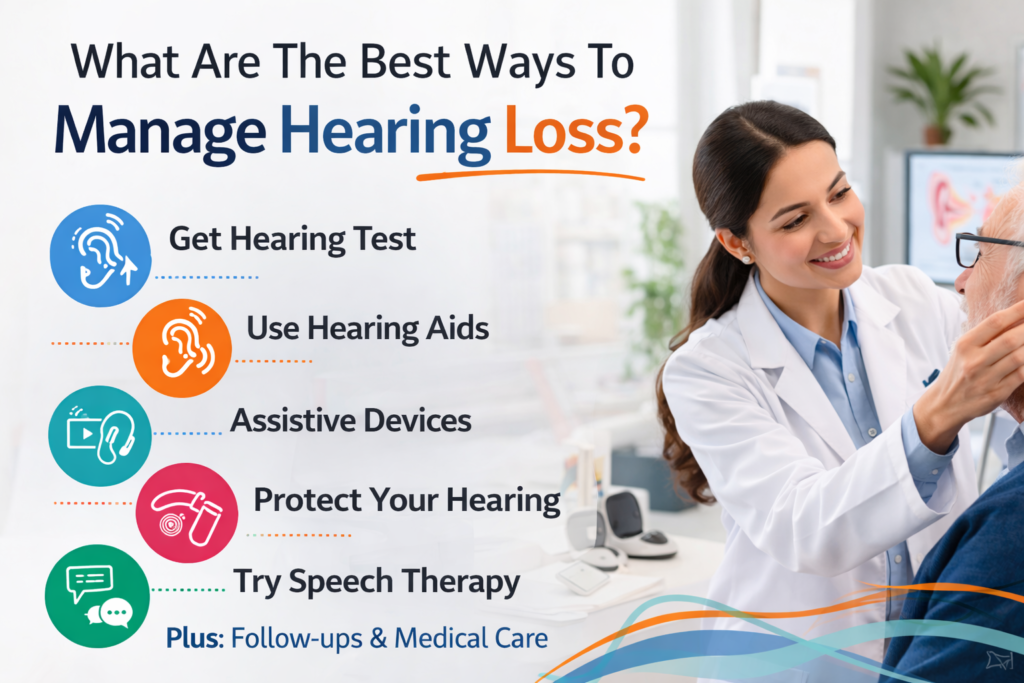
Hearing loss affects over 1.5 billion people worldwide — yet most go years without seeking help. Whether you’re newly diagnosed or supporting a loved one, this guide covers every proven strategy for managing hearing loss and living fully.
1.5B People with hearing loss worldwide
7 yrs Average delay before seeking help
90% Cases improved with proper management
2× Higher dementia risk if untreated
Managing hearing loss is not a single step — it is a layered, ongoing process that combines medical treatment, technology, communication strategies, and lifestyle adjustments. The good news: with the right approach, most people with hearing loss can continue to lead rich, connected, and fulfilling lives.
1. Get a professional hearing assessment first
Before any management strategy can be put in place, you need to understand the nature of your hearing loss. Is it conductive, sensorineural, or mixed? Is it in one ear or both? What frequencies are most affected? Only a qualified audiologist or hearing specialist can answer these questions accurately through a full audiometric evaluation.
2. Hearing aids — the most widely used solution
For the vast majority of people with sensorineural hearing loss, hearing aids remain the most effective and accessible management tool. Modern devices are a far cry from the bulky, whistling instruments of the past. Today’s hearing aids are discreet, rechargeable, Bluetooth-enabled, and capable of learning your listening preferences over time.
- Behind-the-ear (BTE)
Sits behind the ear with a tube leading to a custom ear mould. Suitable for mild to profound hearing loss.
- In-the-ear (ITE)
Custom-moulded to sit in the outer ear. Visible but easy to handle, ideal for those with dexterity issues.
- Receiver-in-canal (RIC)
The most popular style today. Very discreet, with the speaker sitting in the ear canal for a natural sound.
- Invisible-in-canal (IIC)
Sits deep in the ear canal, virtually invisible. Best for mild to moderate high-frequency loss.
3. Cochlear implants and bone-anchored devices
For people with severe to profound hearing loss who gain little benefit from conventional hearing aids, surgical implant options may be recommended. Cochlear implants bypass the damaged inner ear and directly stimulate the auditory nerve, providing a sensation of sound. Bone-anchored hearing aids (BAHA) work through bone conduction and are especially useful for people with conductive or single-sided hearing loss.
These are specialist medical decisions made in consultation with an ENT surgeon and audiologist, and they require significant rehabilitation and adjustment after fitting.
4. Communication strategies and environmental adjustments
Technology alone is rarely enough. Effective hearing loss management also involves changing how you communicate and how your environment is set up. These strategies work alongside devices, not instead of them.
- Face the speaker directly
Visual cues — lip movement, facial expression, gesture — provide up to 30% of speech understanding. Always position yourself to see the speaker’s face clearly.
- Reduce background noise
Choose quieter restaurants, sit away from kitchens and speakers, and don’t hesitate to ask to move to a quieter area. Small changes in environment make a large difference to comprehension.
- Use assistive listening devices (ALDs)
Loop systems, FM systems, captioned telephones, and TV amplifiers all complement hearing aids and help in specific situations where aids alone may struggle.
- Inform others of your needs
Ask people to speak at a normal pace rather than shouting, to rephrase rather than repeat, and to get your attention before speaking. Most people are glad to help when asked clearly.
- Use captions and subtitles
Turn on subtitles on TV, streaming platforms, and video calls. Many smartphones now offer real-time captioning apps that transcribe speech automatically.
5. Auditory rehabilitation and training
Fitting a hearing aid is the beginning, not the end. Your brain needs time to adjust to new sounds, particularly if hearing loss has been present for years. Auditory rehabilitation — sometimes called aural rehab — is a structured programme of listening exercises, counselling, and communication coaching that helps you get the most from your devices.
6. Mental health and social connection
Hearing loss is not just a physical condition. Untreated or poorly managed hearing loss is strongly associated with social withdrawal, anxiety, depression, and cognitive decline. Prioritising connection — maintaining friendships, joining hearing loss support groups, attending hearing cafés — is as important as any device or treatment.
Studies show that wearing hearing aids regularly is associated with a significantly reduced risk of dementia. Treating hearing loss is one of the most impactful modifiable factors in long-term brain health.
7. Prevention and protecting remaining hearing
Managing hearing loss also means protecting the hearing you still have. Exposure to loud noise remains the single biggest preventable cause of hearing damage. Use hearing protection in noisy workplaces and at concerts, keep personal audio device volumes below 60% of maximum, and give your ears regular quiet time to recover from sustained noise exposure.