Liposomal Products Quality Guide for Better Supplement Use
The word liposomal looks precise on a supplement label, but it can hide very different products. Some liposomal products are engineered vesicle systems with measured encapsulation, controlled particle size and verified stability. Others are ordinary vitamin or botanical blends mixed with lecithin and sold under a better-sounding name.
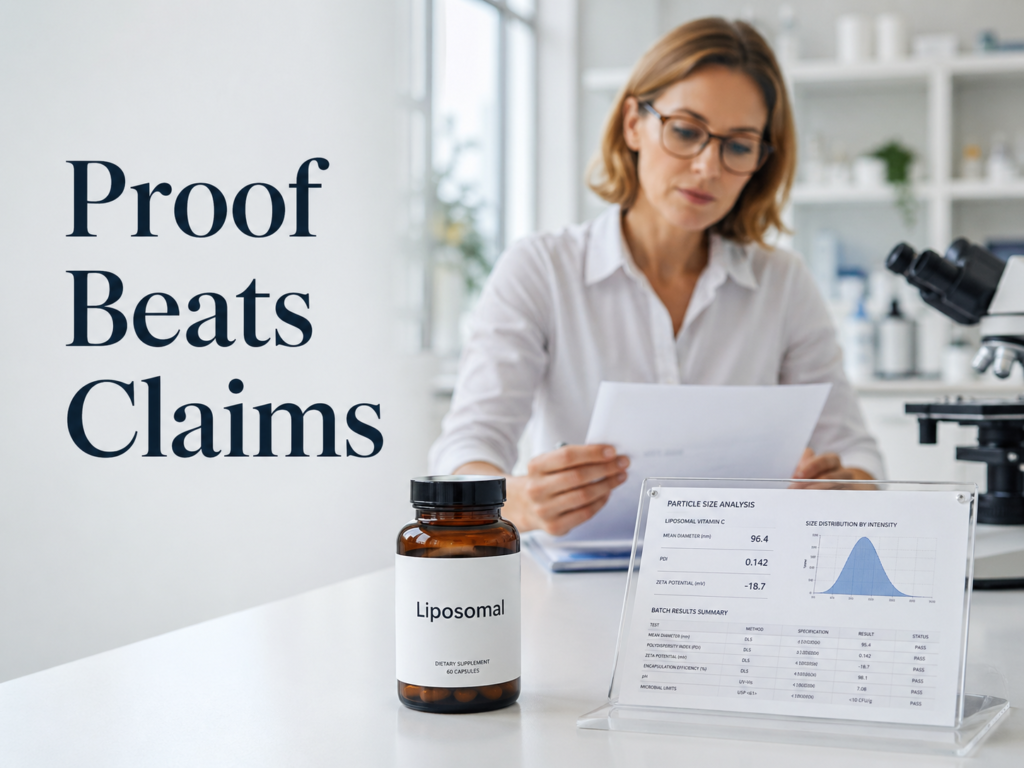
This matters for liposomal supplement quality because the value is in the lab file: encapsulation efficiency, phospholipid composition, size distribution, excipient load and third-party verification. A buyer in Manchester, Mumbai or California may see the same front-panel promise, yet the data behind it can be completely different.
My own bias is simple: a brand that will not discuss encapsulation efficiency should not lead with a premium absorption claim. In supplier reviews, silence around one number can say more than three pages of marketing copy.
The label tells you less than the lab sheet
A true liposome is a vesicle made from phospholipid bilayers. Pharmaceutical delivery reviews describe liposomes as nanoscale carriers, often around 50 to 500 nm, that can hold water-soluble actives in the aqueous core and fat-soluble actives in the lipid membrane (Nsairat et al., 2022; Liu et al., 2022). That bilayer structure is the point.
A blend is different. If vitamin C, glutathione, curcumin or coenzyme Q10 is only mixed with phospholipids in a tank, the finished powder may contain both nutrient and lecithin, but that does not prove vesicle formation. In one formulation review call, the decisive question was not ‘does it contain sunflower lecithin?’ It was ‘can you show particle characterisation after dispersion in water?’. The supplier could not.
That is why I do not treat ‘contains phospholipids’ as proof. The minimum file should include dynamic light scattering for size, microscopy where practical, active assay data and a defined method for encapsulation efficiency in liposomes. Without those, the label is doing too much work.
Encapsulation efficiency is the number too many labels skip
Encapsulation efficiency is the percentage of active ingredient held inside, or associated with, the liposomal carrier. The method depends on the active and matrix. Ascorbate is not tested like a lipophilic botanical extract. Still, if a 500 mg active claim sits on a label, a buyer needs to know how much is protected by the vesicle system.
As a commercial quality threshold, I would be cautious below 70 percent unless the supplier gives a sound formulation reason. This is not a universal pharmacopoeial rule. At 70 percent, at least 350 mg of a 500 mg active load is associated with the intended carrier; at 35 percent, most of the active may behave like the standard ingredient.
The stronger dossiers show both the percentage and the test logic. A 2021 RSC Advances study on surface-engineered liposomal calcium ascorbate reported encapsulation above 90 percent, particle characterisation and a human crossover bioavailability study in 14 healthy volunteers (Joseph et al., 2021). Not every commercial product needs that exact package, but the direction is right: measure first, claim second.
My stance is blunt here: poor liposomal products are usually exposed by what they refuse to measure. A certificate of analysis with active assay and microbial limits is useful, but it does not answer the liposome question. For a premium ingredient, that is not enough.
Particle size matters, but uniformity matters more
Particle size is easy to misuse in sales copy. Smaller is not automatically better. A 90 nm carrier may look elegant, while a 250 nm carrier may hold more active or survive drying better. The useful question is whether the population is narrow, stable and reproducible.
A 2024 randomised, double-blind crossover study on powdered liposomal vitamin C reported hydrated liposomes at 262 +- 49.8 nm, with a 30 percent AUC increase versus non-liposomal vitamin C in a small cohort (Zmuda et al., 2024). The sample size was limited, so I would not treat the result as a universal promise. The useful lesson is that the authors connected size, distribution, zeta potential and pharmacokinetics.
In manufacturing language, a wide distribution can mean aggregation, fusion, sedimentation or processing stress. In consumer language, it means one spoon, sachet or capsule may not behave like the next. That is the quiet enemy of repeat purchase. People rarely complain that a vesicle was polydisperse; they complain that the product felt inconsistent after two bottles.
Sunflower, soy and phospholipid purity are not cosmetic choices
Phospholipids are amphiphilic molecules, with one part drawn to water and another to fat. That dual nature explains their use in lipid-based delivery systems, as summarised by Li et al. (2015). In supplements, common sources are soy lecithin and sunflower lecithin, usually valued for phosphatidylcholine content.
Sunflower often wins on positioning because it avoids soy-allergen concerns and fits non-GM or vegan-led briefs in the US, UK and India. Soy, however, is not automatically inferior; it has a long technical history in liposomal systems and a deep literature base. I would rather buy a clean, well-characterised soy phospholipid than a vague sunflower claim with no purity figure.
The decision should sit in the specification, not the mood board. Ask for phosphatidylcholine percentage, residual solvent status, allergen statement, peroxide value where relevant and storage conditions. Lipid oxidation can change odour, taste and vesicle stability.
Additives can solve a real problem or hide a weak one
Liquid liposomal systems can be fragile. Phospholipid hydrolysis, oxidation and particle fusion are known concerns in aqueous dispersions, and the 2024 powdered vitamin C paper discusses shelf-life problems in liquid systems. That is why brands use powders, granules or dry premixes for capsules, sachets and functional beverages.
This is where clean-label thinking can become lazy. Maltodextrin, glycerol, soluble fibres or hydrogel matrices are not automatically bad. In some systems they protect the carrier during drying or help the powder redisperse in water. The problem starts when a long excipient list compensates for weak encapsulation, unpleasant taste or poor stability.
One brand manager once asked whether ‘no additives’ should be the headline for a sachet format. My answer was no. For a liposomal ingredient, I would rather see a small number of purposeful excipients with a stability file than a fragile liquid product kept alive by vague claims. Purity matters, but functionality matters too.
Bioavailability claims need human data, not label poetry
For anyone comparing liposomal vs standard supplements, bioavailability is the obvious question. It is also the easiest claim to exaggerate. A liposomal format may improve plasma exposure for some nutrients in some formulations, but the size of that improvement varies by active, dose, study design and analytical method.
The vitamin C literature shows this clearly. Joseph et al. (2021) reported a large improvement with a surface-engineered calcium ascorbate system. Zmuda et al. (2024) reported a more modest 30 percent AUC increase and called for larger studies. A 2025 review by Carr and colleagues found higher bioavailability in most included liposomal vitamin C studies, while also noting wide variation. That variation is the part many labels leave out.
The honest position is stronger than the loud one. A brand can say a formulation is designed to improve absorption only if it has evidence for that design. Disease treatment language is different. In the US, the FDA notes that dietary supplement structure/function claims are not pre-approved and must carry the required disclaimer that the product is not intended to diagnose, treat, cure or prevent disease (FDA, 2024). Similar caution is sensible for UK, India and South-East Asian communication.
For brand managers, supplier questions should be uncomfortable
A bulk liposomal ingredients supplier should be ready for technical questioning before pricing is discussed. Ask for batch-level assay data, encapsulation method, particle size distribution, phospholipid specification, microbial limits, heavy metals, residual solvent status, stability conditions and packaging recommendations. For capsules, gummies or RTD shots, ask for matrix-specific stability too.
The uncomfortable question is whether the finished product still contains intact carriers after processing. A powder that looks excellent in water may behave differently in a high-sugar gummy base, a low-pH beverage or a tablet compression line. I genuinely do not know whether a given liposomal premix will survive those conditions without seeing the process and the post-processing data. No serious formulator should pretend otherwise.
For companies such as Samarth Biorigins LLP, the credibility opportunity is not to shout ‘advanced technology’ louder. It is to show the evidence trail: scientific expertise in immune modulation, pharmacy and nutrition, paired with manufacturing processes that can document bioavailability and absorption. In B2B buying, proof beats adjectives every time.
How to choose liposomal products without becoming a formulation chemist
Consumers do not need to read cryo-TEM images before buying a supplement. Brand managers do not need to run every test in-house. A practical check is enough for the first screen: does the company disclose encapsulation efficiency, phospholipid source, particle-size data, excipients and third-party verification? If not, treat the premium claim with caution.
For how to choose liposomal supplements at shelf level, use five filters. First, look for a named active and dose, such as vitamin C, glutathione or curcumin. Second, check whether the phospholipid source is sunflower or soy. Third, scan excipients for unnecessary sweeteners, preservatives or colourants. Fourth, look for third-party testing. Fifth, avoid products promising disease outcomes.
For procurement teams, the same logic becomes a supplier scorecard. Give higher weight to encapsulation efficiency, repeatable particle-size distribution, stability in the intended matrix and clean regulatory language. Give lower weight to glossy sachet mock-ups. The cheapest material is often expensive if it forces reformulation after sensory, stability or legal review.
Better liposomal products are not defined by the label word alone. They are defined by measured encapsulation, appropriate phospholipids, controlled particle behaviour, purposeful excipients and claims that stay inside the evidence. If a premium product refuses to disclose encapsulation efficiency, it may be selling the idea of liposomal delivery rather than the delivery system itself.
Publisher: BlogPulseGuru