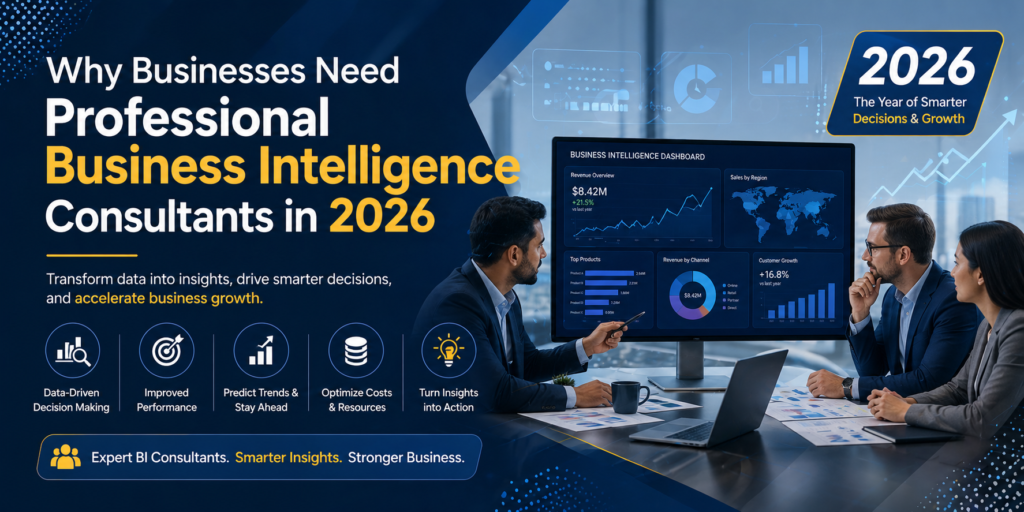
The organizations making confident, fast, high-quality decisions in 2026 are not guessing they are working with professional Business Intelligence Consultants who turn data chaos into competitive clarity.
Data is not the problem anymore.
Every business has more of it than they can process. Sales data. Customer data. Operational data. Financial data. All of it sitting in systems that rarely talk to each other, interpreted differently by different departments, and almost never informing decisions at the speed the business actually needs.
That gap between data existing and decisions improving is exactly where BI consulting solutions make their most visible impact. Not by adding more tools to an already crowded stack but by building the analytical infrastructure that connects what a business knows to what it actually decides. Across the USA organizations that have closed this gap are competing differently — faster responses, sharper resource allocation, and a level of strategic clarity that businesses still running on gut feel and monthly reports simply cannot match.
The 2026 Problem Nobody Is Talking About Loudly Enough
Speed of decision-making has become a competitive variable in a way it never was before.
Three years ago a two-week reporting cycle was inconvenient. In 2026 it is a liability. Markets shift faster. Customer behavior changes faster. Competitive moves happen faster. Organizations waiting for monthly reports to understand what happened last quarter are making strategic decisions on information that is already outdated by the time it reaches leadership.
The businesses that have solved this problem are not necessarily larger or better funded. They built the right infrastructure earlier. And that infrastructure is now compounding in their favor every single quarter.
What Professional Consultants Actually Fix
The Single Version of Truth Problem
Ask three departments what revenue was last month. Get three different numbers.
This is not an unusual scenario. It is the standard experience inside organizations that have grown faster than their data governance kept up with. Different systems. Different definitions. Different people pulling different reports and presenting different conclusions in the same meeting.
BI consulting solutions that address this properly start with definitions before they touch technology. What exactly does this business mean by revenue. By customer. By active user. By conversion. Getting those definitions agreed upon and consistently applied across every data source is unglamorous work. It is also the work that determines whether the reporting built on top of it can be trusted.
Professional Business Intelligence Consultants spend significant time on this layer precisely because skipping it produces impressive dashboards that nobody trusts six months after launch.
Where the Returns Show Up First
Reporting That Runs Itself
The most immediate visible return from a properly executed BI engagement is time.
Reports that required manual compilation across multiple systems start refreshing automatically. The three hours someone spent every Monday morning pulling numbers together gets redirected toward work that actually requires their expertise. Leadership has current information available when they need it rather than waiting for someone to find time to compile it.
That time return is real and measurable within the first weeks of implementation. It also tends to be the return that builds organizational confidence in the broader investment.
Decisions That Happen at the Right Speed
Real-time data availability changes how quickly decisions get made and how confidently they get made.
Resource allocation decisions that used to wait for quarterly reviews start happening monthly, then weekly, as the data infrastructure matures. Pricing decisions informed by current margin data rather than last quarter’s report. Hiring decisions grounded in real operational capacity metrics rather than manager intuition.
BI consulting solutions that connect data to decision-making workflows consistently produce this kind of improvement. Not as a theoretical benefit. As a visible operational change that shows up in how meetings run and how quickly the organization responds to what is happening around it.
The Gap That Keeps Widening
Here is the uncomfortable reality of 2026 for businesses that have not yet invested in proper BI infrastructure.
The organizations that built this capability earlier are not standing still. They are making better decisions every quarter. Those better decisions produce better outcomes. Those better outcomes compound into structural advantages that become increasingly difficult to close through effort or talent alone.
Across the USA that gap between data-mature organizations and those still operating on delayed, inconsistent reporting is already visible in performance differences within the same industries. It is not closing on its own.