We’ve all been there. You grab your phone to check one quick thing, and suddenly, an hour has just… vanished. You’re deep in a rabbit hole of videos you didn’t even want to watch. It’s a total drain, right? Usually, we just tell ourselves we need more willpower. But the truth is, social media addiction isn’t a personal failure. It’s actually by design.
At Curious Mind Hub, we think it’s time to pull back the curtain. When you finally get why these apps feel so magnetic, you stop beating yourself up and start getting smart about taking your time back.
This Is How Dopamine Loops Affect the Brain
You’ve heard of dopamine, but most people get it wrong. It’s not about the “pleasure” of seeing a post. It’s about the itch to see it. It’s the “more” chemical. It’s what drives you to hunt, seek, and anticipate.
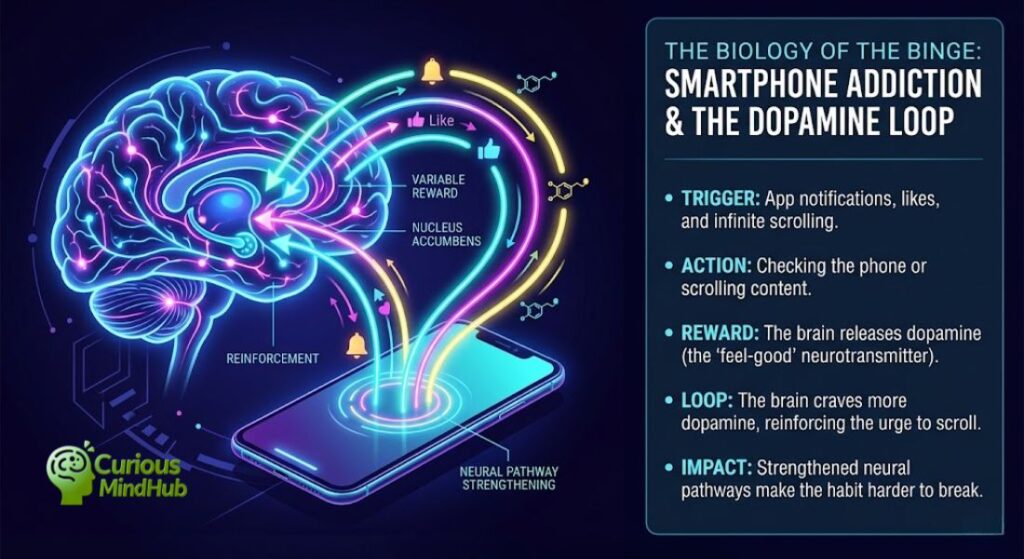
This is basically how dopamine loops affect the brain. You see a red notification badge, and your brain gets a tiny spike. That spike isn’t a reward; it’s a command to check. Once you do, the loop closes for a second, only for a new one to open the moment you start scrolling. It’s a restless, never-ending cycle of craving.
The Weird Neurobiology of Infinite Scrolling
Ever notice how a book has pages and chapters that give you a natural place to stop? Social media doesn’t. That is the neurobiology of infinite scrolling at work. They’ve removed the “stopping cues.”
Because the content never ends, your brain stays on a weird kind of autopilot. There’s no friction. No moment where you have to decide to keep going. You just do. It’s the path of least resistance, and our ancient brains are wired to take that path every single time.
Why It Feels Like a Vegas Slot Machine
If every post you saw was great, you’d get overwhelmed. If they were all boring, you’d quit. The “sweet spot” is the variable reward schedule in social media.
It’s the same trick slot machines use. You scroll past five boring posts, then—boom—a funny meme. Then three mediocre updates, then—zap—a notification from a friend. That total unpredictability is what keeps you hooked. Your brain is essentially playing a digital slot machine every time you refresh your feed.
Why a Scrolling Addiction Feels So Heavy
A scrolling addiction isn’t just about lost hours. It’s about how your head feels afterward.
-
Context Whiplash: Jumping from a tragedy to a dance trend in three seconds is exhausting for your brain.
-
Fragmented Focus: Your brain starts expecting a “reward” every few seconds, making “slow” things like work or reading feel incredibly dull.
-
The Comparison Trap: Seeing everyone’s “best bits” triggers a subtle stress response, even if you know it’s not the full reality.
Rewiring Your Brain for Better Focus
The good news? Your brain is “plastic.” It can heal. Rewiring your brain for better focus is mostly about retraining your attention span. It’s a muscle that’s probably a bit out of shape right now, but you can fix that.
Start by letting yourself be bored. Read a physical book. Go for a walk without a podcast. At first, it’ll feel restless. That restlessness is just your dopamine levels recalibrating. Lean into it.
Digital Minimalism for Mental Health
A “digital detox” is usually just a temporary band-aid. Digital minimalism for mental health is a lifestyle change. It’s about being the boss of your tools instead of letting them boss you around.
If an app makes you feel like garbage, delete it. If a notification doesn’t come from a real human being, you don’t need it. Digital minimalism is about quality over quantity. When you clear out the junk, you finally have room to actually think.
How to Break a Scrolling Addiction (For Real)
If you’re looking for how to break a scrolling addiction, stop relying on willpower. Willpower is a finite resource. Use systems instead. Here are a few ways to reduce social media screen time that actually work:
-
Greyscale Your Phone: Go into settings and turn off the color. When Instagram looks like a grey, 1940s newspaper, it loses its “candy” pull.
-
The “Phone-Free First Hour”: Don’t let an algorithm dictate your mood the second you wake up.
-
Physical Distance: If the phone is in another room, you’re less likely to “accidentally” pick it up.
The Neuroscience of Habit
The neuroscience of habit shows us that habits are just loops: a Cue, a Routine, and a Reward.
-
The Cue: You feel a tiny bit of boredom or stress.
-
The Routine: You reach for the phone.
-
The Reward: That tiny dopamine hit.
To change, you have to swap the routine. When you feel that “boredom cue,” try taking ten deep breaths or drinking a glass of water. It sounds small, but it starts to break the automatic link.
Conclusion: Taking Your Attention Back
At the end of the day, your attention is the most valuable thing you own. Reclaiming it isn’t about being “anti-tech”—it’s about being intentional. By understanding the neurobiology of infinite scrolling and finding new ways to reduce social media screen time, you’re deciding to be the one in charge.
At Curious Mind Hub, we believe a clear head is a superpower. It takes some work, but the clarity you get in return is worth every bit of it. For more ways to navigate the world with intention, come hang out with us at Curious Mind Hub. Let’s start the rewire.
Frequently Asked Questions
Is this a real medical addiction? While “addiction” is a heavy word, we use the term social media addiction to describe these compulsive cycles. It’s a deep behavioral habit. If it’s making you miserable, it’s worth taking it seriously.
How long does it take to get my focus back? Most people feel a massive shift in just 3 to 5 days of cutting back. The mental “fog” starts to clear pretty quickly once your nervous system isn’t being constantly poked.
Do some apps use these dopamine loops more than others? Definitely. Apps built around short-form video and infinite scrolling are the “stickiest” because they hit those reward centers the hardest.
What’s the first step to take? Just turn off your notifications. All of them. Start there and see how much quieter your brain feels.