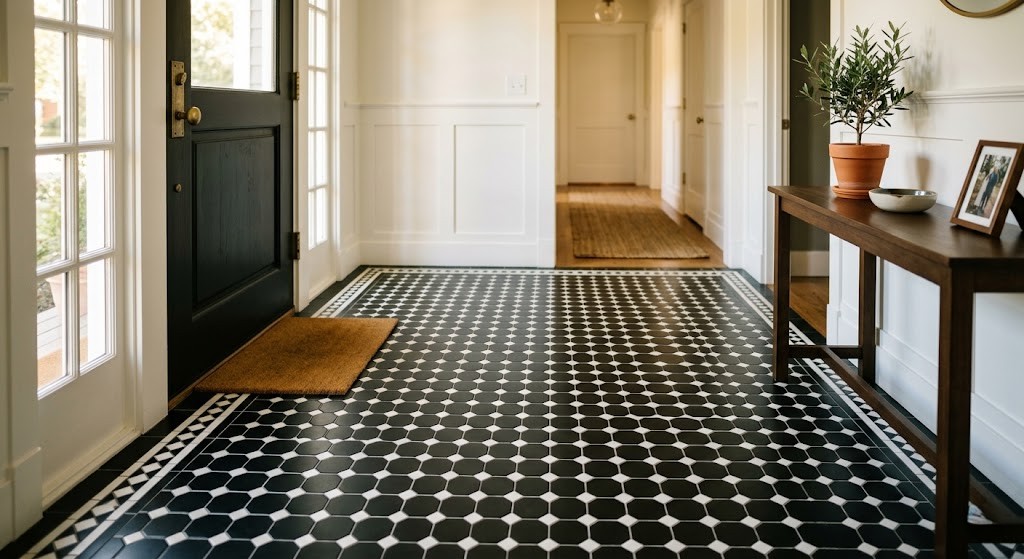
Step into an old subway station, a Victorian-era foyer, or a mid-century modern bathroom, and you will inevitably find the same timeless feature: a black and white mosaic floor. This design has endured for well over a century. Yet it continues to grace newly built homes and fashionable restaurants today.
Why does this specific look remain so enduring while other trends come and go? The answer is not rooted in nostalgia. It lies in practicality, sharp contrast, and remarkable versatility. Let us investigate why black and white mosaic floor tiles never seem to fall out of favor.
The Power of Contrast
The human eye is instinctively drawn to contrast. It helps us define shapes and navigate our environment. Black and white together deliver the ultimate contrast. When you combine these two colors on a floor, you establish a visual rhythm that feels both intentional and stable.
Unlike a monochrome floor that can appear lifeless, a black and white pattern introduces genuine dimension. A classic checkerboard layout makes a room feel more expansive. A bold geometric border defines a space with elegance. Even a simple basketweave pattern gives the eye an engaging path to follow without cluttering the room.
This contrast also offers practical advantages. High-contrast floors conceal many daily imperfections. Dark scuff marks disappear into the black tiles. Dust and light debris become invisible against the white. In a busy entryway or a high-traffic bathroom, that is a tremendous benefit.
A Chameleon in the Design World
Certain flooring options lock you into a narrow design aesthetic. A heavily patterned encaustic tile screams “bohemian.” A pale marble floor announces “traditional opulence.” Black and white mosaic floor tiles do the precise opposite. They shape-shift to suit any surrounding.
Consider how often your room preferences might change. Perhaps you paint the walls a deep forest green this year, but next year you crave a soft coral. A black and white floor accommodates both choices without resistance. It acts as a neutral backdrop. The black elements tie into your hardware and fixtures. The white connects seamlessly to your trim and ceilings.
Because the floor carries no color of its own, it empowers you to add color everywhere else. You can swap out rugs, drapery, and wall art as frequently as you desire, and the floor will always complement your latest scheme. It performs equally well under a sleek, minimalist vanity or a classic clawfoot tub. You never feel confined.
Built to Take a Beating
Style is worthless if the material cannot withstand real-world abuse. This is where the mosaic format truly distinguishes itself.
By definition, a mosaic comprises many small tile pieces—typically one or two inches square—bonded to a mesh backing. Why does this enhance durability? Smaller tiles yield more grout lines. More grout lines create a far stronger, slip-resistant surface.
When you step on a large-format tile, your weight distributes across a broad, flat expanse. On a mosaic floor, the grout grid functions as a network of shock absorbers. This makes mosaic floors exceptionally resistant to cracking. If a house settles or the subfloor shifts slightly, a large tile might fracture. A mosaic flexes instead.
If you are installing flooring in a wet area, this texture becomes critical. Water pools on large, glossy tiles, creating a slipping hazard. Mosaics disrupt that surface tension. That is precisely why you see mosaic floor tiles in showers and around pool decks. You achieve the classic aesthetic without compromising safety.
A Brief History of Persistence
To grasp why this style persists, it helps to examine its origins. Black and white floors first gained widespread popularity in the late 19th and early 20th centuries. During the Victorian era, hygiene became a pressing public concern.
Smooth, hard surfaces suddenly became desirable because they did not trap dust or harbor bacteria like wood or carpet. The materials available at the time—early ceramics and natural stone—were easiest to produce and source in black and white.
The style carried directly into the Art Deco period of the 1920s and 1930s. Designers took the basic black and white palette and expanded the patterns. They introduced chevrons, sunbursts, and intricate geometric borders. It felt modern and industrial, yet still refined.
By the 1950s, the black and white checkerboard became the signature of the mid-century kitchen. The shapes grew bolder, the tiles somewhat larger, but the core concept remained unchanged. Each generation adopts the palette and modifies the pattern to suit its own mood. The structural bones of the design never alter.
Choosing the Right Material
Not all black and white tiles are equivalent. If you plan to install one of these floors, you must select the appropriate material for your specific space.
Ceramic: This is the most prevalent choice. It is affordable, simple to cut, and available in countless shapes. The glaze on ceramic tile makes it highly stain-resistant. If you are tiling a bathroom wall or a lightly used guest powder room, ceramic is a reliable, cost-effective option. A reputable ceramic tile shop will have sample boards so you can observe how the glaze interacts with light.
Porcelain: For flooring, porcelain is typically the superior selection. It is denser than ceramic and absorbs almost no water. If you are laying black and white mosaic floor tiles in a mudroom, an entryway, or a shower, seek out porcelain mosaics. They withstand heavy foot traffic and freeze-thaw cycles if used outdoors.
Natural Stone: Marble and granite mosaics offer unparalleled depth. A black marble tile is never purely black; it contains veins and subtle color variations. Stone demands more maintenance. It requires sealing and can etch if exposed to acidic spills. However, the visual reward for formal spaces is immense.
Glass: Glass mosaics reflect light superbly, making them ideal for darker rooms. They are entirely waterproof. But they reveal every smudge and water spot. Reserve them for walls or very low-traffic floors.
Pattern Selection Matters
The shape of the tile fundamentally changes the room’s atmosphere. You are not limited to the standard grid.
-
Hexagon: The classic honeycomb shape. It softens the room’s geometry and feels both traditional and clean.
-
Basketweave: Creates the illusion of woven strips. It adds a subtle texture that feels very tailored and crisp.
-
Penny Round: Small circles that feel slightly retro and playful. Excellent for smaller spaces.
-
Octagon and Dot: A Victorian standard. The tiny square “dot” in each octagon’s corner adds a delicate intricate detail without becoming busy.
When selecting a pattern, consider your room’s dimensions. Tiny patterns in a vast room can appear chaotic from a distance. Large checkerboards in a tiny bathroom can make the space feel like a carnival funhouse. Aim for a scale that harmonizes with the room.
Installation and Upkeep
Installing mosaic floor tiles is generally more DIY-friendly than large-format tiles. The mesh backing maintains even spacing. You simply press the sheets into the thin-set mortar. The primary challenge is keeping your rows straight as you lay sheet after sheet.
Maintenance is uncomplicated. Sweep or vacuum regularly to remove grit from the surface. Mop with a mild detergent.
The only real consideration is the grout. With mosaics, you have a significant amount of grout. White grout looks crisp when fresh, but it will darken over time in high-traffic zones. If you wish to preserve that clean look, consider dark gray grout. It blends with the black tiles, conceals dirt, and still contrasts sharply with the white. Be certain to seal the grout lines to guard against stains and moisture. Any good ceramic tile shop can recommend a suitable grout sealer for mosaic floors.
The Bottom Line
Trends arrive and depart. Currently, terrazzo is enjoying a resurgence. Bold, colorful encaustic tiles are fashionable. But these looks are highly prescriptive. They dictate the remainder of your design choices.
Black and white mosaic floor tiles do the opposite. They provide a foundation that is visually arresting, nearly indestructible, and endlessly flexible. They have outlived the Victorian era, the Space Age, and the modern farmhouse trend. They will survive whatever follows as well. If you want a floor that you will not tire of in five years, commit to black and white.