Keeping a refrigerator running during a power outage is often a top priority. However, choosing the right backup power system requires more than looking at the refrigerator’s normal wattage. Compressor-driven appliances can require additional power when starting, making both continuous and peak output important.
This guide to generator sizing for a refrigerator explains the main specifications to check before selecting a generator or portable power station.
Why Refrigerator Generator Sizing Matters
Refrigerators use compressors that cycle on and off. During normal operation, the compressor consumes a certain amount of electricity, but its initial startup can temporarily require more power.
This means a generator may need to provide more power than the refrigerator’s listed running wattage at the moment the compressor starts.
An appropriate backup system should therefore have enough continuous output for normal operation and enough peak output to handle startup demand.
Check the Refrigerator’s Electrical Specifications
The first step is to find the refrigerator’s actual electrical requirements. Check the manufacturer’s label, owner’s manual, or technical specifications.
Look for:
- Running or rated wattage
- Voltage requirements
- Startup or surge wattage
- Any manufacturer-specific power requirements
If the startup requirement is not listed, avoid assuming that every refrigerator has the same surge demand. Compressor design, refrigerator size, efficiency, and model can all affect electrical consumption.
Continuous Watts and Peak Watts
Understanding these two ratings is essential for refrigerator backup.
Continuous output refers to the power a generator can provide during normal operation. The refrigerator’s regular electrical demand needs to remain within this rating.
Peak output refers to the higher amount of power the system can temporarily provide. This can help accommodate the compressor’s startup demand.
For example, the GEYOTO N300 offers 300W continuous pure sine wave output and 500W peak output, while the GEYOTO N1000 provides 1,800W continuous pure sine wave output and 3,000W peak output.
The correct choice depends on the refrigerator’s actual requirements rather than the generator’s maximum rating alone.
Capacity and Output Are Different
For battery-powered portable power stations, another important specification is battery capacity.
Capacity is measured in watt-hours (Wh) and represents the energy stored in the battery. Output is measured in watts (W) and determines how much power the system can deliver at one time.
A system can have substantial battery capacity but still be unsuitable for a particular appliance if its output cannot handle the appliance’s running or startup demand.
How Much Capacity Does a Refrigerator Need?
There is no single watt-hour rating that guarantees a specific refrigerator runtime.
Actual energy consumption depends on factors such as:
- Refrigerator power requirements
- Compressor cycling
- Ambient temperature
- Door-opening frequency
- Battery and inverter efficiency
- Other connected equipment
For this reason, use the refrigerator’s actual specifications whenever possible instead of relying on a generic runtime estimate.
GEYOTO N300 Specifications
The GEYOTO N300 is positioned as a compact “Grab and Go” portable power solution.
Its approved specifications include:
- Capacity: 256Wh
- Continuous output: 300W pure sine wave
- Peak output: 500W
- Constant Power: 550W
- Battery: LiFePO4
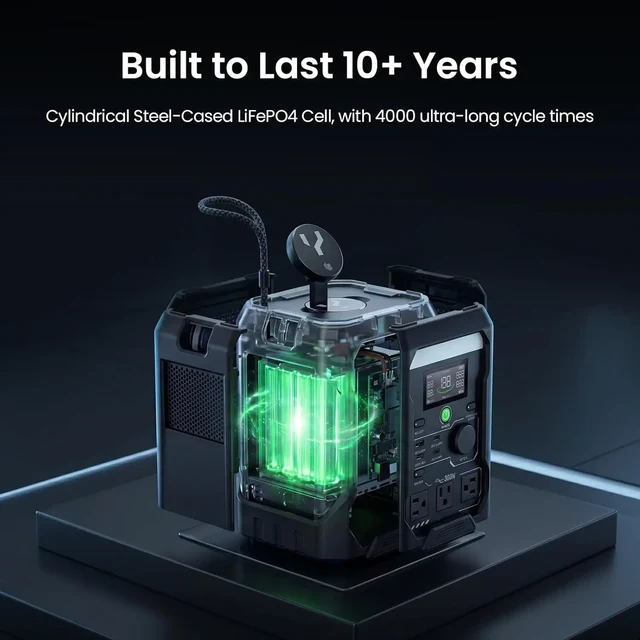
- Battery life: 4,000 cycles
- Full recharge: About 1.5 hours
- Output outlets: 9
- Wireless charging: 25W
- UPS switching: Less than 10ms
The N300 is primarily designed for camping, travel, small electronics, Wi-Fi routers, laptops, lighting, and short-term outage backup. Whether it can support a particular refrigerator depends on that refrigerator’s running and startup requirements.
GEYOTO N1000 Specifications
The N1000 is designed for higher-capacity home emergency applications.
Its approved specifications include:
- Capacity: 1,024Wh
- Continuous output: 1,800W pure sine wave
- Peak output: 3,000W
- Constant Power: 2,400W
- Battery: LiFePO4
- Battery life: 4,000 cycles
- 0–80% recharge: 43 minutes
- 100% recharge: 68 minutes
- Total ports and interfaces: 18
- Output ports: 13
- Wireless charging: Qi2.2 25W
- UPS switching: Less than 10ms
- Vehicle-support output: XT60, 12.6V/30A, up to 378W
The N1000 is positioned for home emergencies that can include compatible refrigerators, CPAP machines, fans, Wi-Fi equipment, and other essential loads.
Consider Startup Surge
Startup surge is one of the most important factors in refrigerator generator sizing.
Suppose a refrigerator operates at a relatively modest wattage once running but temporarily demands considerably more power when its compressor starts. A generator that only barely meets the running requirement may not have sufficient peak capability.
Always compare the refrigerator’s startup requirement with the generator’s peak specification before connecting it.
What Is Constant Power Mode?
Constant Power mode can provide additional flexibility for compatible loads.
The N300 provides 550W Constant Power, while the N1000 provides 2,400W Constant Power.
This feature does not increase the amount of energy stored in the battery. Higher-power operation can consume the available battery energy faster, and the connected appliance must remain within the applicable operating limits.
Pure Sine Wave Output for Refrigerators
Both the N300 and N1000 provide pure sine wave output.
Pure sine wave output is designed to provide an AC waveform similar to utility electricity and can be an important consideration for equipment containing motors or compressors.
However, pure sine wave output alone does not guarantee refrigerator compatibility. Always verify the refrigerator’s electrical requirements before use.
How Long Can a Battery Generator Run a Refrigerator?
Runtime varies from one refrigerator to another.
A simple watt-hour calculation can provide a rough starting point, but it does not account for compressor cycling, inverter losses, environmental conditions, or other variables.
A refrigerator may draw power only when its compressor and other components are operating. Therefore, actual energy consumption over several hours can differ from continuously multiplying the refrigerator’s maximum running wattage by the number of hours.
Can You Run Other Devices With the Refrigerator?
That depends on the generator’s available output and the combined requirements of the connected equipment.
If you connect lights, a Wi-Fi router, phones, fans, or other devices, their power requirements add to the refrigerator’s load. High-power appliances can also introduce additional startup demands.
During an extended outage, prioritize essential equipment and disconnect unnecessary loads to conserve battery energy.
Recharge Speed for Extended Outages
Recharge speed can be particularly useful when power returns temporarily or when outages occur repeatedly.
The N300 can fully recharge in about 1.5 hours.
The N1000 can recharge from 0–80% in 43 minutes and reach 100% in 68 minutes.
Faster charging can help restore the available energy reserve sooner after the backup system has been used.
UPS Switching
Both the N300 and N1000 have a specified UPS switching time of less than 10 milliseconds.
UPS functionality can help minimize interruptions for compatible connected equipment when utility power fails. Users should still verify the requirements and compatibility of individual devices.
Tips for Conserving Refrigerator Power
Once a suitable backup system is connected, energy management can help extend available runtime.
Keep the refrigerator and freezer doors closed as much as possible during an outage. Opening the doors frequently allows cold air to escape and can increase cooling demand.
It is also useful to avoid connecting unnecessary high-power appliances to the same battery system. If the outage lasts longer than expected, preserving energy for refrigeration and other essential loads becomes increasingly important.
Refrigerator Generator Sizing Checklist
Before selecting a generator, confirm the following:
- Check the refrigerator’s running wattage.
- Find its startup or surge requirement.
- Compare running wattage with the generator’s continuous output.
- Compare startup demand with its peak output.
- Check the battery capacity if using a portable power station.
- Consider how long the refrigerator needs backup power.
- Account for other devices that may share the system.
- Review available ports and connections.
- Check recharge speed for repeated outages.
- Follow the generator and refrigerator manufacturers’ operating instructions.
Final Thoughts
Generator sizing for a refrigerator requires looking at both power and energy. The generator must be capable of handling the refrigerator’s normal running load and temporary compressor startup demand, while its battery capacity determines how much stored energy is available for continued operation.
The GEYOTO N300 offers 256Wh, 300W continuous output, and 500W peak output for compact and short-term backup applications. The N1000 offers 1,024Wh, 1,800W continuous output, and 3,000W peak output and is positioned for higher-capacity home emergency applications, including compatible refrigerators.
The most reliable approach is to check your refrigerator’s actual specifications first, then compare them with the generator’s continuous output, peak output, capacity, and other relevant features.