Financial Due Diligence in the UAE: What Investors Should Review Before Making an Investment
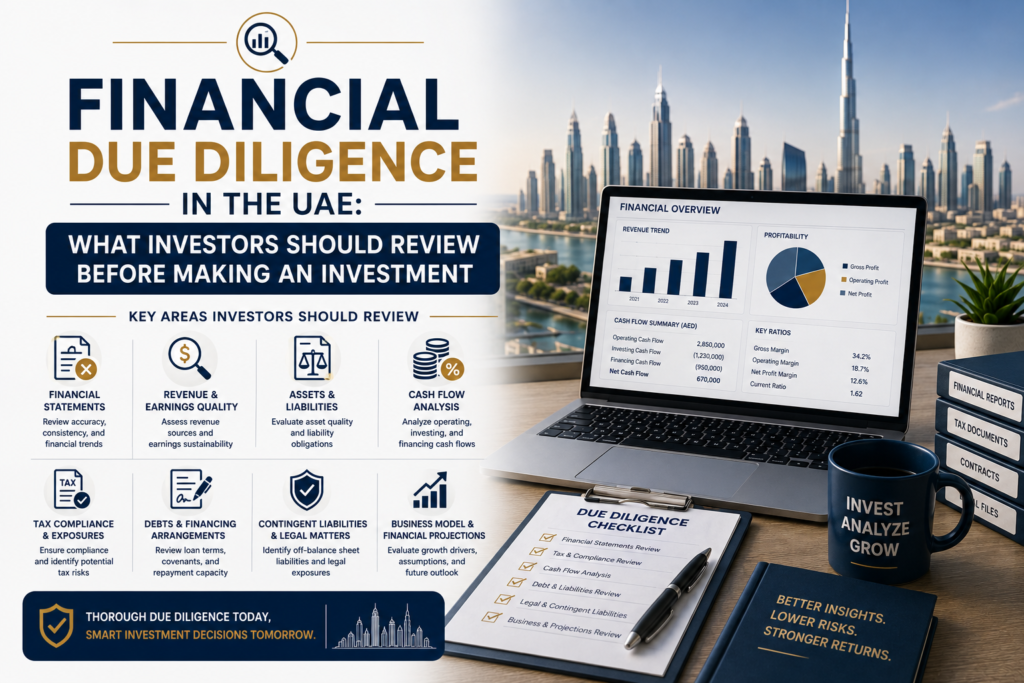
Investing in an existing business can provide an opportunity to enter a market with established operations, customers, employees, and revenue. However, financial performance presented by a business does not always provide the complete picture.
Before committing capital, investors need to understand what they are actually buying. Are the reported revenues sustainable? Are expenses accurately recorded? Does the company have undisclosed liabilities? Is its cash flow healthy? Are there unusual transactions that could affect future performance?
These questions make financial due diligence in UAE an important part of the investment decision-making process.
Financial due diligence involves examining a company’s financial information, performance, assets, liabilities, cash flow, and other relevant financial factors to help an investor understand the business’s actual financial position and identify potential risks before completing a transaction.
What Is Financial Due Diligence?
Financial due diligence is a detailed review of a company’s financial information before an investment, acquisition, merger, partnership, or other significant transaction.
The process typically examines areas such as:
- Financial statements
- Revenue
- Operating expenses
- Profitability
- Cash flow
- Assets
- Liabilities
- Debt
- Working capital
- Accounts receivable
- Accounts payable
- Tax-related records
- Financial forecasts
The exact scope depends on the nature of the transaction and the investor’s objectives.
The goal is not simply to determine whether a business is profitable. It is to understand the quality, sustainability, and reliability of its financial performance.
Why Is Financial Due Diligence Important for UAE Investors?
An investment decision based only on information provided by the seller can expose investors to unnecessary risks.
A business may appear attractive because of strong revenue figures, but further analysis could reveal:
- High customer concentration
- Declining margins
- Significant outstanding debt
- Weak cash flow
- Overdue receivables
- Unusual expenses
- Unrecorded liabilities
- Unsustainable revenue growth
Financial due diligence helps investors investigate these areas before making a major financial commitment.
1. Review the Company’s Financial Statements
Financial statements are one of the first areas investors should examine.
Depending on the business and transaction, these may include:
- Profit and loss statements
- Balance sheets
- Cash flow statements
- General ledgers
- Trial balances
- Management accounts
Investors should review several periods rather than focusing only on the latest year.
Looking at historical financial information can help reveal trends in:
- Revenue
- Gross margins
- Operating expenses
- Profitability
- Debt
- Working capital
A single strong financial year does not necessarily indicate sustainable long-term performance.
2. Analyse Revenue Quality
Revenue is an important indicator of business performance, but investors should examine where that revenue comes from.
Questions may include:
- Is revenue growing consistently?
- Are sales concentrated among a small number of customers?
- Are major customers under long-term contracts?
- Is revenue recurring or one-time?
- Are there significant discounts?
- Are there unusual increases before the transaction?
- Are outstanding invoices being collected?
Understanding revenue quality can help investors assess whether reported income is sustainable.
3. Examine Profitability and Margins
Revenue growth does not necessarily mean a business is becoming more profitable.
Investors should examine:
- Gross profit
- Gross margin
- Operating profit
- Net profit
- EBITDA where relevant
- Changes in operating expenses
For example, a business may generate higher revenue while its margins decline because operating costs are increasing faster than sales.
A financial due diligence review can help identify these trends and provide greater context around reported profitability.
4. Assess Cash Flow
Cash flow is one of the most important areas to examine during financial due diligence in UAE.
A business can report accounting profits while still experiencing cash flow pressure.
Investors should review:
- Operating cash flow
- Investing cash flow
- Financing cash flow
- Working capital movements
- Customer collections
- Supplier payments
- Recurring cash expenses
Strong cash generation can provide greater confidence in the company’s ability to fund ongoing operations.
5. Review Accounts Receivable
Outstanding customer balances can have a significant impact on working capital.
Investors should examine:
- Total receivables
- Aging of receivables
- Overdue invoices
- Major customer balances
- Collection history
- Bad debt provisions
A high level of overdue receivables may indicate that reported revenue is not translating into cash quickly enough.
It may also indicate the need for more conservative assumptions about future collections.
6. Examine Accounts Payable
Investors should also understand the company’s outstanding obligations to suppliers and other creditors.
The review may include:
- Supplier balances
- Payment terms
- Overdue payables
- Significant suppliers
- Unrecorded obligations
- Changes in payment patterns
A business that appears cash-rich may have significant short-term obligations that are not immediately obvious from headline financial figures.
7. Identify Existing Debt and Liabilities
Understanding a company’s debt position is essential before investing.
Investors should review:
- Bank loans
- Financing arrangements
- Credit facilities
- Lease obligations
- Outstanding supplier liabilities
- Contingent liabilities
- Other financial commitments
The purpose is to understand how much of the company’s future cash flow may be required to meet existing obligations.
Unexpected liabilities can significantly affect the attractiveness of an investment.
8. Review Working Capital Requirements
Working capital represents the resources a business needs to support its day-to-day operations.
Investors should examine relationships between:
- Receivables
- Inventory
- Payables
- Cash
A company experiencing rapid revenue growth may still require significant additional working capital to fund that growth.
Understanding historical working capital requirements can help investors develop more realistic financial projections.
9. Examine Tax and Financial Records
Tax-related information can provide additional insight into a company’s financial position.
Depending on the business and transaction, investors may review relevant:
- VAT records
- Corporate tax information
- Tax filings
- Tax-related correspondence
- Supporting financial records
The objective is to identify potential tax exposures, inconsistencies, or obligations that could affect the transaction.
Tax treatment depends on the company’s specific circumstances, so investors should involve qualified tax professionals where necessary.
10. Compare Financial Statements With Supporting Records
An important part of financial due diligence is checking whether reported financial information is supported by underlying documentation.
For example, reported revenue may be compared with:
- Customer invoices
- Bank receipts
- Contracts
- Accounting records
Similarly, expenses may be reviewed against:
- Supplier invoices
- Bank transactions
- Contracts
- Payment records
This process can help identify discrepancies and improve confidence in the financial information being reviewed.
Financial Red Flags Investors Should Watch For
During financial due diligence, certain findings may warrant additional investigation.
Declining Profit Margins
Revenue may be increasing while profitability is falling.
High Customer Concentration
A significant portion of revenue may depend on a small number of customers.
Increasing Overdue Receivables
Customers may be taking longer to pay.
Unexplained Expenses
Unexpected or unusual expenses may require further investigation.
Significant Debt
High debt levels can increase financial risk.
Inconsistent Financial Records
Differences between financial statements and supporting documentation may indicate accounting issues.
Unusual Revenue Growth
Sudden increases in revenue, particularly near a transaction, should be investigated.
Weak Operating Cash Flow
Accounting profits without corresponding cash generation can be a warning sign.
Financial Due Diligence and Business Valuation
Financial due diligence can also support business valuation.
An investor may initially value a business based on its reported revenue or profitability. However, further analysis may reveal that certain earnings are not sustainable or that the company has additional liabilities.
Financial due diligence can therefore provide information that helps investors evaluate whether the proposed purchase price is reasonable.
It may also help identify areas where the transaction structure or price requires further negotiation.
Financial Due Diligence for Business Acquisitions in the UAE
When purchasing an existing UAE business, investors should consider more than the company’s current revenue.
A comprehensive review may cover:
- Historical financial performance
- Revenue quality
- Profit margins
- Cash flow
- Working capital
- Accounts receivable
- Accounts payable
- Debt and liabilities
- Tax-related records
- Financial forecasts
This information can help investors develop a clearer understanding of the business before completing the acquisition.
How Financial Due Diligence Helps Reduce Investment Risk
Financial due diligence cannot eliminate investment risk. However, it can help investors identify issues before they commit capital.
For example, discovering significant overdue receivables before an acquisition gives an investor an opportunity to investigate the issue and consider its implications.
Similarly, identifying undisclosed liabilities can help prevent unexpected financial exposure after the transaction.
The earlier these issues are identified, the more opportunity an investor has to assess, negotiate, or address them.
Common Financial Due Diligence Mistakes
Investors should avoid several common mistakes.
Focusing Only on Revenue
High revenue does not automatically mean a healthy business.
Reviewing Only One Financial Year
Historical trends often provide more useful information than a single reporting period.
Ignoring Cash Flow
Profitability without healthy cash generation can create financial concerns.
Overlooking Working Capital
Acquisitions can require additional working capital after completion.
Accepting Financial Information Without Verification
Important financial figures should be supported by appropriate documentation.
Ignoring Tax-Related Issues
Potential tax exposures should be assessed as part of the broader financial review.
What Documents Are Usually Required?
The exact documents depend on the transaction, but investors may request:
- Financial statements
- Management accounts
- Bank statements
- General ledger
- Trial balance
- Sales reports
- Purchase records
- Accounts receivable aging
- Accounts payable aging
- Debt schedules
- Tax records
- Major customer contracts
- Major supplier contracts
- Financial forecasts
Having these documents organised can make the due diligence process more efficient.
When Should Investors Conduct Financial Due Diligence?
Financial due diligence should generally be conducted before finalising a major investment or acquisition.
It can be particularly valuable when:
- Buying an existing business
- Acquiring a significant ownership stake
- Entering a partnership
- Considering a merger
- Investing in a growing company
- Evaluating a strategic acquisition
The scope and timing should be tailored to the transaction’s size, complexity, and risk profile.
How Professional Due Diligence Support Can Help
Financial due diligence can involve reviewing large amounts of financial information and identifying relationships that may not be immediately obvious.
Professional due diligence specialists can help investors:
- Organise financial information
- Analyse historical performance
- Review cash flow
- Examine assets and liabilities
- Assess working capital
- Identify financial inconsistencies
- Review relevant tax records
- Highlight potential risks
DBTA provides due diligence services covering financial, commercial, and legal aspects of business transactions, helping investors evaluate potential risks and make more informed decisions.
Conclusion
Financial due diligence in UAE is an important step for investors considering a business acquisition, investment, merger, or partnership. Reviewing financial statements alone is not enough. Investors should examine revenue quality, profitability, cash flow, working capital, receivables, payables, debt, liabilities, tax-related information, and supporting documentation.
A thorough financial review can reveal issues that may not be visible from headline financial figures and can give investors a clearer understanding of the risks and opportunities associated with a transaction.
For investors and businesses conducting transactions in the UAE, Dubai Business and Tax Advisors (DBTA) can provide professional due diligence support across financial, commercial, and legal areas. Working with experienced professionals can help investors assess financial information more systematically and approach important investment decisions with greater clarity and confidence.