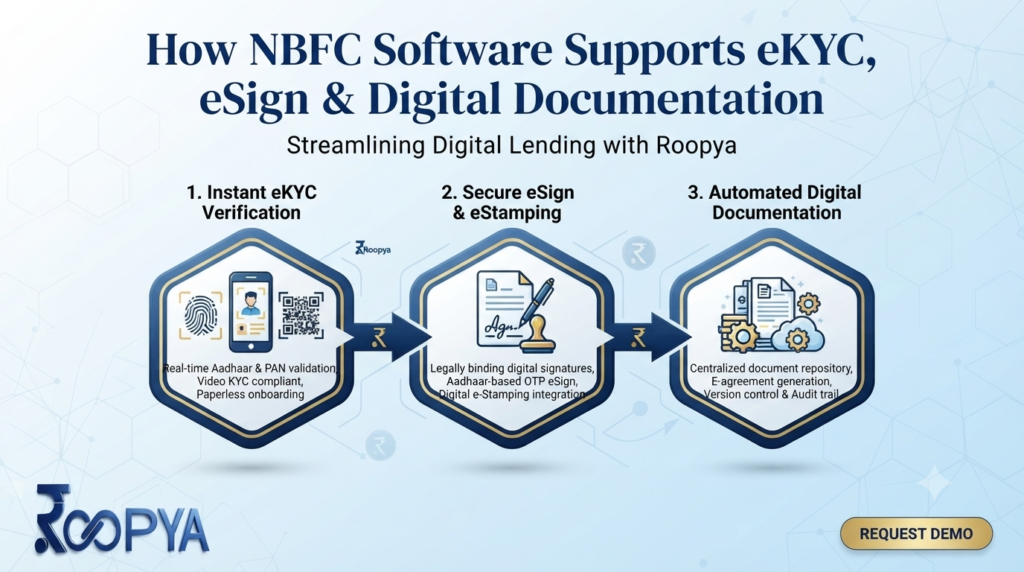
See how NBFC loan management software powers eKYC, Aadhaar eSign and digital documentation — from Video KYC and CKYC to auto-generated, digitally signed loan agreements.
A decade ago, opening a loan file at an NBFC meant a physical folder, a photocopy of a ration card or passport, a wet-ink signature on a stack of paper, and a courier run to a central office where someone would eventually key the details into a system. Today, the same journey can happen between a customer’s morning coffee and their commute to work — because eKYC, eSign and digital documentation have quietly become the backbone of how non-banking financial companies originate and manage loans.
This shift did not happen because NBFCs decided paper was inconvenient. It happened because regulation, customer expectation and competitive pressure converged at the same moment. The Reserve Bank of India opened up Aadhaar-based authentication to NBFCs, UIDAI and NSDL built the rails for digital signatures, and a generation of borrowers who already order groceries and book cabs on their phones simply stopped tolerating paperwork-heavy loan processes.
The piece connecting all of this together is NBFC software — specifically, the loan management system (LMS) and loan origination system (LOS) that sit at the centre of an NBFC’s operations. This article walks through exactly how modern NBFC software supports eKYC, eSign and digital documentation: what each of these pieces actually does, how they fit into a loan file from first click to disbursement, what the current RBI framework expects, and what an NBFC should look for before choosing a platform to run all of this on.
Why Digital Onboarding Has Become Non-Negotiable
Three forces are pushing NBFCs toward fully digital onboarding, and none of them are optional to ignore.
The first is regulatory permission combined with regulatory pressure. NBFCs were historically barred from using Aadhaar’s online eKYC facility following a Supreme Court ruling, until a 2021 notification allowed them to apply for a KYC User Agency (KUA) or sub-KUA licence to use it for customer authentication. Since then, the compliance bar has only risen: the RBI consolidated its KYC instructions into sector-specific Master Directions in November 2025, and enforcement action against regulated entities for weak KYC and AML controls has increased in frequency since 2022. An NBFC running onboarding on spreadsheets and physical files is not just slow — it is exposed.
The second force is unit economics. Every manual step in an onboarding journey — a field visit to collect documents, a back-office employee re-keying data from a scanned form, a courier delivering a signed agreement — adds cost and time to a loan that may be worth only a few thousand rupees in interest income. For NBFCs competing on speed of disbursal, digital onboarding is what makes small-ticket, high-volume lending viable in the first place.
The third is simply what borrowers now expect. A customer who can open a savings account or buy an insurance policy entirely on a phone is unlikely to accept driving to a branch, photocopying a PAN card and waiting three days for loan approval. Digital-first lenders and fintech-NBFC partnerships have reset the baseline; any NBFC still running paper-first onboarding is competing with one hand tied behind its back.
NBFC software — the LOS and LMS that manage the loan lifecycle — is where all three of these pressures get resolved in practice. It is the system that actually executes eKYC checks, triggers eSign requests, stores digitally signed documents, and produces the audit trail an RBI inspection will eventually ask for.
What eKYC Actually Means Inside a Loan Origination Stack
“eKYC” is often used as a single catch-all term, but inside a loan origination system it covers several distinct verification methods, each suited to a different risk level, customer segment and regulatory limit. Good NBFC software supports more than one of these, because no single method covers every scenario.
Aadhaar OTP-Based eKYC
This is the fastest path: the customer enters their Aadhaar number, receives an OTP on their registered mobile, and the system pulls verified demographic data — name, address, date of birth, photograph — directly from UIDAI in real time. It is well suited to small-ticket, low-risk loans, though OTP-based eKYC carries a transaction cap and does not by itself satisfy the face-to-face equivalence RBI requires for higher-value relationships.
Offline Aadhaar XML / Digital Identity Documents
Here the customer downloads a UIDAI-signed XML or QR file and shares it with the lender, who verifies the digital signature without ever touching UIDAI’s live database or the Aadhaar number itself. This method is useful where connectivity is a constraint, and it satisfies standard customer due diligence requirements under the current Master Directions.
Biometric eKYC
For NBFCs that qualify as authentication user agencies, biometric eKYC — a fingerprint or iris scan captured at a point of service, such as a field agent’s device — produces an instantly verifiable record. This is common in secured lending and semi-urban or rural lending models where field agents already visit the customer.
Digital KYC (D-KYC)
D-KYC is the standard non-face-to-face path when video-based verification is not feasible. A representative captures a live, geo-tagged photograph of the customer alongside their original document and digitally certifies the process. Because the photograph is a live capture rather than an uploaded image, and the geo-tag and timestamp must match the certification record, this method still leaves a strong audit trail.
Video Customer Identification Process (V-CIP)
V-CIP is the closest digital equivalent to an in-branch, face-to-face KYC check: a real-time video interaction in which the customer’s identity, document and liveness are verified together. Because it achieves face-to-face equivalence, V-CIP removes the transaction limits that apply to OTP-based eKYC, which is why it has become the default for higher-ticket personal loans, business loans and secured lending on many NBFC platforms. Recent regulatory clarifications have also confirmed that liveness checks do not need to rely on specific facial gestures such as blinking or smiling — a small but meaningful accessibility improvement.
What ties all five methods together at the software level is orchestration. A well-built LOS does not hard-code a single verification path; it routes each applicant to the appropriate method based on loan amount, product type and risk category, and falls back to an alternative method automatically if one channel fails — for example, moving a customer from OTP eKYC to V-CIP if their Aadhaar-linked mobile number is unreachable.
The RBI Regulatory Backdrop NBFC Software Must Respect
None of this technology exists in a vacuum — it is built to satisfy a specific and fairly detailed regulatory framework, and this is where purpose-built NBFC software earns its keep over generic workflow tools.
On 28 November 2025, the RBI consolidated thousands of prior circulars into a set of sector-specific KYC Master Directions covering ten categories of regulated entities, including NBFCs, and withdrew thousands of superseded circulars in the same move. The consolidation did not loosen requirements; if anything, it sharpened them clause by clause while reaffirming that Aadhaar-based verification is one option among several, never mandatory for the customer.
A few structural requirements matter directly for how NBFC software is designed:
- Tiered due diligence — Simplified, Standard (CDD) and Enhanced (EDD) — with different verification depth and monitoring requirements depending on customer risk, so the system needs to classify risk at onboarding and adjust the KYC path accordingly.
- CKYC upload to CERSAI within a prescribed window after onboarding, so that a customer’s 14-digit CKYC number becomes portable across regulated institutions and does not need to be re-collected from scratch elsewhere.
- Periodic re-KYC on a risk-based schedule — broadly more frequent for high-risk customers and less frequent for low-risk ones — which now needs to be tracked, reminded and executed digitally rather than left to manual follow-up.
- An auditable decision trail for every onboarding outcome, including the specific data points behind an approval, rejection or manual review referral, with officer justifications recorded for rejected applications.
- A board-approved KYC policy with a named Principal Officer and Designated Director accountable for the programme — a governance requirement that software can support with role-based approvals but cannot substitute for.
For an NBFC evaluating loan management software, the practical test is simple: can the system prove, for any customer file picked at random during an RBI inspection, exactly which verification method was used, when, by whom, and what the outcome was — without someone having to reconstruct the story from emails and spreadsheets afterward. That provability is the real product of good eKYC tooling, not just the speed of the initial check.
eSign: Turning Loan Agreements Into a Few Taps
Once a loan is approved, the agreement itself has to be executed — and this is the second major place where NBFC software removes paper from the process. Aadhaar-based eSign lets a borrower digitally sign a loan agreement, sanction letter or NACH mandate using an OTP or biometric authentication linked to their Aadhaar, producing a legally recognised electronic signature under the Information Technology Act framework.
For an NBFC, the practical benefits show up at every stage of documentation:
- Same-session execution — the agreement can be generated, presented and signed in the same digital session as the eKYC check, instead of being couriered out and back.
- Co-borrower and guarantor signing — multiple parties can sign the same document remotely, in sequence or in parallel, which matters for joint loans and loans requiring a guarantor.
- Tamper-evidence — the signed PDF carries a cryptographic signature that invalidates if the document is altered afterward, which is stronger evidence in a dispute than a photocopied wet signature.
- Timestamped audit trail — the exact time, IP address, device and authentication method used to sign becomes part of the permanent record, which is exactly what a lender needs if a loan agreement is ever contested.
None of this changes the underlying contract law — a loan agreement still needs the same essential elements to be enforceable — but it changes how quickly and cheaply that agreement can be produced, and how strong the evidence of consent is if the borrower later disputes having agreed to the terms.
Good NBFC software treats eSign as a workflow event rather than a bolt-on: the LMS should be able to trigger an eSign request automatically the moment a credit decision is made, track which documents are pending signature, send reminders, and only release funds for disbursal once every required signature is captured and verified.
Digital Documentation Beyond the Signature
eKYC and eSign get most of the attention, but the documentation layer around them is just as important to how an NBFC actually operates day to day.
- DigiLocker integration — pulling verified documents such as driving licences, education certificates or Aadhaar directly from a customer’s DigiLocker account removes the need for scanned uploads that may be blurry, cropped or outdated.
- Auto-generated agreements — loan agreements, sanction letters, key fact statements and repayment schedules are generated from templates populated with the applicant’s underwriting and pricing data, removing manual drafting errors and ensuring every document uses the currently approved template.
- E-stamping — where state stamp duty rules allow it, agreements can be e-stamped as part of the same digital workflow instead of requiring physical stamp paper purchased in advance.
- Centralised document vault — every KYC document, signed agreement, disbursement instruction and repayment record for a loan lives in one system of record, searchable by loan ID, customer ID or date, instead of being scattered across email threads and shared drives.
- Version and access control — documents are locked once signed, and access to sensitive files is restricted by role, which matters both for data protection and for audit readiness.
The value of this layer compounds over the life of a loan. A disbursement query, a regulatory inspection, a securitisation due-diligence exercise or a customer complaint two years into a loan’s tenure all depend on being able to retrieve the complete, correctly executed file in minutes — not on someone digging through a filing cabinet or an old employee’s inbox.
How an LMS Stitches It All Into One Customer Journey
The real value of NBFC software is not that it does eKYC, eSign and documentation separately — it is that it sequences them into a single, continuous journey without the customer or the credit team having to manually hand off between systems. A typical flow looks like this:
- Lead capture and eligibility check — the applicant’s basic details are captured through a web form, app or partner integration, and a rule engine runs a preliminary eligibility check before any documentation begins.
- eKYC verification — based on the product, ticket size and risk segment, the system routes the applicant to Aadhaar OTP eKYC, offline XML, D-KYC or V-CIP, and pulls PAN, address and photograph data automatically.
- Credit assessment — bureau pulls, bank statement analysis and any alternative data checks run against the verified identity, and the underwriting engine returns an approve, reject or refer-for-review decision.
- Document generation — on approval, the system auto-populates the sanction letter, loan agreement, NACH mandate and key fact statement from the underwriting output, so the numbers on every document match the system of record exactly.
- eSign execution — the borrower (and any co-applicant or guarantor) signs digitally, with the LMS tracking pending signatures and sending reminders until the file is complete.
- CKYC and regulatory filing — the completed KYC record is pushed to CERSAI within the prescribed window, and the file is tagged for the correct periodic re-KYC schedule based on the customer’s risk classification.
- Disbursement — funds are released only once every required document is signed and verified, with the disbursement instruction itself logged against the same loan file.
- Servicing and audit — repayment records, any later document amendments, and all customer communication continue to attach to the same file, so the full lifecycle of the loan is reconstructable from a single record years later.
What makes this genuinely useful, rather than just a checklist, is that each step feeds the next automatically. The underwriting engine does not need someone to re-key KYC data; the document generator does not need someone to re-key underwriting output; the disbursement step does not proceed until the eSign step reports completion. Removing these manual handoffs is where most of the actual time savings — and most of the actual error reduction — comes from.
Business Impact: What Changes When This Is Automated
For an NBFC deciding whether to invest in this kind of platform, the return shows up in a handful of measurable places.
- Time to disbursal — onboarding journeys that took days on paper can often be completed in minutes when eKYC, credit decisioning and eSign are chained together, which directly affects conversion: applicants who have to wait rarely stay engaged.
- Cost per loan — API-based verification and auto-generated documentation remove field visits, manual data entry and courier costs that scale linearly with volume; digital processes scale far more cheaply.
- Data accuracy — information pulled directly from UIDAI, PAN databases or DigiLocker is less error-prone than manually keyed data from a scanned photocopy, which reduces downstream servicing issues caused by mismatched names or addresses.
- Fraud reduction — biometric checks, liveness detection and cross-verification against government databases make identity fraud and document forgery meaningfully harder than a purely manual review process.
- Audit and inspection readiness — a complete, timestamped digital trail for every loan file turns an RBI inspection or an internal audit from a scramble into a straightforward data pull.
- Portfolio scalability — because the marginal cost of processing one more application is low, NBFCs can profitably serve smaller ticket sizes and thinner-margin products than a paper-based process would ever support.
None of these gains are automatic, though — they depend on the underlying software actually being built for lending workflows rather than adapted from generic document-signing or form-building tools. This is the distinction between NBFC-specific software and a general-purpose SaaS product being repurposed for lending.
Risks and Guardrails NBFCs Still Need to Manage
Digitising onboarding does not remove risk — it relocates it, and a responsible NBFC needs its software to address the new risk surface directly rather than assume digital automatically means safe.
- Deepfake and synthetic identity risk — as video and photo verification have become standard, so has interest in spoofing them; current RBI guidance has specifically tightened deepfake-prevention requirements for video-based verification, and NBFC software needs liveness detection that keeps pace with this.
- Data protection obligations — KYC data is sensitive personal data under India’s Digital Personal Data Protection Act, which means consent capture, storage limitation and breach-notification processes need to be built into the platform, not treated as a separate compliance exercise.
- Over-reliance on a single verification channel — a platform that only supports OTP-based Aadhaar eKYC will struggle with customers who have no linked mobile number, poor connectivity, or transaction sizes above the OTP cap; multiple fallback methods need to be genuinely available, not just listed as a feature.
- Vendor and API dependency — eKYC and eSign both depend on third-party rails such as UIDAI, DigiLocker and licensed eSign providers, so an NBFC should understand its software vendor’s uptime history and fallback plan for when any single rail is unavailable.
- Manual review still matters — automation should route ambiguous or high-risk cases to a human reviewer rather than force a binary approve/reject outcome; the August 2025 amendment specifically requires recording officer justifications for rejected applications, which assumes a human is still in that loop where needed.
Choosing NBFC Software That Gets This Right
For an NBFC evaluating loan origination and management platforms specifically for eKYC, eSign and documentation strength, a few questions tend to separate genuinely capable systems from ones that will create problems later.
- Does it support multiple eKYC methods natively — OTP, offline XML, biometric, D-KYC and V-CIP — with automatic routing based on product and risk, rather than requiring a separate integration project for each?
- Is CKYC upload to CERSAI built into the workflow, with tracking of submission timelines and confirmation status, rather than a manual batch process run periodically by the operations team?
- Does the periodic re-KYC schedule run automatically off each customer’s risk classification, with reminders and escalation, instead of relying on someone remembering to check a spreadsheet?
- Is eSign integrated directly into the document generation step, so agreements are populated, sent and tracked for signature without leaving the platform?
- Can every step of a loan file — verification method used, documents generated, signatures captured, disbursement authorised — be reconstructed from the audit log for any file, on demand?
- Does the vendor demonstrate an active compliance process for keeping pace with RBI Master Direction updates, rather than treating the current rulebook as a one-time build?
- How does the platform handle failure states — an unreachable UIDAI service, a failed video session, an expired OTP — and does it degrade gracefully to an alternative verification path?
These questions matter more than surface-level feature lists, because the cost of getting this layer wrong is not just inefficiency — it is regulatory exposure, disputed loan agreements, and customer trust that is expensive to rebuild once lost.
Where Roopya.money Fits In
Roopya.money works in this exact space — loan management systems built for banks and NBFCs that need eKYC, eSign and digital documentation to be dependable parts of the lending workflow, not a patchwork of point solutions stitched together after the fact. The goal is straightforward: let credit and operations teams move a loan from application to disbursement with verification, documentation and compliance handled inside one system, so growth in loan volume does not have to come with a proportional growth in manual work or audit risk.
For an NBFC weighing whether to build this capability in-house, extend an existing core system, or bring in purpose-built loan management software, the right starting point is usually a conversation about the specific products, ticket sizes and customer segments involved — because the right eKYC and documentation configuration for a small-ticket digital personal loan looks quite different from the right configuration for a secured business loan with a guarantor. That is the kind of conversation an NBFC software partner should be able to have in detail, not just in general terms.
Frequently Asked Questions
These questions are written to double as the on-page FAQ section and the FAQPage schema markup below.
Q: What is eKYC in NBFC software, and how is it different from manual KYC?
A: eKYC is the electronic verification of a customer’s identity — through Aadhaar OTP, offline Aadhaar XML, biometric authentication, Digital KYC or Video KYC (V-CIP) — instead of physically collecting and manually checking paper documents. Inside NBFC software, eKYC pulls verified data directly from sources like UIDAI or DigiLocker in real time, so the loan file starts with authenticated data rather than a scanned copy that still needs manual verification.
Q: Is Aadhaar eKYC mandatory for NBFC loan applicants?
A: No. RBI’s KYC Master Directions explicitly reaffirm that Aadhaar-based verification is one option among several, not mandatory for the customer. NBFC software should support alternative Officially Valid Documents such as passport, driving licence, Voter ID or NREGA job card alongside Aadhaar-based methods.
Q: What is V-CIP and why do some loans require it instead of OTP-based eKYC?
A: V-CIP (Video Customer Identification Process) is a real-time video verification that achieves face-to-face equivalence under RBI rules, which removes the transaction limit that applies to OTP-based Aadhaar eKYC. NBFCs typically route higher-ticket loans, secured lending or enhanced due diligence cases through V-CIP rather than OTP eKYC alone.
Q: Is an Aadhaar-based eSign legally valid on a loan agreement?
A: Yes. Aadhaar-based eSign produces an electronic signature recognised under India’s Information Technology Act framework, and the signed document carries a cryptographic signature along with a timestamped audit trail of the authentication method, device and time of signing — evidence that is generally considered strong in the event of a dispute.
Q: How does NBFC software connect eKYC, credit decisioning and eSign into one flow?
A: A loan origination system typically routes the applicant through the appropriate eKYC method based on product and risk, feeds the verified data into underwriting, auto-generates the sanction letter and agreement from the underwriting output once approved, and then triggers an eSign request — with disbursement held until every required signature is captured and verified. Each step passes data to the next automatically, without manual re-entry.
Q: What is CKYC, and does NBFC software handle it automatically?
A: CKYC (Central KYC) is the centralised registry maintained by CERSAI that makes a customer’s KYC record portable across regulated institutions using a 14-digit CKYC number. Regulated entities, including NBFCs, are required to upload completed KYC records to CERSAI within a prescribed window after onboarding; purpose-built NBFC software automates this submission and tracks confirmation status rather than relying on periodic manual batch uploads.
Q: How often does an NBFC need to re-verify a customer’s KYC?
A: Periodic re-KYC follows a risk-based schedule under RBI’s Master Directions — broadly more frequent for higher-risk customers and less frequent for low-risk ones. NBFC software should track each customer’s risk classification and re-KYC due date automatically, sending reminders and supporting digital re-verification rather than requiring the customer to visit a branch again.
Q: What documentation, besides the signed agreement, should NBFC software manage digitally?
A: Beyond the signed loan agreement, a complete digital documentation layer typically includes the sanction letter, key fact statement, repayment schedule, NACH mandate, KYC documents (often fetched via DigiLocker), and — where applicable — e-stamping, all stored in a searchable, access-controlled document vault tied to the loan file.
Q: How does digital KYC and documentation help with RBI audits and inspections?
A: Because every verification method used, document generated, and signature captured is timestamped and logged against the loan file, an NBFC can reconstruct the complete history of any loan on demand — which is exactly what an RBI inspection or internal audit needs, instead of requiring staff to piece the file together from emails, spreadsheets or physical folders after the fact.
Q: What should an NBFC look for when choosing loan management software for eKYC and eSign?
A: Key things to check include native support for multiple eKYC methods with automatic routing, built-in CKYC submission and periodic re-KYC tracking, eSign integrated directly into document generation, a complete audit trail for every loan file, graceful handling of verification failures, and an active process for keeping the platform aligned with RBI’s evolving Master Directions.