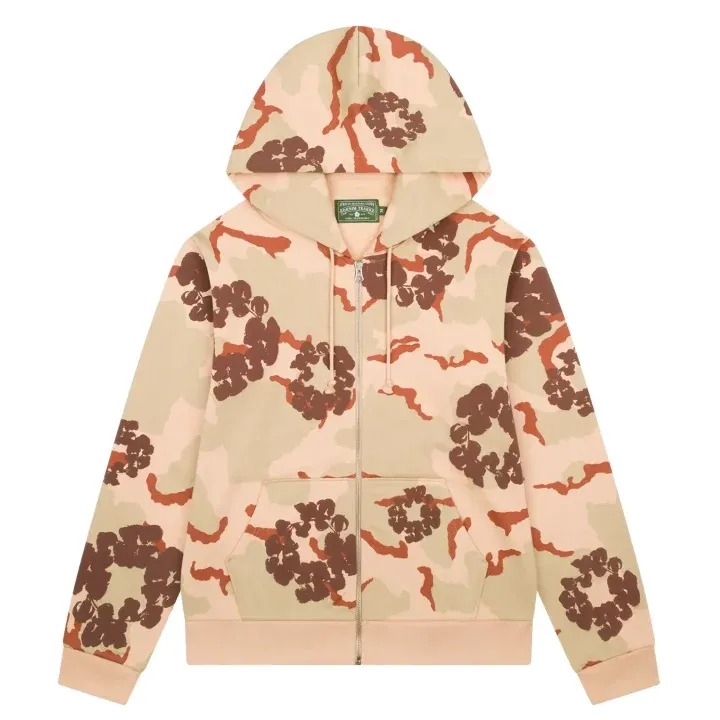
Denim Tears: The Story Behind the Brand That Turned
Denim Tears: The Story Behind the Brand That Turned Pain into Purpose
Introduction:
If you’ve ever scrolled through social media and spotted a pair of jeans with a white cotton wreath stitched across the thigh, you’ve encountered Denim Tears. But what makes this brand different from the countless streetwear labels competing for attention? The answer goes far deeper than fabric and fit.
Denim Tears isn’t just selling clothes. It’s selling a story. A story that many Americans weren’t taught in school. A story that founder Tremaine Emory believes needs to be told, one garment at a time.
Founded in 2019, Denim Tears has grown from a niche creative project into a cultural force generating “tens of millions” in annual revenue, doubling sales every year since its inception . And it did this without investors, without selling out, and without compromising its message.
Let’s break down everything you need to know about this brand—its origins, its symbolism, its most iconic pieces, and why it matters.
Who Is Tremaine Emory?
From Queens to the Fashion World
Tremaine Emory was born in Atlanta, Georgia in 1981 and raised in Jamaica, Queens, New York . His path to fashion wasn’t a straight line. His first job was on a J.Crew shop floor, followed by various retail positions at Marc Jacobs .
In 2010, Emory moved to London and co-founded No Vacancy Inn with Ade “Acyde” Odunlami and Brock Korsan—a creative collective that worked across fashion, art, music, and nightlife . This collective became his training ground, connecting him with influential figures across multiple creative industries.
The Resume Speaks Volumes
Before launching Denim Tear, Emory built an impressive resume. He served as art director-at-large at Stüssy, brand director of Yeezy, and creative director of GOOD Music in 2018 . In 2022, he was appointed creative director of Supreme—the streetwear juggernaut’s first major hire after being acquired by VF Corp for $2.1 billion .
His collaborators read like a who’s who of contemporary culture: Virgil Abloh, Frank Ocean, André 3000, Theaster Gates, and Hank Willis Thomas, among others .
But it was Emory’s departure from Supreme in August 2023—citing “systematic racism at play within the structure of Supreme”—that solidified his reputation as someone who would prioritize principles over profit .
The Birth of Denim Tears
A Name with Deep Meaning
The name “Denim Tears” isn’t random. It refers to Emory’s grandmother, who wore a denim apron while working, and to the collective struggle of African Americans throughout history . Denim—a fabric often called “Negro cloth” when worn by enslaved people in the West Indies and American colonies—becomes the canvas for Emory’s storytelling .
The Cotton Wreath: A Symbol of Remembrance
The brand’s most recognizable motif is the cotton wreath. This design, partially inspired by artist Kara Walker’s work, acknowledges the central role cotton farming played in the American slave trade .
The wreath appears across Denim Tears’ collections in various forms—screen prints, rhinestones, flocked patterns, and oxidized studs . It’s a powerful visual reminder of a painful history, transformed into something that sparks conversation every time someone wears it.
Levi’s x Denim Tears: A Historic Partnership
In 2020, Denim Tears Clothing partnered with Levi’s for their first collaboration, featuring the now-iconic Cotton Wreath 501 jeans . The collection told the story of cotton in the United States and its legacy intertwined with slavery. Pieces from this collection were exhibited at The Metropolitan Museum of Art’s “In America: A Lexicon of Fashion” exhibition .
The partnership continued with multiple seasons. Season 2 explored the history of the Gullah Geechee people and their forced labor in indigo dye production . Season 3 examined Black biker culture, drawing from Martin Dixon’s book Brooklyn Kings: New York City’s Black Bikers .
The most recent collaboration, Season 4, launched in April 2025, honored New Orleans and the Black Masking Indian tradition. Shot with members of the Young Seminole Hunters and Big Chief Demond Melancon, the collection featured photo-printed garments that captured the community in their ceremonial regalia .
What made this collection unique was the “intentional imperfection process” applied during printing—ensuring no two pieces were exactly alike, mirroring the handcrafted nature of Mardi Gras Indian costumes themselves .
Denim Tears Today: The Brand’s Evolution
Going In-House
In December 2025, Denim Tears debuted its first proprietary denim collection, marking a significant milestone in the brand’s evolution . After years of collaborating with Levi’s, Emory took full control of the denim production.
“Denim was originally called ‘Negro cloth’ worn by slaves in the West Indies and the Southern and Northern colonies in America,” Emory told Sourcing Journal . “The plan is to continue to make quality products from a genuine place.”
The in-house denim collection features baggy silhouettes and selvedge constructions in light washes—a continuation of the brand’s aesthetic while representing a new chapter of independence .
Critical Recognition
Denim Tears has achieved something rare: commercial success paired with institutional recognition. The brand’s pieces are held in the permanent collection of The Costume Institute at The Metropolitan Museum of Art . In 2026, the SCAD Museum of Art will present “Denim Tears from the Pool of Black Genius,” a retrospective exhibition showcasing Emory’s creative output alongside works by Jacob Lawrence, Romare Bearden, and Faith Ringgold .
This recognition places Denim Tears in the same conversation as artists and designers who have shaped American culture—not just fashion.
The Business of Meaning
Despite minimal retail distribution—primarily through Dover Street Market and its own flagship stores—Denim Tears has built a loyal following. On StockX, sales of Denim Tears items grew 290 percent in 2024 compared to 2023, with products selling 31 percent above retail on average in the first half of 2025 .
The brand’s flagship store in New York, called “African Diaspora Goods,” and its Atlanta location serve as physical spaces where the brand’s message comes to life . Expansion plans include Tokyo in 2026 and eventual stores in Atlanta, Chicago, Houston, Philadelphia, Portland, and Los Angeles .
Frequently Asked Questions About Denim Tears
1. What does Denim Tears stand for?
Denim Tears is a clothing brand that explores Black American history and the African diaspora through fashion, using denim and cotton symbolism to tell stories about slavery, resilience, and cultural heritage .
2. Who is the founder of Denim Tears?
Tremaine Emory founded Denim Tears in 2019. He was born in Atlanta, raised in Queens, and previously served as creative director of Supreme .
3. What is the Cotton Wreath motif?
The Cotton Wreath is Denim Tears’ signature design, symbolizing the role of cotton farming in the American slave trade and acknowledging the history of Black labor in the United States .
4. Is Denim Tears associated with Levi’s?
Yes, Denim Tears has collaborated with Levi’s on multiple collections since 2020. The partnership has produced four seasons of clothing, each exploring different aspects of Black American history .
5. Where is Denim Tears sold?
Denim Tears is available through its official website, Dover Street Market, and its African Diaspora Goods flagship stores in New York and Atlanta .
6. Why is Denim Tears so popular?
Denim Tears resonates because it combines high-quality streetwear with meaningful storytelling. Its limited distribution and powerful messaging have created strong demand in both retail and resale markets .
7. Did Denim Tears collaborate with Supreme?
No, Denim Tears did not collaborate with Supreme. However, founder Tremaine Emory served as Supreme’s creative director from 2022 to 2023 before resigning .
8. What materials does Denim Tears use?
Denim Tears primarily uses cotton and denim, materials historically significant to Black American labor and the slave trade. Recent collections have expanded into selvedge denim and various fabric treatments .
9. Is Denim Tears owned by a Black person?
Yes, Denim Tears was founded and is owned by Tremaine Emory, a Black American designer from Atlanta and Queens .
10. What makes Denim Tears different from other streetwear brands?
Denim Tears distinguishes itself through its commitment to telling overlooked stories from Black American history. Unlike brands that use graphics purely for aesthetics, Denim Tears embeds social narratives into every collection .
Conclusion:
In a world where fashion often prioritizes hype over substance, Denim Tears stands apart. Tremaine Emory has built something that matters—a brand that generates revenue while challenging customers to think about history, identity, and the stories that shaped America.
The cotton wreath isn’t just a logo. It’s a reminder. The denim isn’t just fabric. It’s a historical document. And Denim Tears isn’t just a clothing brand. It’s a platform for education, reflection, and cultural preservation.
Whether you’re a longtime collector or just discovering the brand, understanding the story behind Denim Tears adds meaning to every piece. These aren’t just clothes you wear. They’re stories you carry.