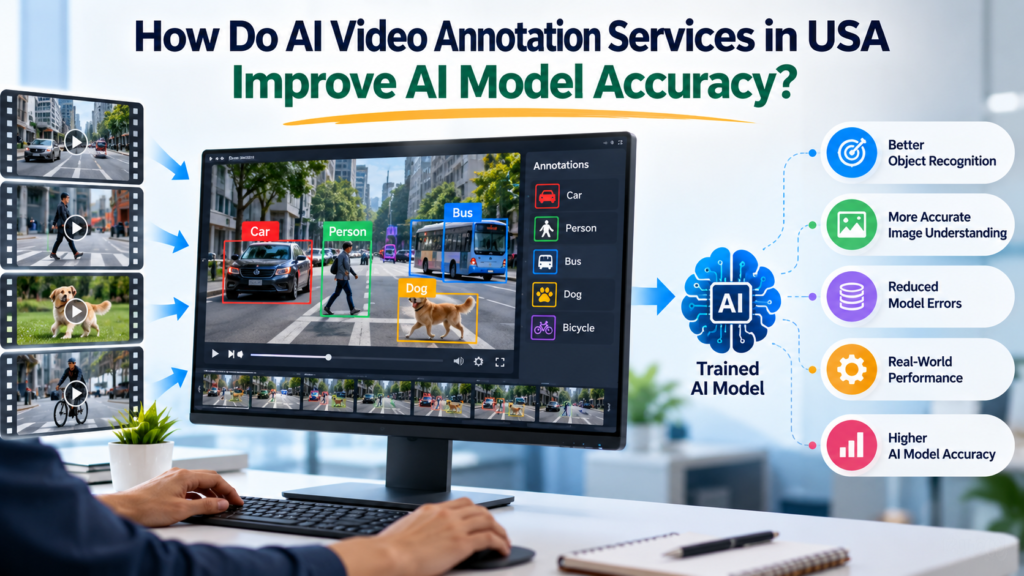
Artificial intelligence is becoming increasingly dependent on video data. From autonomous vehicles and smart surveillance to healthcare systems, retail analytics, robotics, and sports technology, AI models need to understand what is happening inside moving images. But collecting video is only the first step. The real challenge is teaching an AI system how to interpret that video correctly.
This is where AI Video Annotation Services in USA play an important role. Video annotation adds meaningful labels to objects, actions, movements, and events across video frames so machine learning models can learn from structured and accurately labeled data. When annotation is consistent and detailed, AI systems have a stronger foundation for recognizing patterns and making predictions.
For businesses developing computer vision solutions, the quality of training data can directly affect model performance. A model trained on incomplete, inconsistent, or poorly labeled videos may struggle when it encounters real-world situations. Professional annotation helps reduce these problems and creates datasets that are more useful for AI development.
Vision Infotech helps businesses prepare and manage high-quality datasets for AI and machine learning projects. In this article, we will explore how video annotation improves model accuracy, what the process involves, common annotation methods, and why professional expertise matters.
What Is Video Annotation?
Video annotation is the process of labeling objects, actions, movements, and other important elements within video content. These labels provide context that an AI model cannot automatically understand from raw footage.
For example, imagine a video recorded by a traffic camera. A human annotator may identify and label:
- Cars
- Buses
- Trucks
- Pedestrians
- Traffic signs
- Road lanes
- Vehicle movements
- Accidents or unusual events
The labels are applied across multiple frames because objects do not remain in the same position. This makes video annotation more complex than simply labeling a single image.
With AI Video Annotation Services in USA, businesses can create structured datasets that help computer vision systems understand both objects and changes over time.
Why Does Video Data Quality Matter for AI Models?
An AI model learns from the examples provided during training. If those examples contain inaccurate or inconsistent labels, the model can learn the wrong patterns.
Consider a pedestrian detection system. If pedestrians are incorrectly labeled in some frames or missed completely in others, the model may have difficulty recognizing people under different conditions.
The same principle applies to autonomous vehicles, security systems, warehouse robots, and medical video analysis.
High-quality annotation helps provide:
- More consistent training examples
- Better object recognition
- Improved movement tracking
- Greater consistency between frames
- Better handling of different environments
- More reliable model evaluation
This is why AI Video Annotation Services in USA can become an important part of an AI development workflow rather than being treated as a simple data-entry task.
How AI Video Annotation Services in USA Improve Model Accuracy
1. They Create Consistent Training Data
Consistency is one of the most important parts of machine learning data preparation.
Suppose one annotator labels the complete body of a person while another labels only the visible upper body. The resulting dataset contains different interpretations of the same object.
Professional annotation teams establish clear labeling guidelines before work begins. These guidelines define how objects should be identified, how partially visible objects should be handled, and how different events should be classified.
Consistent labels give the model a clearer learning pattern and reduce unnecessary variation within the dataset.
2. They Help AI Understand Objects Across Multiple Frames
A video is made up of a sequence of frames. An object can move, change direction, become partially hidden, or leave and re-enter the camera view.
Video annotation can track the same object across these frames. This is particularly important for applications that need to understand movement rather than simply identify objects.
For example, in a warehouse, an AI system may need to track a forklift moving between storage areas. Frame-by-frame annotation helps the model learn where the forklift is and how its position changes over time.
This temporal information can improve the model’s ability to understand real-world activity.
3. They Improve Object Detection
Object detection is a common computer vision task. The model needs to identify an object and determine its location within a frame.
Annotators may use bounding boxes, polygons, or other labeling techniques to identify objects precisely.
When the annotations accurately represent the object’s position, shape, and boundaries, the training dataset becomes more useful.
AI Video Annotation Services in USA can support object detection projects involving vehicles, people, products, machinery, animals, medical objects, and many other categories.
4. They Support Object Tracking
Object tracking goes beyond identifying something in a single frame. It requires the AI model to understand that an object appearing in consecutive frames is the same object.
For example, consider a retail store camera. A customer may walk from one aisle to another. A properly annotated dataset can help an AI system learn how to maintain the identity and movement of that customer across multiple frames.
Accurate tracking is useful for applications such as traffic monitoring, security analytics, robotics, sports analysis, and customer behavior research.
5. They Capture Actions and Events
Not every AI application needs to recognize objects alone. Some need to understand what people or objects are doing.
A video annotation project may label activities such as:
- Walking
- Running
- Falling
- Picking up an object
- Opening a door
- Driving
- Loading goods
- Operating equipment
These action labels help models learn relationships between frames.
For example, an AI safety system may need to distinguish between a worker standing normally and a worker falling. That difference cannot always be understood from one image. The sequence of movements provides the necessary context.
Common Types of Video Annotation
Bounding Box Annotation
Bounding boxes place rectangular labels around objects. They are widely used for object detection.
For example, every car in a traffic video can be surrounded by a box. The boxes can then be tracked as vehicles move through the scene.
Polygon Annotation
Polygon annotation provides more precise boundaries around irregular objects.
This can be useful when the exact shape of an object matters. For example, an AI system analyzing machinery or medical images may require more detailed boundaries than a simple rectangle can provide.
Semantic Segmentation
Semantic segmentation assigns a category to individual pixels.
In an autonomous driving dataset, different areas of an image could be labeled as road, vehicle, pedestrian, building, sky, or vegetation. This gives the AI model a more detailed understanding of the scene.
Instance Segmentation
Instance segmentation goes one step further by distinguishing individual objects within the same category.
For example, if five cars appear in a frame, each car can be separately identified rather than simply marking the entire area as “cars.”
Keypoint Annotation
Keypoints identify specific points on an object or person.
For human pose estimation, keypoints may represent the head, shoulders, elbows, wrists, knees, and ankles. This can help AI systems understand body position and movement.
The Role of Temporal Consistency
One major difference between image and video annotation is time.
A single image provides information about one moment. Video provides a sequence of moments. Therefore, labels must remain consistent as objects move.
If a person’s bounding box suddenly changes size or position without a corresponding movement in the video, the dataset can contain noise.
Professional AI Video Annotation Services pay attention to frame-to-frame consistency. This helps models learn realistic movement patterns instead of learning annotation errors.
Temporal consistency can be especially important for applications involving:
- Autonomous driving
- Security monitoring
- Sports analytics
- Industrial automation
- Robotics
- Traffic management
- Healthcare video analysis
How Video Annotation Works With AI Model Training
Video annotation is one part of a larger AI development process.
A typical workflow may begin with collecting suitable video data. The data is then reviewed, organized, and prepared for annotation. After that, annotators apply the required labels according to project guidelines.
The completed dataset may go through quality checks before being delivered to the machine learning team.
This is where AI Model Training Services in USA can complement annotation work. Once the dataset is prepared, machine learning professionals can use it to train, validate, and refine computer vision models.
The process is not simply about producing a large quantity of labels. The goal is to produce relevant, accurate, and consistent training data.
Video Annotation vs. Image Annotation
Video and image annotation are closely related, but they serve different data requirements.
AI Image Annotation Services in USA generally focus on individual images. Annotators identify objects, boundaries, categories, or other visual features within a static frame.
Video annotation includes these same concepts but adds the dimension of time.
For example, an image annotation project might identify a person standing next to a vehicle. A video annotation project can show how that person approaches the vehicle, opens the door, enters, and drives away.
Both approaches can be useful depending on the AI application.
When a business needs a computer vision model to understand movement, sequence, or behavior, video data can provide information that individual images cannot capture.
Real-World Example: AI for Traffic Monitoring
Consider a company developing an intelligent traffic monitoring system.
Raw traffic videos may contain hundreds of vehicles, pedestrians, cyclists, traffic signals, and other objects. The AI model needs to recognize these elements and understand how they move.
A professional annotation team can label vehicles across frames, identify pedestrians, mark lanes, and classify specific traffic events.
The resulting dataset can then be used to train a model for vehicle detection and movement analysis.
If the annotations are inconsistent, the model may struggle with crowded roads, changing lighting, or partially blocked vehicles. More carefully prepared data gives the development team a stronger foundation for testing and improvement.
What Makes High-Quality Video Annotation Effective?
Clear Annotation Guidelines
Every project should have defined instructions. These guidelines should explain categories, edge cases, object boundaries, and difficult scenarios.
Quality Control
Annotation should include review processes. A second reviewer or quality assurance team can identify incorrect labels before the dataset reaches the model training stage.
Handling Difficult Video Conditions
Real-world videos are rarely perfect. They may contain:
- Motion blur
- Poor lighting
- Occlusion
- Low resolution
- Crowded scenes
- Camera movement
- Partial objects
An experienced annotation team needs clear rules for handling these situations.
Scalable Workflows
AI projects can involve thousands or millions of frames. The annotation workflow should therefore be designed to handle large datasets without sacrificing consistency.
This is another reason businesses use AI Video Annotation Services in USA when internal teams do not have the resources or specialist workflows required for large annotation projects.
How Businesses Can Get More Value From Video Annotation
Simply outsourcing annotation does not guarantee a useful dataset. Businesses should first define what their AI model needs to learn.
For example, a company building a worker safety system should determine whether it needs labels for people, helmets, equipment, falls, restricted areas, or specific actions.
The annotation strategy should then be designed around those objectives.
Businesses should also establish quality metrics, review samples regularly, and update annotation guidelines when new edge cases appear.
A practical approach is to start with a representative sample of videos, identify annotation challenges, refine the guidelines, and then scale the project.
Why Choose Vision Infotech for AI Video Annotation?
Vision Infotech understands that AI projects depend heavily on the quality of the data behind them. Our approach focuses on creating organized, accurate, and application-specific datasets rather than treating annotation as a simple labeling exercise.
Businesses can work with Vision Infotech when they need support with video annotation, image annotation, data preparation, and AI-focused workflows.
Industry-Focused Annotation
Different industries require different labeling approaches. A traffic dataset has different requirements from a healthcare, retail, manufacturing, or robotics dataset. Vision Infotech can structure annotation workflows around the intended AI application.
Quality-Focused Processes
Annotation quality can affect downstream model development. Vision Infotech focuses on clear instructions, consistent labeling, review processes, and dataset organization.
Support for Different Annotation Requirements
Projects may require bounding boxes, polygons, segmentation, keypoints, object tracking, or activity labeling. The right approach depends on the model and use case.
Scalable Data Workflows
As AI projects grow, the amount of training data can increase quickly. Vision Infotech can support businesses that need structured annotation workflows for larger datasets.
Connected AI Data Services
Video data may be only one part of an AI project. Businesses may also need image annotation, data preparation, and model training support. Combining these services can create a more connected workflow from raw data to AI development.
Key Benefits of Professional AI Video Annotation
When implemented properly, AI Video Annotation Services can provide several practical benefits for AI development.
They can help businesses create more consistent datasets, improve object recognition, support movement tracking, identify activities, and reduce errors caused by poor labeling.
More importantly, professional annotation gives machine learning teams cleaner information to work with. This can make model development more structured because developers are not constantly dealing with unclear or unreliable training examples.
The exact improvement in model accuracy will depend on the application, dataset, model architecture, and evaluation method. Annotation quality is an important factor, but it is not the only factor determining final model performance.
Final Thoughts
AI systems do not learn directly from raw video in the same way humans understand a scene. They need structured examples that explain what objects are present, where they are located, and how they behave over time.
That is why AI Video Annotation Services in USA have become an important part of many computer vision workflows. Accurate bounding boxes, segmentation, keypoints, object tracking, and activity labels can give machine learning models the information they need to recognize patterns more effectively.
For businesses developing computer vision applications, the focus should be on more than simply producing a large volume of annotations. Clear guidelines, consistent labeling, quality checks, suitable annotation methods, and an understanding of the final AI use case all matter.
When combined with AI Model Training Services in USA and AI Image Annotation Services in USA, video annotation can become part of a complete data-to-AI workflow.
Vision Infotech helps businesses build structured data workflows designed around their AI requirements. Whether the goal is computer vision, automation, object detection, video analytics, or another AI application, starting with reliable training data gives the development process a stronger foundation.