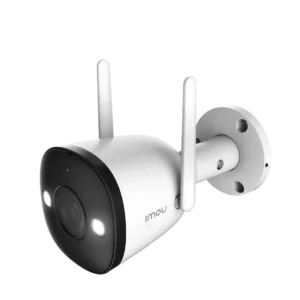
Off-grid in this context doesn’t mean no electricity exists anywhere nearby — it means the specific spot the camera needs to watch has no practical access to it: a boundary wall, a detached gate, a field edge, a rooftop corner far from any socket. Both a standalone Battery Camera and a solar-assisted one solve the immediate installation problem the same way, with no cable run needed. The difference only shows up afterward, in how much ongoing attention each one demands to keep running.
Two Different Products Solving the Same Starting Problem
A standalone battery camera runs entirely on its internal charge, recharged manually by removing it or plugging in a cable, with no ongoing power input otherwise. A solar-assisted camera pairs the same kind of battery with a small panel that trickle-charges it during daylight hours, aiming to offset or eliminate the need for manual recharging. Both still need wifi to transmit video and alerts — “off-grid” here refers only to the power source, not the connectivity method.
How Long a Standalone Battery Camera Actually Lasts
Battery duration depends far more on usage pattern than on battery size alone. A camera using motion-triggered recording, where it sits in low-power standby until it detects movement, lasts considerably longer between charges than one recording continuously, since continuous recording keeps the sensor, processor, and wifi radio active almost constantly. A unit like the EZVIZ CB3 Standalone Smart Home Battery Camera illustrates the category well — no solar panel included, so its entire runtime comes from the internal battery alone, recharged manually when needed.
A quiet spot with occasional motion might run such a camera for a month or more before needing a recharge. A busy location with frequent triggers can need recharging every one to two weeks. Cold or very hot conditions also reduce battery efficiency, which shortens runtime further compared to the manufacturer’s best-case rating.
What Solar Actually Changes
A solar panel doesn’t change how much power the camera itself draws — it changes whether that drain needs to be manually replaced. The Imou Cell PT Kit 3MP Wifi Solar camera bundles a pan-tilt battery camera with a solar panel specifically to offset this draw automatically, so that under reasonable daylight conditions, the battery stays topped up without anyone needing to visit the camera to recharge it.
This only works as well as the sunlight the panel actually receives. A panel in full, unobstructed sun for a meaningful part of the day can keep a camera running indefinitely without manual intervention. A panel in partial shade, or one facing a direction that gets limited direct sun, offsets less of the battery drain and may still require occasional manual charging, particularly during long stretches of overcast weather.
Why “Lasts Longer” Means Different Things for Each
For a standalone battery camera, “lasts longer” is a countdown — a fixed number of days or weeks before the battery needs attention, after which the camera stops working if nothing is done. For a solar-assisted camera in a genuinely good sun position, the more relevant question shifts from “how long until it dies” to “how reliably does the panel keep pace with the camera’s draw” — a system that, done right, doesn’t really run out in any meaningful sense, as long as the panel keeps receiving sunlight.
This means a fair comparison isn’t really solar versus battery in the abstract — it’s whether the specific mounting spot has enough reliable sun exposure to make solar’s advantage real. A solar camera mounted somewhere shaded most of the day behaves, in practice, much like a standalone battery camera that happens to recharge itself a little faster than it otherwise would, without ever fully escaping the need to check on it.
Weather and Seasonal Considerations for Solar Charging
Monsoon season and extended cloudy stretches reduce how much a solar panel can charge, even on a panel with otherwise good positioning. This doesn’t mean the camera stops working during these periods — the battery still holds whatever charge it had — but it does mean the margin solar normally provides narrows considerably, and a panel that comfortably keeps pace with camera use in summer sun might fall behind during a stretch of overcast days, requiring the same kind of manual check a standalone battery camera would need anyway.
For a property in a region with longer cloudy seasons, or a mounting spot with only moderate sun exposure, it’s worth treating solar as a meaningful extension of battery life rather than a guarantee of never needing to check the camera at all.
Maintenance Habits: The Practical Day-to-Day Difference
A standalone battery camera requires an ongoing habit — checking the charge level periodically through the app and recharging or swapping the battery before it fully depletes. Some households find this easy to forget until the camera goes offline unexpectedly, at which point there’s a gap in coverage until someone notices and addresses it.
A solar-assisted camera in a good position largely removes this task, replacing it with an occasional check that the panel is clean and unobstructed — dust, leaves, or bird droppings accumulating on the panel surface over time can gradually reduce charging efficiency, which is a different, lower-effort kind of maintenance than tracking and recharging a battery on a schedule.
Mounting Considerations Specific to Each Option
A standalone battery camera’s mounting position only needs to satisfy coverage and wifi signal requirements, since there’s no sun-exposure constraint to factor in — this gives more flexibility in placement, including shaded or north-facing spots where solar wouldn’t perform well anyway. A solar camera’s position needs to satisfy coverage, wifi signal, and meaningful daylight exposure simultaneously, which can sometimes conflict with the ideal coverage angle — the best vantage point for watching an area isn’t always the spot with the best sun exposure, and compromises between the two are common in real installations.
Cost Comparison Between the Two Approaches
A solar-bundled camera generally costs more upfront than an equivalent standalone battery model, reflecting the added panel hardware and solar charging circuitry. Whether that extra cost is worthwhile depends on how much manual recharging a standalone unit would otherwise require at that specific location — for a hard-to-reach mounting point, like a remote boundary wall or an elevated position requiring a ladder each time, the convenience of not needing to physically retrieve and recharge the camera regularly can easily justify the solar premium. For an easily accessible spot where swapping or recharging a battery takes a few minutes, a standalone battery camera’s lower upfront cost may be the more practical choice.
Which Option Fits a Genuinely Off-Grid Spot Better
For a remote, hard-to-reach position with decent, unobstructed sun exposure — a boundary wall, a detached gate, a field-facing camera — solar is generally the better long-term fit, since it minimizes the need to physically visit a location that’s inconvenient to reach regularly. For a spot that’s easy to access even without power nearby, or one that doesn’t get reliable direct sun due to shading or orientation, a standalone battery camera with a straightforward manual recharge routine is often simpler and avoids paying for solar hardware that won’t perform to its potential in a shaded position.
Choosing Based on the Actual Spot, Not a General Preference
Neither option is universally the better choice — the right one depends on two things specific to the exact mounting location: how reachable the spot is for periodic manual recharging, and how much reliable sunlight that spot actually gets throughout the year. A remote, sun-exposed position favors solar. An accessible position, or one with limited sun regardless of remoteness, often does just as well with a standalone battery camera and a simple recharge habit. Matching the camera type to what the specific CCTV camera in the Pakistan installation spot can realistically support — access, sunlight, and how often someone can reasonably check on it — determines which one actually keeps running longer in practice, not a general assumption that solar always wins.