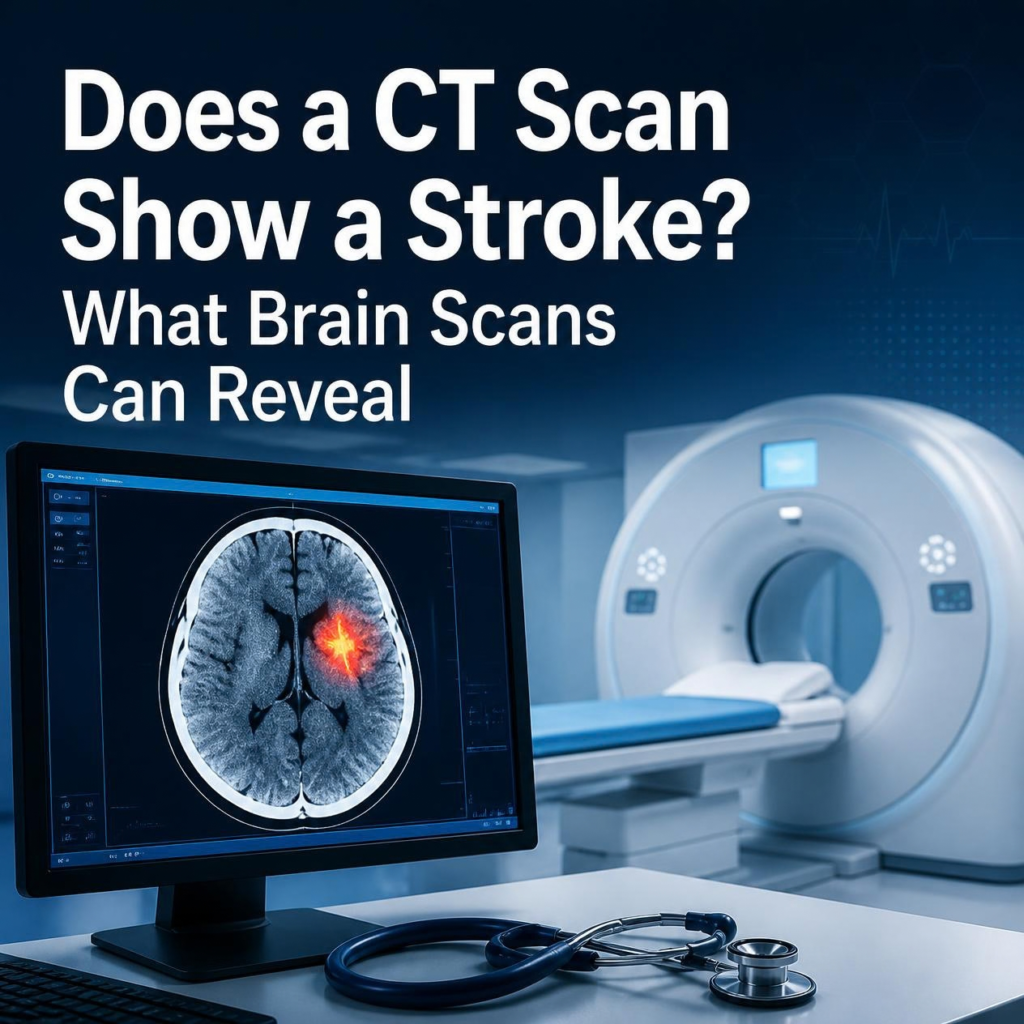
When someone has possible stroke symptoms, doctors often need to look inside the brain quickly.
One of the tests commonly used is a CT scan.
A CT scan can provide important information about what may be happening in the brain.
But can it always show a stroke?
The answer is a little more complicated.
A CT scan can help doctors identify certain types of stroke and can also help rule out other serious problems.
However, some strokes may not be clearly visible on an early CT scan.
What Is a CT Scan?
CT stands for computed tomography.
A CT scan uses X-rays and a computer to create detailed images of the inside of the body.
For a brain scan, the machine takes images of the head and brain.
The test is usually quick, which makes it useful during a suspected stroke.
Why Is a CT Scan Used During Stroke?
When a person arrives at the hospital with possible stroke symptoms, doctors need to know what is happening as quickly as possible.
One important question is whether the stroke is caused by a blocked blood vessel or bleeding.
A CT scan can help doctors identify bleeding in the brain.
This information is important because treatment for bleeding can be very different from treatment for a blocked blood vessel.
Can a CT Scan Show a Blood Clot?
A standard CT scan may not always clearly show the actual blood clot during the earliest stage of an ischemic stroke.
However, it can still provide useful information.
Doctors may look for early changes in the brain and may use other imaging tests when necessary.
A CT scan is therefore still an important part of emergency stroke evaluation.
What Does a CT Scan Show?
A CT scan can help doctors look for:
- Bleeding in the brain
- Signs of brain swelling
- Some areas of brain damage
- Other conditions that may cause similar symptoms
- Certain changes in blood vessels when special CT techniques are used
The exact information depends on the type of CT scan performed.
What Is a CT Angiogram?
Sometimes doctors use a special CT scan called a CT angiogram.
It can provide images of blood vessels.
This may help doctors identify a blocked or narrowed blood vessel.
A contrast material may be used to make blood vessels easier to see.
The healthcare team decides whether this test is appropriate.
What Is CT Perfusion?
Another specialized test is CT perfusion.
It can provide information about blood flow through areas of the brain.
This may help doctors understand which brain tissue has been affected and which areas may still have the potential to benefit from treatment.
Not every patient needs this type of scan.
The decision depends on the situation and the hospital’s available technology.
Can an Early CT Scan Be Normal?
Yes.
A person can have stroke symptoms even when an early standard CT scan does not show obvious brain damage.
This is especially possible with some ischemic strokes during the early period.
That does not mean the symptoms are not real.
Doctors may use the person’s symptoms, medical history, examination, and other tests to make a diagnosis.
What About an MRI?
An MRI uses a different type of technology to create images of the brain.
MRI can be very useful for detecting certain types of brain injury.
It can sometimes show an ischemic stroke more clearly than a standard CT scan.
However, MRI is not always the first test used during an emergency.
CT is often quicker and more widely available.
The doctor chooses the imaging method based on the person’s condition and the information needed.
Why Can’t Doctors Use Symptoms Alone?
Stroke symptoms can sometimes look like other medical problems.
For example, weakness, confusion, dizziness, or speech problems can have different causes.
Brain imaging helps doctors understand what is happening.
This is important because the wrong treatment can be harmful.
The scan is only one part of the evaluation.
Does a CT Scan Take Long?
A standard brain CT is usually a quick test.
The patient lies on a table that moves through the scanner.
The machine takes images of the head.
The process itself may only take a short amount of time.
In an emergency, speed is one of the reasons CT is commonly used.
Is a CT Scan Painful?
A standard CT scan is generally not painful.
The patient usually needs to lie still during the scan.
If contrast material is used for certain CT tests, it is given according to the medical team’s instructions.
The healthcare team will explain the procedure and any preparation needed.
What Happens After the CT Scan?
Doctors review the images along with the patient’s symptoms and other test results.
They may decide whether more imaging is needed.
Treatment depends on the type of stroke and the patient’s condition.
The patient may also receive blood tests, heart tests, and other examinations.
Can CT Detect Every Stroke?
No imaging test is perfect in every situation.
A CT scan is very useful, particularly for identifying bleeding and evaluating the brain during an emergency.
However, some early ischemic strokes may not be clearly visible on a standard CT scan.
Doctors consider the complete clinical picture rather than relying on one image alone.
Should You Wait for a CT Scan Before Seeking Help?
No.
If someone suddenly develops signs of a stroke, emergency medical help should be sought immediately.
Do not wait for a scan to confirm that something is wrong.
The medical team will decide which tests are needed.
The sooner the person reaches medical care, the sooner the evaluation can begin.
Final Thoughts
A CT scan is an important tool doctors use when a stroke is suspected.
It can help identify bleeding, show certain brain changes, and provide valuable information about the brain and blood vessels.
However, an early standard CT scan may not clearly show every ischemic stroke.
Doctors may use additional tests, such as specialized CT scans or MRI, when needed.
If someone suddenly develops weakness, facial drooping, speech problems, vision changes, severe headache, dizziness, or difficulty walking, seek emergency medical care immediately.
Do not wait for the symptoms to disappear.
This article is for general information and does not replace advice from a qualified healthcare professional. If you want more simple and useful health tips, read more health blogs on Wisdom Sparkle.