Introduction
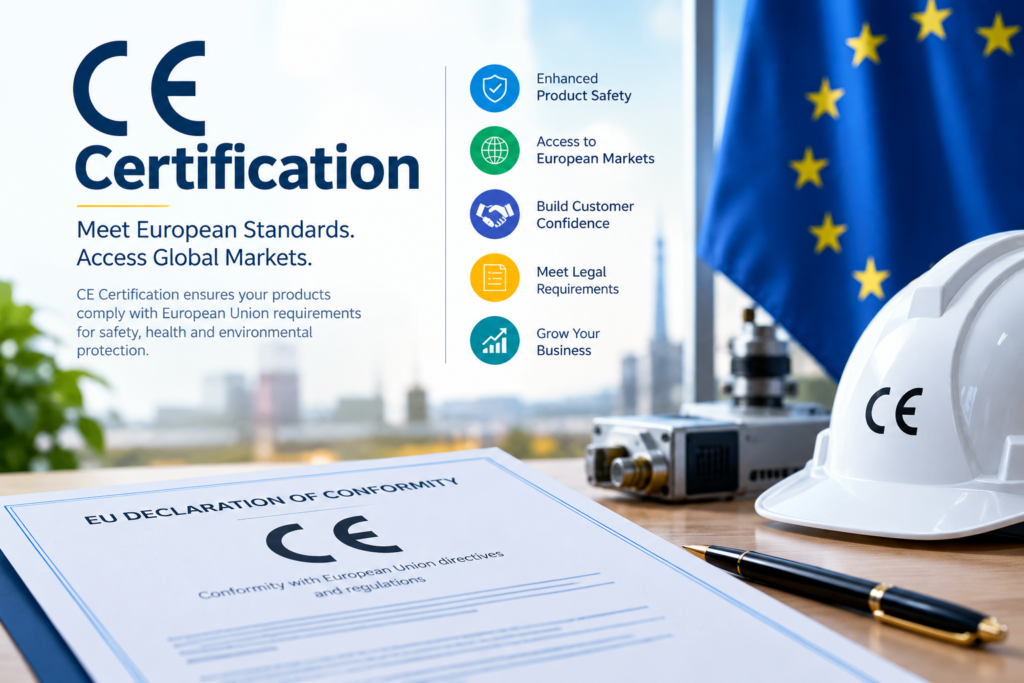
CE Certification is an important requirement for many products sold within the European Economic Area (EEA). It indicates that a product meets the applicable European Union requirements for safety, health, and environmental protection. Manufacturers planning to enter European markets must understand the CE marking process and determine which regulations apply to their products. Proper compliance helps businesses demonstrate responsibility, improve market access, and build customer confidence.
What Is CE Certification?
CE Certification, commonly associated with CE marking, demonstrates that a product conforms to the applicable EU legislation. The CE mark allows products covered by relevant legislation to be placed on the European market when all necessary conformity requirements are satisfied.
Products that may require CE marking include electrical and electronic equipment, machinery, toys, personal protective equipment, medical devices, and certain construction products. However, CE marking is not mandatory for every product. Requirements depend on the product category and the legislation that applies.
Manufacturers are responsible for identifying relevant requirements, conducting appropriate conformity assessments, preparing technical documentation, and issuing an EU Declaration of Conformity when required.
Why Is CE Certification Important?
CE marking plays an important role in helping manufacturers demonstrate that their products meet applicable European requirements. It supports access to the European market and helps businesses establish a structured approach to product compliance.
Key benefits include:
- Market access: Helps eligible products enter European markets when applicable requirements are fulfilled.
- Product safety: Encourages manufacturers to identify and address relevant safety risks.
- Customer confidence: Demonstrates attention to applicable regulatory requirements.
- Legal compliance: Helps businesses meet their responsibilities under relevant EU legislation.
- Business opportunities: Supports manufacturers and exporters seeking European customers and distributors.
CE marking does not automatically guarantee product quality or acceptance in every country. Businesses must ensure that their products meet all applicable legal and technical requirements.
Which Products Require CE Marking?
CE marking applies to specific product groups regulated by EU legislation. These may include machinery, low-voltage electrical equipment, radio equipment, toys, personal protective equipment, medical devices, and construction products covered by relevant rules.
For example, an electrical equipment manufacturer may need to assess electrical safety and electromagnetic compatibility. A machinery manufacturer may need to address hazards associated with moving parts, operation, and maintenance.
Before beginning the process, businesses should identify the product’s intended use, relevant legislation, applicable standards, and conformity assessment procedure. This step helps prevent unnecessary testing and documentation errors.
Steps Involved in the CE Certification Process
Although the exact procedure varies by product, the process generally involves several important stages.
1. Identify applicable legislation: Determine which EU directives or regulations apply to the product.
2. Assess product risks: Identify potential hazards and establish suitable measures to address them.
3. Meet technical requirements: Apply relevant harmonised standards where appropriate and demonstrate conformity with essential requirements.
4. Conduct testing and assessment: Complete the necessary evaluations, tests, or conformity assessment procedures. Some products require involvement from a notified body.
5. Prepare technical documentation: Compile design information, risk assessments, test reports, and other required evidence.
6. Issue the Declaration of Conformity: Prepare and sign the EU Declaration of Conformity when required.
7. Affix the CE marking: Place the marking on the product, packaging, or accompanying documents as permitted by the applicable legislation.
Who Needs CE Certification?
CE marking is relevant to manufacturers, importers, authorised representatives, and distributors involved in supplying regulated products to the European market. Manufacturers outside the EU, including businesses in India and other exporting countries, may also need to meet CE marking requirements before selling applicable products in Europe.
Understanding these responsibilities helps businesses prepare documentation, coordinate testing, and avoid compliance delays.
Conclusion
CE Certification is an important part of European regulatory compliance for many product categories. By identifying applicable legislation, assessing risks, completing required evaluations, and maintaining technical documentation, businesses can demonstrate conformity and prepare their products for the European market. A clear understanding of CE marking requirements helps manufacturers reduce compliance risks, strengthen customer confidence, and pursue international business opportunities.