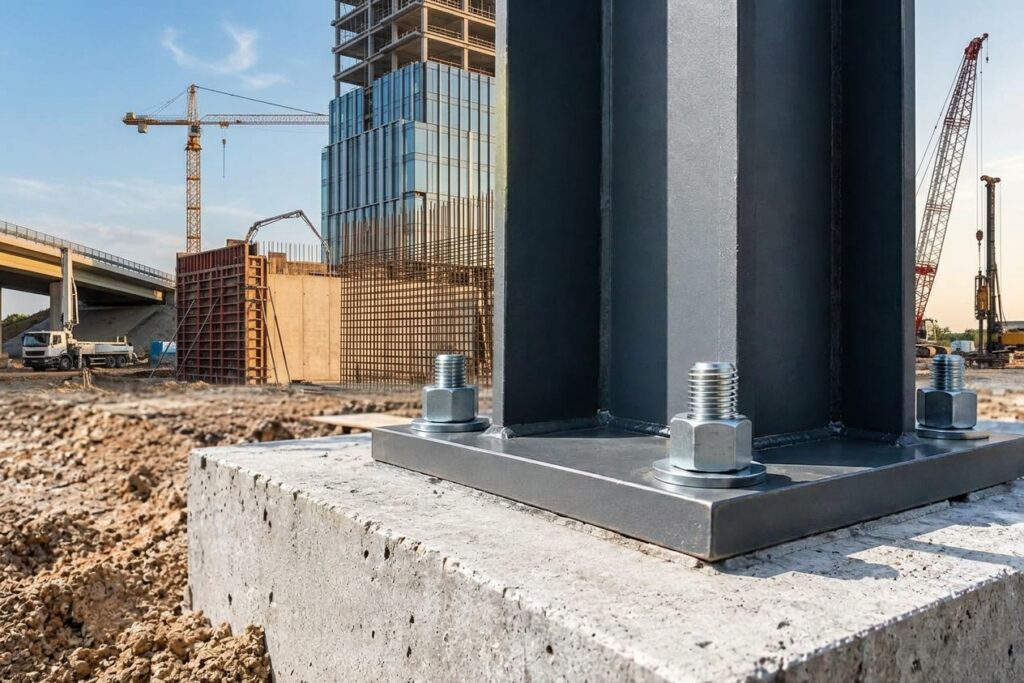
Look at an anchor bolt and it seems almost too simple: a steel rod, a thread, a nut. Yet the physics behind it involves steel mechanics, concrete fracture, friction, and even chemistry. Understanding that science is what separates a connection that merely fits from one that is truly reliable.
Load moves into concrete by bearing, not grip
Many people assume a bolt holds because concrete grips its shaft. For most cast-in Anchor Bolts, that isn’t the main mechanism. The head or plate at the buried end bears against the concrete as the bolt is pulled, much like a hook catching on a ledge. The concrete resists in compression, and as the load rises, a cone-shaped chunk of concrete can break away. Engineers commonly idealize that cone at roughly 35 degrees from the surface.
This is why embedment depth and edge distance matter so much. They determine how much concrete is available to resist the pull. A short bolt or one near an edge has a smaller cone, and therefore less capacity.
The steel side: yield, stretch, and thread area
Steel is predictable, so designers generally want it to be the part that yields first. A ductile bolt stretches and shows distress before it breaks, while concrete failure can be sudden.
One detail often overlooked is that tension capacity is calculated from the tensile stress area of the threaded section, which is smaller than the plain shank. The bolt is only as strong as its thinnest cross-section, and that’s usually at the threads.
Shear and the problem of stand-off
In shear, the bolt bears against the base plate hole, bends slightly, and pushes on the concrete near the surface. Leveling nuts and thick grout pads create a gap that acts like a lever arm, which increases bending in the bolt. For that reason, codes such as ACI 318 reduce shear capacity where grout pads are used.
Friction between the plate and grout can carry some shear while the plate is pressed down. But that help disappears if the load reverses or uplift occurs, so critical designs don’t depend on it.
Why tightening is physics, not habit
Tightening a nut stretches the bolt slightly and squeezes the joint together. Where pretension is specified, that clamping force keeps the plate from separating, and it means the bolt sees only a fraction of each load cycle. That can improve fatigue life considerably.
Without it, a vibrating machine can work the nut loose and subject the bolt to the full swing of every cycle. Fatigue cracks tend to start at stress concentrations, commonly the thread root, which is why thread quality matters. Rolled threads generally resist fatigue better than cut ones. All of this explains why serious projects specify and record a tightening procedure instead of leaving it to feel.
Corrosion is chemistry at work
Concrete is naturally alkaline, which forms a thin protective film on embedded steel. Chlorides, common in coastal and Gulf environments, can break that film down, and moisture trapped beneath a base plate speeds the process.
Hot-dip galvanizing helps because zinc corrodes in place of the steel, protecting it for a long time. Stainless steel suits harsher conditions. Whichever protection you choose, the vulnerable spot is still where the bolt leaves the concrete, since water, oxygen, and salts all meet there. That’s the area to inspect first.
From calculation to specification
Good science only helps if the product matches the calculation. Check the steel grade, thread form, coating, and test certificates, with ASTM F1554 being a widely specified standard for anchor rods. Ask for mill certificates so the material can be traced.
Suppliers vary in what they make and document, so compare them on certification, testing, and size range. In the Gulf, manufacturers such as Petrofast Middle East FZC, which lists stud anchors among its products, are among those serving industrial and infrastructure projects. Whoever you choose, check the paperwork against the specification before installation, not after.
What to remember
A strong structure begins where it meets the ground, and that connection works because of several principles working together: bearing and breakout in the concrete, ductile behavior in the steel, controlled shear and stand-off, proper tightening, and protection against corrosion. Overlook any one, and the others can’t fully make up for it.
The next time you see a tall frame, tank, or tower, remember that its stability depends on a few threaded rods doing precise mechanical work out of sight. Always follow the project engineer’s specifications and the applicable code.