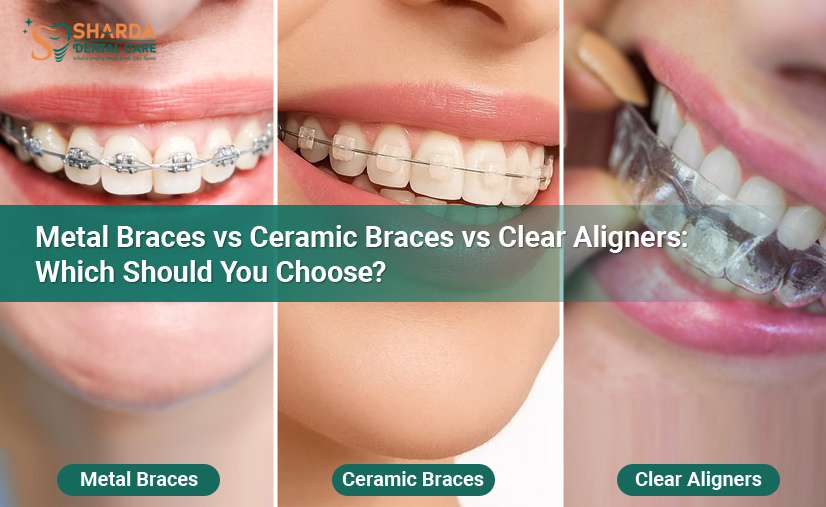
Straightening your teeth is a big commitment, and choosing between braces and aligners isn’t easy. One friend swears by invisible trays, your dentist mentions metal, and a quick search throws ceramic into the mix. This guide breaks down metal braces vs ceramic braces vs clear aligners in plain language, covering looks, comfort, cost and treatment time, so you can walk into your consultation at Sharda Dental Care knowing exactly what to ask.
The Quick Answer
Metal braces are the most affordable and can fix almost any alignment problem. Ceramic braces work the same way but use tooth-coloured brackets, so they are harder to spot and cost a little more. Clear aligners are removable, nearly invisible trays that suit mild to moderate cases, as long as you wear them 20 to 22 hours a day. The right pick depends on your teeth, your lifestyle and your budget, and only an orthodontic check-up can confirm it.
What Are Metal Braces?
Metal braces use small stainless-steel brackets joined by a thin wire that gently guides your teeth into position. You visit the clinic every four to eight weeks for adjustments.
- Pros: They treat crowding, gaps, deep overbites and underbites. They are fixed, so there is nothing to forget. They are tough and usually the lowest-cost option.
- Cons: They are the most visible choice. Teeth feel sore for a few days after each adjustment, you need to avoid sticky and hard foods, and brushing takes longer.
What Are Ceramic Braces?
Ceramic braces work exactly like metal ones, but the brackets are tooth-coloured or clear, often paired with a white wire. From a normal talking distance, many people won’t notice them.
- Pros: They are discreet, fixed, and can handle many complex cases.
- Cons: They cost more than metal. The brackets are more brittle, the elastic ties can pick up stains from chai, coffee and curry, and the brackets are slightly bulkier.
They are a popular middle path for older teens and adults who want fixed braces with a quieter look.
What Are Clear Aligners?
Clear aligners are thin, transparent trays made from a digital scan of your teeth. Every one to two weeks you switch to a new set, and each one moves your teeth a little further.
- Pros: They are nearly invisible and removable, so you can eat freely and brush and floss as usual. With no brackets, there is nothing to poke your cheeks.
- Cons: They only work if worn 20 to 22 hours a day. Trays can be lost, severe bite problems may need fixed braces, and aligners are usually the costliest option.
Metal Braces vs Ceramic Braces vs Clear Aligners: Side-by-Side
Here is how the three stack up at a glance.
| Feature | Metal Braces | Ceramic Braces | Clear Aligners |
| Visibility | Most visible | Less visible | Nearly invisible |
| Removable | No | No | Yes |
| Best for | Most cases, including complex ones | Adults and teens wanting a discreet fixed option | Mild to moderate cases |
| Relative cost | Lowest | Medium | Usually highest |
| Typical duration | 12 to 24 months | 12 to 24 months | 6 to 18 months (mild cases) |
| Food restrictions | Yes | Yes | No, remove to eat |
Which Option Suits Which Person?
Treat these as starting points, because your examination and X-rays make the final call.
- Teenagers: Metal braces are a safe choice since they can’t be left in a school bag. Aligners work only if your teen will truly wear them.
- Working adults: Ceramic braces or aligners keep things discreet at the office.
- Complex bite problems: Severe crowding, big overbites and crossbites are usually best treated with fixed braces, metal or ceramic.
- Tight budget: Metal braces deliver excellent results at the lowest cost.
- Prefer removable treatment: Only aligners come out, as long as you can trust yourself with the wear time.
How Much Do They Cost and How Long Do They Take?
There is no single price for any of these treatments, so be careful of anyone quoting one before seeing your teeth. Broadly, metal costs the least, ceramic sits higher and aligners tend to be the most expensive. The final figure depends on how complex your case is, how long treatment lasts, the brackets or aligner brand, and extras such as cleaning, fillings, extractions and retainers.
When comparing quotes, ask one question: what is covered from my first visit to my last retainer? A low headline number can hide a lot.
Braces usually take 12 to 24 months, and ceramic follows a similar timeline to metal. Mild aligner cases can finish sooner, but only if the trays are worn properly every day.
Protect Your Teeth During Treatment
Whichever option you choose, cleanliness matters. Food trapped around brackets or under trays builds up plaque quickly. Follow a solid daily oral hygiene routine and learn the difference between plaque and tartar so small problems don’t turn into big ones.
If you have cavities or gum issues, they should be treated before straightening begins, and restorative dentistry can get your teeth ready. Once your teeth are aligned, many patients finish with whitening or other cosmetic dentistry in Indirapuram for a complete smile makeover. And remember your retainer, because teeth tend to drift back without one.
Why Choose Sharda Dental Care?
At Sharda Dental Care in Indirapuram, Ghaziabad, led by Dr Sharda Bhat Sarup with over 25 years of experience, all three treatments are available. That means your case is weighed on its own merits, not matched to whatever a clinic happens to offer.
Still unsure about metal braces vs ceramic braces vs clear aligners? Book a consultation and get an answer based on your own teeth.
Frequently Asked Questions
Which is better, braces or clear aligners?
It depends on your teeth and habits. Aligners suit mild to moderate cases and people who can stay disciplined. Braces are better for complex problems or if you might forget to wear trays.
Are ceramic braces more expensive than metal braces?
Usually yes, because tooth-coloured ceramic costs more than steel. Still, the difficulty and length of your treatment affect the final bill more than the bracket material does.
Can adults get braces or clear aligners?
Yes. Age is rarely the issue; healthy gums and bone matter far more. Many adults choose ceramic braces or aligners for a discreet look.
How long does orthodontic treatment take?
Braces typically take 12 to 24 months, while simple aligner cases can be quicker. Your age, gum health and how well you follow instructions all change the timeline.
Do I need a retainer after treatment?
Yes. A retainer, either a thin glued wire or a removable clear one, stops your teeth from moving back. Most people wear one in some form for years.
This article is for general information only and is not a substitute for a dental check-up. Please consult Dr Sharda Bhat Sarup or a qualified dentist before starting orthodontic treatment.