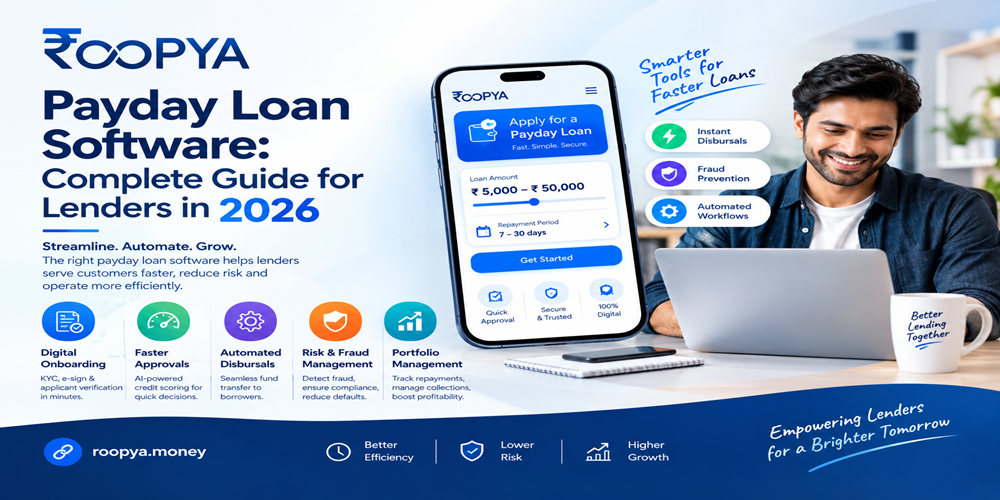
Complete 2026 guide to payday loan software for lenders: features, risk, compliance, AI, costs and how to choose. See how Roopya helps.
Payday lending runs on speed and thin margins. Loans are small, tenures are short and borrowers expect money in their account within minutes of applying. A lender that takes a day to decide, or spends more servicing a loan than it earns on it, will not last long. That is why the software behind a payday loan business matters as much as the capital behind it.
Payday loan software is the system that runs the whole product: application, verification, underwriting, disbursal, repayment and collections. The right platform lets a lender approve good borrowers instantly, keep fraud and defaults low, stay within regulatory limits and grow volumes without growing headcount at the same rate.
This guide is written for NBFCs, banks, microfinance institutions, fintech apps and loan service providers that are evaluating or replacing their payday and salary-advance systems in 2026. It explains how the software works, which features matter, how automation and AI change risk decisions, what to check on compliance, and how to choose and roll out a platform. It also shows where Roopya fits.
Key takeaways
- Payday loan software should cover the full lifecycle, from onboarding to collections, on one data model.
- Instant, rules-based decisions backed by real income verification are the core of profitable short-term lending.
- Repayment automation, such as UPI AutoPay or e-mandates, often affects losses more than small underwriting tweaks.
- Compliance, disclosure and responsible-lending controls must be built into the workflow, not added afterwards.
What Is Payday Loan Software?
Payday loan software is a lending platform designed for small-ticket, short-term loans that are typically repaid from the borrower’s next salary or within a few weeks. Compared with a general loan system, it is optimized for high volumes, fast decisions and a very low cost per loan. Many lenders use the same software to run salary-advance products, where repayment is linked to the borrower’s pay cycle.
At a minimum, a platform covers digital application and KYC, income and bank-account verification, a credit decision, disbursal, repayment collection, overdue management and reporting. Modern systems group these into a loan origination system (LOS), a loan management system (LMS) and a collections module that share data, so a decision made at origination carries through to servicing without manual re-entry.
The product looks simple, but a single loan that lasts under thirty days still needs identity checks, a credit decision, a payout, a repayment schedule, reminders, accounting entries, regulatory records and, if things go wrong, a recovery plan. Multiplied by thousands of loans a day, those steps are only manageable with automation.
Payday Loan Software vs. General Loan Management Software
Many lenders start by adapting a general loan management system and then discover the gaps. Payday lending differs from term lending in ways that affect software design:
- Volume and speed. Thousands of small loans a day need instant decisions and automated payouts, not a multi-day underwriting queue.
- Short, fast lifecycles. Tenures of days or weeks mean due dates and overdue stages move much faster than in a monthly-EMI product.
- Repayment mechanics. Single-payment repayments, part-payments, rollovers and extensions need dedicated handling and pricing rules.
- Unit economics. With small ticket sizes, a few manual touches per loan can erase the margin, so cost per loan becomes a design constraint.
- Repeat borrowing. Returning customers need limit management and re-borrowing rules without repeating full onboarding.
A platform built for these patterns, or configurable enough to model them, saves a great deal of rework later.
Who Uses Payday Loan Software?
- NBFCs and banks launching or scaling short-term personal credit under their own license.
- Fintech apps and loan service providers that originate and service loans on behalf of a regulated lender.
- Salary-advance and earned-wage products, where employer or payroll data supports the loan.
- Microfinance institutions moving small-ticket products from branch-led processes to digital journeys.
- Embedded lenders offering short-term credit inside another app or marketplace.
Business models differ, but the requirements overlap: fast onboarding, dependable decisions, automated repayment and clean audit trails.
How a Payday Loan Moves Through the Software
It helps to follow a single loan from start to finish:
- The borrower completes a short form, completes eKYC and gives consent.
- The system checks identity, reads bank statements and runs fraud checks.
- The rule engine returns approve, decline or refer, with an amount, tenure and price.
- The loan agreement is e-signed and the payout is sent and reconciled.
- Reminders go out and the mandate or payment link collects on the due date.
- Recover or close. Late accounts enter collections workflows, while repaid loans close and the borrower becomes eligible for repeat credit.
When each handoff is automated, the borrower sees one smooth journey and the lender sees one consistent record.
Core Features to Look for in Payday Loan Software
A feature list is only useful if each item solves a real operating problem. These are the capabilities that most affect speed, risk and cost.
Digital Onboarding and eKYC
Onboarding should take minutes on a phone. Look for configurable application forms, eKYC, PAN validation, selfie and liveness checks, and consent capture. Each step needs a fallback, such as a manual review queue, so that a failed verification does not silently lose a customer.
Income and Bank Statement Verification
Payday loans are underwritten on cash flow, not collateral. A good platform reads bank statements through account aggregator or statement-analysis APIs, detects salary credits, measures income stability and flags existing obligations. Where employer or payroll data is available, it adds further confidence for salary-linked products.
Rule Engine and Credit Decisioning
A business rule engine turns your credit policy into instant decisions covering eligibility, loan amount, tenure, pricing and routing of borderline cases. With a no-code interface, credit teams can adjust cut-offs, test changes and publish them without waiting for a development release. That speed matters when delinquencies move quickly in one channel or city.
Disbursal
Disbursal is where speed is most visible to the borrower. The platform should trigger payouts through bank transfer or UPI APIs, confirm success, handle failures and reconcile every transaction automatically.
Repayment Automation
Short tenures leave little room for collection errors. Support for UPI AutoPay, e-NACH or other e-mandates, payment links and auto-debits lets the lender collect on or just after the due date without manual follow-up. Part-payment, rollover, extension and foreclosure handling should be configurable and consistently priced.
Collections and Early Warning
Collections should begin before a missed payment. Automated reminders across SMS, email, WhatsApp and calls, stage-based workflows and agent management support recovery after the due date. An early warning system adds a further layer by flagging accounts whose behavior suggests they may not repay on time.
Fraud Detection
Payday products attract fraud because loans are small, fast and unsecured. Useful controls include duplicate-application checks, device and location signals, document tampering detection, identity mismatch alerts and velocity limits on repeat applications.
Loan Management, Accounting and Reporting
The loan management system holds the schedule, interest, fees, penalties and status of every account. It should post accounting entries automatically and produce portfolio, regulatory and management reports without manual spreadsheets.
How Automation and AI Improve Payday Lending
Automation handles the predictable work. AI helps where patterns are too complex for fixed rules. Used together, they improve three things that matter most in payday lending: decision speed, loss rates and operating cost.
- Straight-through decisions. Applications that clearly meet or fail policy are approved or declined instantly, and only borderline cases go to an underwriter.
- Document and statement analysis. OCR and machine learning extract and cross-check data from IDs and bank statements, cutting manual data entry and catching tampering.
- Alternative-data scoring. Models can use cash-flow behavior and other signals to assess borrowers with thin bureau files, provided the data is collected with consent and used fairly.
- Smarter collections. Models rank accounts by repayment likelihood and suggest the best channel and timing for each contact.
Responsible use is essential. Lenders should expect explainable decisions, override controls, model monitoring and regular validation, especially where a model influences who gets credit and at what price. AI should work within limits that credit and risk leaders set, not replace their judgment.
Compliance and Responsible Lending
Short-term, high-frequency lending attracts close regulatory attention in almost every market. Rules differ by country and, in some cases, by state or region, so software should let you configure controls rather than hard-code one regime. Capabilities to look for include:
- Clear pre-contract disclosures, such as a key fact statement, showing the amount, fees, interest and effective annual cost.
- Consent capture, data minimization and secure storage of borrower information.
- Controls on fund flows, so disbursals and repayments move between the lender’s and borrower’s bank accounts as the rules require.
- Limits on rollovers, repeat borrowing and fees where regulations or your own policy require them.
- Grievance workflows, complete audit trails and reports that can be produced on request.
In India, regulated entities should follow the Reserve Bank of India’s digital lending guidelines, and lenders in other markets face their own conduct and rate rules. Beyond legal minimums, responsible lending means checking affordability, being transparent about cost and treating borrowers fairly during collections. These practices protect borrowers and also reduce complaints, defaults and regulatory risk. Software supports compliance, but responsibility stays with the lender, so legal teams should review configurations before launch.
Integrations a Payday Lending Stack Needs
Payday loan software rarely works alone. Typical integrations include credit bureaus, KYC and identity providers, account aggregators and bank statement analyzers, payment gateways, UPI and mandate providers, e-sign tools, messaging channels and internal systems such as CRMs and accounting software.
Pre-integrated connectors reduce launch time because each source can be switched on instead of built. An open REST API layer then lets you connect proprietary systems or serve partners. If you plan to distribute loans through other apps, check for white-label journeys and embedded finance support as well.
Build, Buy or Hybrid?
Building in-house gives control but demands sustained engineering effort and compliance tracking. Buying a platform shortens launch and shifts maintenance to the vendor. Many lenders choose a hybrid, using a platform for the core lifecycle and adding proprietary scoring or customer interfaces through APIs.
| Factor | Build In-House | Buy a Platform |
| Time to launch | Months to years | Days to weeks, depending on scope |
| Upfront cost | High engineering and infrastructure spend | Low, often usage-based |
| Product changes | Development cycle for each change | No-code configuration |
| Regulatory updates | Tracked and coded by your team | Maintained by the vendor |
| Integrations | Built and maintained one by one | Pre-integrated plus open APIs |
Common Mistakes When Choosing or Running Payday Loan Software
- Optimizing approval rate alone. Higher approvals look good until early delinquency catches up. Judge rules by portfolio quality, not volume.
- Treating collections as a late-stage function. Reminders and mandate set-up should be part of the origination journey.
- Hard-coding policy. Rules buried in code are slow and risky to change. Keep them in a configurable engine with version history.
- Ignoring failure paths. Failed payouts, bounced mandates and duplicate payments are routine, so test them before launch.
- Underestimating compliance. Disclosures, consent records and conduct rules are easier to build in from the start than to retrofit.
- Skipping data discipline. Poor records of channels, rule versions and outcomes make later tuning guesswork.
Trends Shaping Payday Loan Software in 2026
Several shifts are changing what lenders expect from their platforms:
- Automated repayment as standard. UPI AutoPay and e-mandates are becoming the default way to collect short-term loans, which makes mandate success rate a key operating metric.
- Consent-based financial data. Account aggregator frameworks and bank statement APIs give underwriters richer, verified cash-flow data with the borrower’s consent.
- AI inside the workflow. Document analysis, fraud scoring and collections prioritization are moving from experiments to standard modules, with growing emphasis on explainability.
- Partner and embedded distribution. Lenders increasingly reach borrowers through other apps, which raises demand for APIs and white-label journeys.
- Greater regulatory scrutiny. Disclosure, data handling and recovery conduct draw closer attention, so configurable controls matter more than ever.
How to Choose the Right Payday Loan Software
Use these questions to compare vendors:
- Lifecycle coverage. Does one platform handle origination, servicing, collections and early warning?
- Decision speed. How quickly does an application move from submission to disbursal, and how much is fully automated?
- Can credit and product teams change rules, pricing and workflows without engineering?
- Repayment tools. Are UPI AutoPay, e-mandates and payment links supported and reconciled automatically?
- Fraud and risk controls. What checks are built in, and how are they tuned?
- Compliance posture. How are disclosures, consent, audit trails and regulatory updates handled?
- Pricing model. Do costs scale with loan volume, and are there large upfront fees?
- Support and expertise. Is credit risk and analytics support available when you need to tune scorecards or pricing?
A Practical Implementation Roadmap
- Define the product. Set ticket size, tenure, pricing, fees and target unit economics.
- Document the credit policy. Capture eligibility, income rules, cut-offs and exceptions so they can be configured as rules.
- Choose integrations. Select KYC, bureau, bank statement, payment and communication providers.
- Configure and test. Set up journeys, rules and schedules, then test edge cases such as failed payouts and part-payments.
- Launch a pilot. Start with a controlled cohort and conservative limits, and monitor results daily.
- Tune and scale. Adjust rules from real performance data, then widen channels, limits and products.
Metrics That Show Whether Your Software Is Working
- Time to disbursal. From application to money in the account, split by auto-approved and reviewed cases.
- Auto-decision rate. The share of applications handled without manual intervention.
- Approval and conversion rates. Where borrowers drop out of the journey.
- First-payment default and early delinquency. By channel, score band and loan amount.
- Collection efficiency. Collected amounts against due amounts at each delinquency stage.
- Cost per loan. Total origination and servicing cost divided by loans booked.
Read these together. A rule change that raises approvals but also raises early delinquency has not improved the business.
How Roopya Supports Payday Lenders
Roopya provides autonomous lending systems on a no-code, unified lending infrastructure that spans origination, loan management, collections and early warning. Its dedicated payday loan software page covers the product in detail. Key capabilities relevant to payday lenders include:
- Fast go-live. Plug-and-play infrastructure with a one-day setup and pay-as-per-use pricing with zero upfront cost.
- Pre-configured products. More than 20 ready loan products and customer journeys.
- 300+ pre-integrated APIs. Credit bureaus, verification services, payment gateways and more, plus an open REST API architecture.
- No-code business rule engine. Self-configurable credit policy, approvals and workflows.
- Fraud and AI modules. Built-in fraud checks, AI document analysis and intelligent credit decisioning.
- Lending analytics and credit risk analytics for scorecards, pricing and portfolio monitoring.
The platform is built for NBFCs, banks, microfinance institutions and loan service providers. Plan details are on the pricing page.
If you are launching a payday or salary-advance product, or replacing a system that cannot keep up with your volumes, request a demo to see how it can be configured for your use case.
Frequently Asked Questions
What is payday loan software?
Payday loan software is a lending platform built for small-ticket, short-term loans. It automates application, KYC, income verification, credit decisioning, disbursal, repayment collection, overdue management and reporting, so lenders can serve many borrowers quickly at a low cost per loan.
What features should payday loan software have?
Key features include digital onboarding with eKYC, bank statement and income verification, a rule engine for instant decisions, automated disbursal, repayment tools such as UPI AutoPay or e-mandates, collections and early warning workflows, fraud checks, accounting and reporting.
How does payday loan software reduce defaults?
It does so by verifying income and identity before approval, applying consistent credit rules, automating repayment collection, flagging at-risk accounts early and starting recovery workflows on time. Faster, data-based decisions also reduce human error and inconsistency.
Can the same software run salary-advance products?
Yes. Most platforms can configure shorter tenures, salary-linked repayment dates and smaller ticket sizes, so one system can run both payday and salary-advance products. Roopya offers pre-configured journeys for more than 20 loan products.
Is payday loan software compliant with regulations?
A good platform provides disclosures, consent capture, audit trails, access controls and regulatory reports, and is updated as rules change. Lenders remain responsible for their own compliance and should review configurations with legal and compliance teams before launch.
How long does it take to launch with payday loan software?
Roopya advertises a go-live in as little as one day on its plug-and-play infrastructure. Actual timelines depend on the products, integrations and compliance reviews involved in your setup.
Do I need a technical team to use it?
Not for day-to-day work. A no-code platform lets credit, product and operations teams configure rules, journeys and workflows through a visual interface. Developers are mainly needed for custom integrations with your own systems through open APIs.
How is Roopya priced?
Roopya describes a pay-as-per-use model with zero upfront cost, so charges scale with usage. For current plan details, see the pricing page or contact the team.