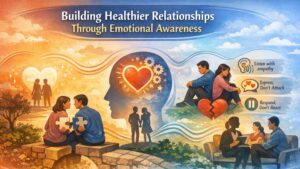
Relationships rarely struggle because love disappears. More often, they struggle because emotions remain unseen, unheard, or misunderstood for long periods of time. Many people continue caring deeply for their partners while feeling emotionally distant inside. Conversations begin to feel repetitive. Small disagreements start carrying a weight that feels far heavier than the situation itself. This is often the stage where guidance from the Best Psychologist in Gurgaon becomes helpful, not to decide who is right or wrong, but to understand what is happening beneath the surface of the relationship.
Healthy relationships are not built on perfection. They are built on emotional awareness. The ability to recognize feelings, understand emotional triggers, and respond with clarity rather than impulse plays a central role in how relationships either grow stronger or slowly disconnect.
Understanding Emotional Awareness in Relationships
Emotional awareness is the ability to notice what you are feeling in the moment and to understand why you are feeling that way. It involves recognizing emotions before they turn into reactions that may harm connection.
When emotional awareness is present, individuals are more likely to pause and reflect instead of reacting automatically. They can identify whether their response is shaped by the current situation or influenced by past experiences. This awareness helps conversations feel calmer and more constructive.
Without emotional awareness, misunderstandings often escalate. Emotions remain unspoken, assumptions increase, and communication becomes defensive or withdrawn.
How Emotional Distance Develops Quietly
Most relationship difficulties do not begin with major conflicts. They begin with small emotional moments that go unaddressed. Feeling unheard during conversations. Feeling dismissed when expressing concerns. Feeling taken for granted during daily interactions.
Over time, these experiences accumulate. Individuals may begin protecting themselves emotionally by withdrawing or avoiding difficult conversations. This can lead to
• reduced emotional openness
• repeated arguments about the same issues
• loss of emotional safety
• loneliness even while being together
Emotional distance grows not because people stop caring, but because emotions stop being acknowledged.
Emotional Triggers and Their Hidden Influence
Many relationship conflicts are driven by emotional triggers rather than the immediate situation. These triggers often develop from past experiences, early relationships, or unmet emotional needs.
Common emotional triggers include
• fear of abandonment
• desire for validation
• sensitivity to criticism
• feeling unimportant or ignored
When triggers are activated, reactions may feel intense or disproportionate. Emotional awareness helps individuals recognize when a trigger has been activated, allowing them to respond with understanding rather than defensiveness.
Reacting Versus Responding
Reacting is automatic and emotionally driven. Responding is intentional and thoughtful. Emotional awareness creates the pause needed to move from reaction to response.
When individuals learn to respond instead of react
• conversations become calmer
• misunderstandings reduce
• trust begins to rebuild
• emotional safety increases
This shift often transforms how partners communicate during challenging moments.
Creating Emotionally Safe Communication
Healthy communication is not about avoiding conflict. It is about creating an environment where emotions can be expressed without fear.
Emotionally safe communication includes
• speaking honestly without blame
• listening without interrupting
• validating feelings even during disagreement
• respecting boundaries when emotions are intense
When communication feels safe, individuals are more willing to be vulnerable, which deepens connection.
Emotional Awareness and Intimacy
Intimacy is not limited to physical closeness. Emotional intimacy develops when people feel seen, understood, and accepted.
Emotional awareness strengthens intimacy by helping partners
• feel emotionally connected
• rebuild closeness after conflict
• develop mutual trust
• support each other during stressful periods
This emotional closeness forms the foundation of long term relationship satisfaction.
Recognizing Repeating Relationship Patterns
Every relationship develops patterns over time. Some patterns encourage closeness, while others repeatedly create conflict.
Emotional awareness allows individuals to
• identify recurring emotional cycles
• understand habitual responses
• recognize unhelpful communication styles
• consciously choose healthier interactions
Once patterns become visible, change becomes possible.
The Role of Self Awareness
Emotional awareness also involves understanding one’s own emotional responsibility. This includes recognizing personal needs, boundaries, and reactions without projecting them onto a partner.
Self awareness helps individuals
• communicate needs clearly
• reduce blame
• take accountability for emotional responses
• develop emotional maturity
This clarity strengthens relationship stability and trust.
When Professional Support Helps
Sometimes emotional dynamics become difficult to manage alone. Communication may feel stuck. Emotions may feel overwhelming or confusing.
Professional support can help individuals and couples
• understand emotional patterns
• rebuild trust
• improve communication skills
• navigate conflict with clarity and empathy
Seeking help reflects commitment to growth rather than failure.
Building Emotional Resilience Together
Relationships evolve through life changes, stress, and transitions. Emotional awareness helps partners adapt without losing connection.
When emotional understanding is prioritized
• conflicts feel manageable
• emotional security increases
• communication improves
• growth becomes a shared process
Resilience grows through awareness rather than avoidance.
A Closing Reflection
Healthy relationships thrive when emotional awareness becomes part of daily interaction. Understanding emotions before reacting allows empathy to replace defensiveness and connection to replace distance.
When emotional challenges begin to affect closeness, thoughtful relationship counselling Gurugram can support individuals and couples in developing awareness, strengthening communication, and building relationships rooted in emotional safety, respect, and understanding.
Emotional awareness does not create perfect relationships.
It creates real ones—where both voices are heard and valued.