STEM education now focuses on practical learning rather than theory alone. Schools want students to build, test, and solve real problems. Affordable computing platforms make this shift possible.
Recent education technology studies show strong growth in hands-on digital learning:
-
Over 65% of schools now include physical computing in STEM programs.
-
Nearly 70% of educators report higher engagement during project-based learning.
-
Students retain up to 75% more knowledge when they learn through experimentation.
-
Global demand for embedded systems skills continues to grow across engineering careers.
Small computing boards help meet this demand. The Raspberry Pi ecosystem plays a major role in classrooms worldwide. Add-on boards called HATs extend its capabilities. These tools turn a basic computer into a full lab device.
Raspberry Pi HATs support sensors, robotics, networking, and automation. They allow students to build systems that reflect real engineering environments. One example is the Raspberry Pi 4G LTE HAT, which introduces wireless communication and IoT learning.
What Are Raspberry Pi HATs?
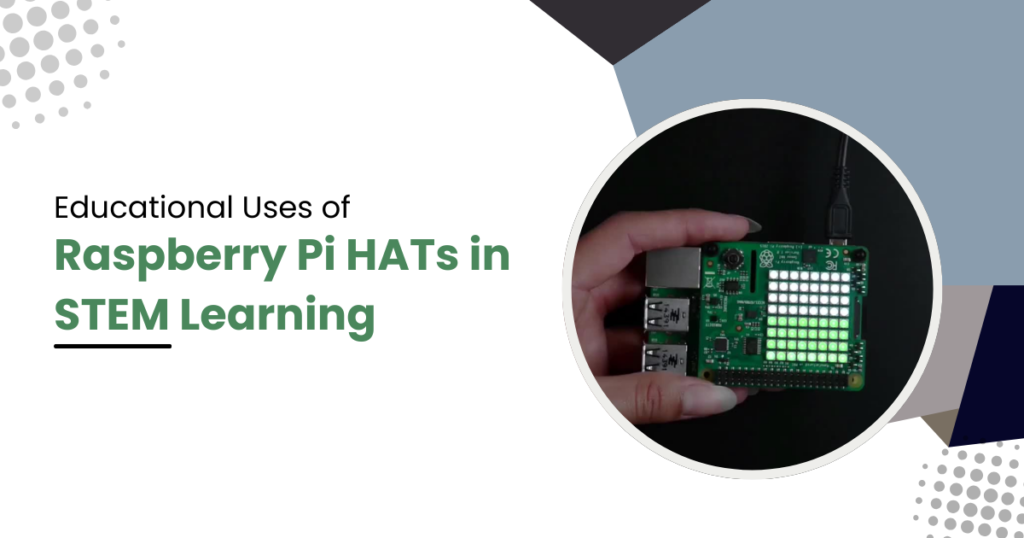
HAT stands for Hardware Attached on Top. These boards connect directly to the Raspberry Pi GPIO header. Each HAT adds a specific function.
HATs follow a defined mechanical and electrical standard. This ensures compatibility and simple installation. Students attach the board without complex wiring.
Key Features of Raspberry Pi HATs
-
Plug-and-play hardware expansion
-
Built-in drivers and EEPROM identification
-
Reliable electrical layout
-
Support for industrial protocols
-
Easy integration with Python and Linux tools
These features reduce setup time. Teachers can focus on concepts rather than troubleshooting.
Why STEM Education Needs Hardware-Based Learning
Students often struggle to connect theory with application. Reading about circuits does not build engineering intuition. Building systems do.
Hardware computing introduces cause-and-effect learning. Students see how code interacts with real devices.
Benefits of Physical Computing in STEM
-
Reinforces mathematics through measurement and calibration
-
Connects programming to real-world outputs
-
Builds engineering thinking early
-
Encourages experimentation and debugging
-
Develops teamwork through lab-based tasks
This learning model mirrors professional engineering workflows.
Role of Raspberry Pi HATs in Classroom Laboratories
Traditional labs require expensive equipment. Many schools cannot afford advanced instrumentation. Raspberry Pi platforms replace several tools at low cost.
A single setup can function as:
-
Data acquisition system
-
Robotics controller
-
Environmental monitor
-
Communication gateway
-
Automation testbed
Students design complete systems rather than isolated experiments.
Teaching Electronics Through Sensor-Based HATs
Sensor HATs allow students to measure temperature, humidity, motion, or light. These activities teach analog and digital interfacing.
Example Learning Activity
Students build a weather station using a sensor HAT.
They perform these steps:
-
Configure GPIO communication.
-
Read sensor values using Python libraries.
-
Apply calibration equations.
-
Store data in a database.
-
Plot trends using visualization tools.
This project connects physics, coding, and data science.
Concepts Students Learn
-
Signal sampling
-
Error handling
-
Unit conversion
-
Data logging
-
Statistical analysis
Such exercises build strong engineering fundamentals.
Robotics Education Using Motor Control HATs
Robotics motivates students because results are visible. Motor driver HATs simplify robotic development. They control DC motors, servos, and stepper motors.
Classroom Robotics Projects
-
Line-following robots
-
Autonomous obstacle detection vehicles
-
Smart warehouse models
-
Agricultural monitoring robots
Students write control algorithms and test mechanical performance.
Skills Developed
-
Embedded programming
-
Feedback control systems
-
Mechanical integration
-
Power management
-
Troubleshooting methods
These skills match real robotics engineering practices.
Teaching Internet of Things with Raspberry Pi 4G LTE HAT
Connectivity defines modern engineering systems. Many educational kits rely on Wi-Fi networks. However, real deployments often use cellular communication.
The Raspberry Pi 4G LTE HAT enables direct mobile network access. Students can deploy devices without local infrastructure.
Why Cellular IoT Matters in Education
Industrial systems operate in remote environments. Farms, highways, and energy sites rarely use Wi-Fi. Cellular connectivity solves this problem.
Students learn how field devices communicate with cloud platforms.
Example IoT Project Using Raspberry Pi 4G LTE HAT
A class designs a remote environmental monitoring system. The project workflow includes connecting sensors to Raspberry Pi, attaching the Raspberry Pi 4G LTE HAT for network access, configuring SIM-based communication, sending telemetry to a cloud dashboard, and analyzing alerts and thresholds. This project simulates real smart-city deployments.
Concepts Covered
MQTT and HTTP protocols, edge computing principles, secure data transmission, network latency analysis, and remote diagnostics are covered in this learning process. Students gain exposure to telecom-integrated embedded systems.
Data Science Learning Through Real-Time Acquisition
Many STEM programs now include data literacy. Raspberry Pi HATs generate live datasets for analysis.
Students collect real signals instead of using static datasets.
Example Data-Oriented Experiments
Energy consumption tracking, machine vibration monitoring, soil condition analysis, and air quality measurement are included in these experiments. These activities combine coding with scientific interpretation.
Tools students use include Python Pandas for data processing, visualization libraries for trend analysis, and statistical modeling techniques. Learning becomes multidisciplinary rather than isolated.
Teaching Industrial Automation Concepts
Automation drives modern manufacturing. Schools can simulate production environments using relay and control HATs.
Students design small-scale automation cells.
Sample Automation Exercise
Build a conveyor simulation using sensors and relays. System functions include object detection, timed motor activation, fault detection alarms, and human-machine interface display. Students learn logic design similar to PLC programming.
Engineering Topics Introduced
Digital control logic, timing diagrams, industrial safety concepts, and systems integration are introduced during this stage. This prepares students for Industry 4.0 careers.
Supporting Interdisciplinary STEM Education
Raspberry Pi platforms encourage collaboration across subjects.
|
Discipline |
Application Using HATs |
|
Physics |
Motion tracking experiments |
|
Biology |
Environmental monitoring |
|
Mathematics |
Predictive modeling |
|
Computer Science |
Embedded software |
|
Engineering |
System prototyping |
Students see how disciplines intersect in real systems.
Advantages of Raspberry Pi HATs for Educational Institutions
Educational institutions benefit from modular hardware platforms that support practical learning, reduce laboratory costs, and align classroom activities with real engineering applications.
1. Cost Efficiency
Traditional lab setups require large capital investment. Raspberry Pi solutions cost a fraction of that amount. Schools can scale programs easily.
2. Modular Learning Structure
Teachers introduce one HAT at a time. Students progress from basics to advanced systems without replacing hardware.
3. Industry-Relevant Skill Development
Students work with Linux environments, scripting, and communication protocols used in professional settings.
4. Rapid Experimentation
Projects can be assembled and modified quickly. This encourages curiosity and iterative design.
5. Open Ecosystem
Extensive documentation and community support reduce learning barriers.
Example Curriculum Integration Model
Educational programs can introduce Raspberry Pi HAT-based learning in gradual stages. Each stage builds technical depth and reinforces earlier concepts.
Beginner Level focuses on foundational hardware interaction. Students learn GPIO basics, practice LED and sensor interfacing, and write introductory Python programs to control physical components. This stage builds confidence in embedded programming and hardware communication.
Intermediate Level introduces system-level design. Students develop robotics projects using motor HATs, perform data logging and visualization, and implement local network communication between devices. They begin to understand how multiple subsystems operate together.
Advanced Level moves toward real-world engineering applications. Students design cellular IoT solutions using the Raspberry Pi 4G LTE HAT, apply edge analytics for local decision-making, and build distributed monitoring systems that simulate industrial deployments.
This structured progression mirrors real engineering pathways, moving from basic interfacing to connected, intelligent systems.
Challenges Educators May Face
Despite the benefits, institutions must address several issues.
Common Challenges
-
Teachers require technical training.
-
Hardware maintenance needs planning.
-
Network configuration may be complex.
-
Curriculum alignment takes effort.
Solutions
-
Provide instructor workshops.
-
Use preconfigured software images.
-
Start with guided experiments.
-
Introducing open-source teaching materials.
With preparation, these challenges remain manageable.
Real-World Learning Outcomes Observed
Schools using Raspberry Pi-based labs report measurable improvements.
-
Students complete projects faster than traditional lab formats.
-
Participation in engineering competitions increases.
-
Learners show stronger debugging and analytical skills.
-
Interest in embedded systems careers grows significantly.
Hands-on exposure reduces the gap between education and employment.
Future of STEM Learning with Modular Computing Platforms
Education continues to move toward experiential learning models. Technologies like AI, smart infrastructure, and connected devices demand system-level understanding.
Platforms built around Raspberry Pi HATs provide that environment.
Future classrooms may include:
-
Smart laboratory networks
-
Student-built satellite communication models
-
Autonomous system simulations
-
Remote science experiments over cellular networks
These trends align with global demand for practical engineering education.
Conclusion
Modern STEM education must connect theory with application. Students learn best when they build systems and observe results directly.
Raspberry Pi HATs transform a small computer into a versatile teaching platform. They enable experimentation across electronics, robotics, data science, and automation. The Raspberry Pi 4G LTE HAT adds real-world connectivity, allowing students to explore IoT and remote monitoring systems.
These tools offer affordability, scalability, and technical depth. They prepare learners for careers in embedded systems, telecommunications, and intelligent infrastructure.
Educational institutions that adopt such platforms create environments where students design, test, and solve real engineering problems. That approach builds not only knowledge, but also confidence and innovation skills essential for the future STEM workforce.