My respect for EPDM roofing installation details came the hard way. Early in my career, I inspected a five-year-old flat roof that should’ve lasted thirty. The membrane was fine. The details were not. Poor edge bonding and rushed seams destroyed the system.
That job permanently changed how I approach every EPDM install.
Why EPDM Roofing Fails More Often Than It Should
Most EPDM roofs don’t fail because of material defects. They fail because installers overlook fundamentals during epdm rubber roofing installation. I’ve torn off perfectly good membranes ruined by lazy prep and sloppy flashing.
Details aren’t optional. They are the roof.
Understanding EPDM Before Installation Begins
Before installing EPDM, you need to understand its behavior. EPDM expands, contracts, and moves constantly. That flexibility is its strength, but only if detailing allows it to move freely.
Rigid thinking leads to cracked seams.
Deck Preparation: The Silent Success Factor
Every successful rubber flat roof installation starts below the membrane. Decks must be dry, smooth, and mechanically sound. I once delayed a project two days to replace marginal plywood.
That delay saved decades of performance.
Installing EPDM Rubber Roofing the Right Way
When installing EPDM rubber roofing, membrane layout matters. Always dry-fit first. Let the sheet relax naturally. Skipping this step guarantees wrinkles that never fully disappear.
Patience here pays off long-term.
Applying EPDM Rubber Roofing Adhesives Correctly
Applying EPDM rubber roofing adhesive isn’t about coverage alone. It’s about timing. Too wet and the membrane floats. Too dry and bonding fails. I still test tack with my knuckle before laying sheets.
That habit has saved countless installs.
EPDM Install Adhesive Selection Insights
Water-based adhesive works well on wood decks. Solvent-based is better for metal or concrete. On a factory retrofit, solvent adhesive doubled bond strength during a high-wind test.
Material choice matters more than brand loyalty.
Fitting EPDM Roof Sheets with Precision
Fitting EPDM roof sheets means working with gravity, not against it. Start from the low point and work upward. Always cut oversized, then trim back.
Anyone asking how to fit EPDM roof properly should practice this method first.
Seam Work: The Most Critical Detail
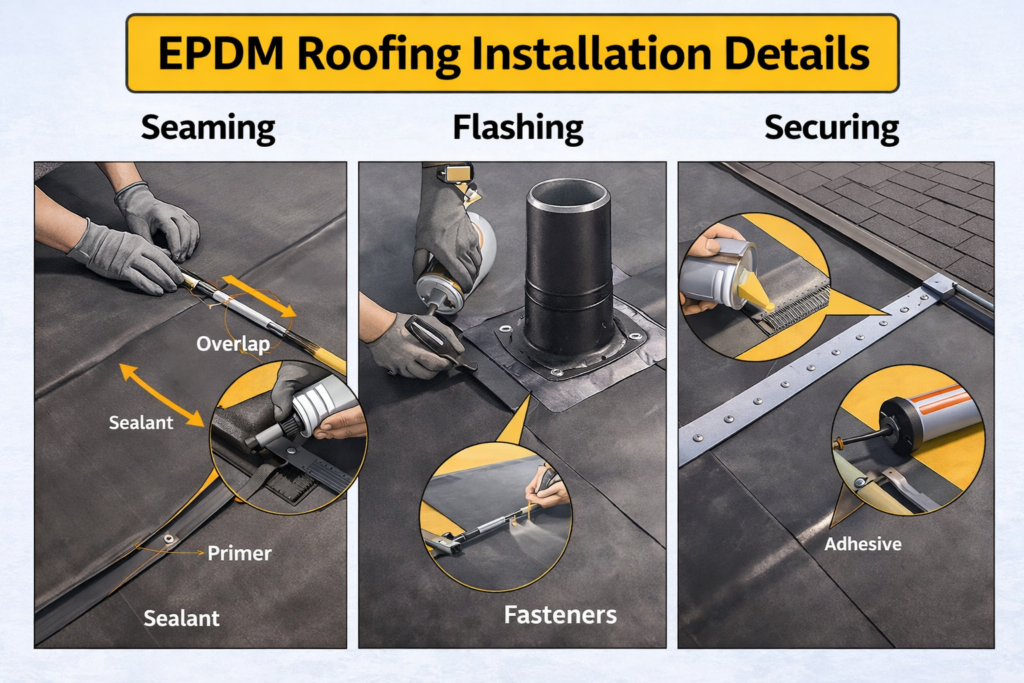
Seams decide roof lifespan. During epdm install, primer must be evenly scrubbed, not brushed lazily. Seam tape needs firm pressure with a steel roller.
Finger pressure doesn’t count.
Installing Rubber Roof Edges Correctly
When installing rubber roof edges, termination bars and drip edges must allow movement. Over-tightening fasteners causes stress fractures over time.
I’ve seen perfect fields fail because edges were locked down too hard.
EPDM Roofing Installation Details at Penetrations
Pipes, drains, and skylights are failure zones. Proper epdm roofing installation details here include pre-formed boots, reinforced patches, and lap sealant.
Hand-cut corners work only if you understand stress paths.
Firestone EPDM Rubber Roofing Installation Insights
I’ve followed Firestone EPDM rubber roofing installation specs on multiple large-scale projects. Their guidelines on seam spacing and edge restraint are conservative, but effective.
Those roofs still pass inspections years later.
Installing EPDM in Challenging Weather
Temperature changes everything. Installing EPDM below 5°C slows adhesive cure. Above 30°C, flash times shrink dramatically. I adjust work hours accordingly.
Good installers chase conditions, not deadlines.
EPDM Install Mistakes I See Repeatedly
Common errors include uneven adhesive spread, rushed seams, and ignored substrate moisture. Every failed epdm install I’ve inspected showed at least two of these mistakes.
Failure patterns repeat predictably.
Rubber Flat Roof Installation for Long-Term Performance
A proper rubber flat roof installation includes inspection access. I design walk paths and inspection zones intentionally. Maintenance teams appreciate it later.
Roofs need care, not neglect.
Installing EPDM Rubber Roofing on Real Projects
In 2020, I supervised a 6,500 sq ft warehouse installing EPDM rubber roofing system. We documented every step. Five years later, infrared scans show zero moisture intrusion.
Process discipline works.
EPDM Roofing Installation Details for Homeowners
Homeowners should ask contractors about seam methods, edge restraint, and drainage slopes. If they can’t explain epdm roofing installation details, they shouldn’t install your roof.
Knowledge reveals competence quickly.
Maintenance After EPDM Install Completion
After epdm install, annual inspections matter. Clean drains. Check seams. Reseal edges as needed. EPDM forgives neglect better than most systems, but not forever.
Small fixes prevent big failures.
Why EPDM Roofing Still Wins
Despite newer membranes, EPDM remains dominant because it’s honest. When installed correctly, it lasts. When rushed, it fails visibly.
The material tells the truth.
Final Thoughts from the Field
After years of inspections, installs, and repairs, I can say this confidently: EPDM roofing installation details matter more than membrane thickness or brand name. Get the details right, and the roof quietly performs for decades.