power press machine manufacturer
Machines make metal behave. People make machines last.
One wrong decision about the wrong power press machine manufacturer can have consequences that affect every aspect of manufacturing: quality, availability, cost, safety, delivery, maintenance, and bottom-line profitability.
This is not vendor shopping based on pretty pictures and slick sales talk. This is digging into hard credibility, engineering backbone, industrial performance, consistency, and long-term reliability.
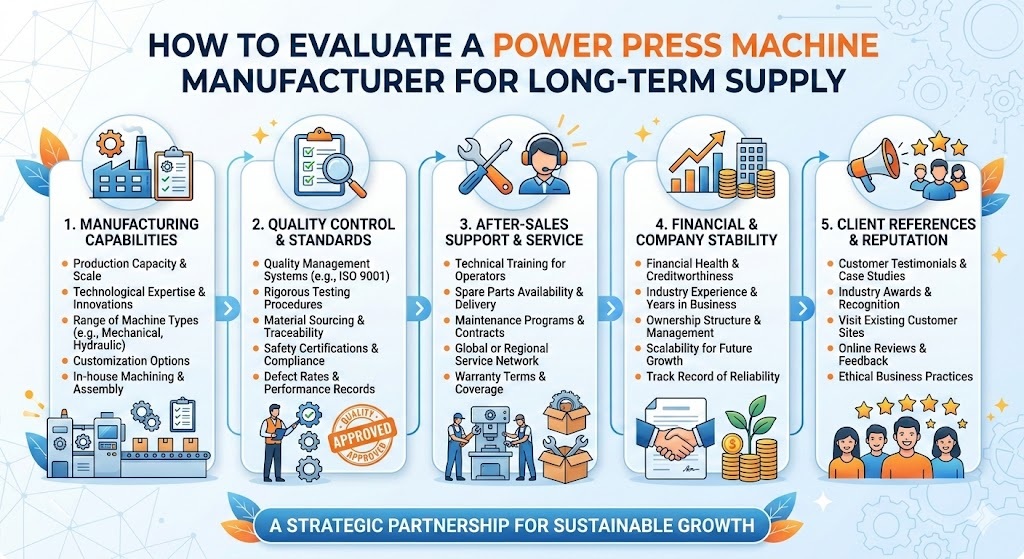
Real manufacturing leaders don’t pick suppliers by brand slogan. They pick them by performance history under load, documented reliability, engineering transparency, and supply continuity. This article dissects what matters when evaluating a power press machine supplier you plan to partner with for years.
Longevity Begins with Engineering DNA
A supplier’s engineering philosophy — not their marketing — reveals what products actually deliver on the floor.
A true industrial power press machine manufacturer designs machines to handle real workloads, not just controlled test pieces.
Ask:
- Are machines built with conservative load margins?
- Are components over-engineered rather than cost-optimized?
- Is there evidence of rigorous finite-element structural validation?
- Are critical parts made in-house or sourced from unknown suppliers?
For machines that will run shifts every day, engineering discipline is the foundation of long life.
When a manufacturer cuts corners in design, the product will eventually show it — crankshaft fatigue, frame flexing, imbalanced inertia, misaligned ram travel, and high wear patterns.
A good manufacturer anticipates these stresses and designs machines to mitigate them.
Manufacturing Footprint Tells the Real Story
A supplier’s factory reveals more than their brochure:
- Are machining centers capable of high-capacity precision work?
- Is there evidence of quality control stations?
- Are finished machines leveled and tested under real load?
- Are welds inspected with proper methods?
- Is there a dedicated assembly team trained on press machines specifically?
A production line optimized for consumer buzz products will never produce industrial-class power presses.
Look for depth in production tooling, separating true industrial capability from mere volume assembly.
Component Transparency Matters
Industrial machines are only as strong as their weakest element. A true evaluation must verify core components:
- Ram guides manufactured with precision tolerances
- Crankshafts from forged blanks, not cast cheap alloys
- Gears and shafts ground rather than simply finished
- Press tables with stress-relieved and precision machined surfaces
- Hydraulic and lubrication systems designed for sustained duty cycles
A reputable power press machine manufacturer will disclose component origins, material grades, and production tests. If that information is vague or hidden, there’s risk.
Often the best suppliers document component traceability alongside product specifications.
Performance Data Should Reflect Real Production
Sales curves drawn on flat surfaces mean nothing if they don’t represent real production demands.
Good manufacturers provide performance data based on industrial workloads:
- Cycle rates under continuous duty
- Vibration and harmonics analysis
- Thermal rise and oil temperature impacts
- Component lifecycle projections
- Wear and replacement intervals
Beware of performance numbers generated from ideal lab conditions that never occur on the factory floor.
Reliable suppliers validate equipment in operational environments and document it.
Post-Sales Support Determines Machine Life
Machines are built once. Support decides how long they stay operational.
A low-quality machine with excellent support can outlive a high-quality machine with poor support.
Evaluate:
- Spare parts availability worldwide
- Service network density
- Remote diagnostics capability
- Training and documentation quality
- Warranty terms that protect uptime
A committed power press machine manufacturer stands behind machines for years — not just until payment clears.
World-class suppliers ship spare parts quickly, stock common wear items near major manufacturing hubs, and offer trained technicians for commissioning and support.
Quality Assurance Is Non-Negotiable
True industrial suppliers don’t rely on final-visual inspection alone.
Look for quality processes such as:
- Dimensional inspection with calibrated CMM
- Weld integrity testing
- Run-in tests with actual loads
- Statistical process control
- ISO or equivalent quality certifications
Ask for evidence, not just statements.
A manufacturer that treats quality as “optional” will deliver variable machines — and that inconsistency costs money.
Engineering Collaboration Is a Strategic Advantage
After selecting a machine, modifications will eventually be needed:
- Guarding changes
- Automation integration
- Tooling adaptations
- Control upgrades
- Productivity enhancements
A good supplier doesn’t just sell machines — they engineer solutions.
Are their engineers willing to:
- Answer detailed questions?
- Attend on-site evaluations?
- Provide technical customization?
- Validate tooling designs?
If engineering collaboration feels transactional, future projects will feel the same.
Factory Acceptance Testing: The Final Proof
Before shipment, the highest performing manufacturers offer factory acceptance testing (FAT):
- Machines tested with real loads
- Operation observed by the buyer’s engineers
- Compliance verified against performance clauses
- Reports documented and signed
This protects buyers from receiving machines that “tested perfect” in theory but fail under real conditions.
A manufacturer that resists FAT is one to avoid.
Documentation and Traceability Save Money
Industrial machines without proper documentation will cost far more over time.
Good documentation includes:
- Detailed drawings
- Bill of materials
- Maintenance schedules
- Test reports
- Calibration data
- Control logic documentation
Without this, small breakdowns turn into hours lost. Technicians spend time guessing instead of fixing.
A reputable power press machine manufacturer treats documentation like part of the product — not an afterthought.
Culture of Continuous Improvement
Long-term suppliers don’t stagnate.
Evaluation should include:
- New machine innovations in response to industry requirements
- Revisions based on real feedback
- Continuous training programs
- Post-delivery improvement tracking
A supplier who sold the same machine for decades without meaningful enhancement is a supplier living on old reputation, not forward performance.
Reputation Backed by Verifiable References
Claims mean nothing without proof.
Technical evaluation must include:
- Multiple references from facilities using similar machines
- Evidence of long term performance over years
- Maintenance histories and uptime records
- Testimonials that include real output metrics
Reference checks are not optional. They separate theory from reality.
A manufacturer with long-term customers who can speak to performance under load is worth attention.
Scalability of Supply Chain
A manufacturer’s ability to deliver consistently — volume after volume — matters as much as the quality of a single unit.
Ask:
- Can they increase output without sacrificing quality?
- Do they have multiple sources for critical components?
- Are there risks of supply bottlenecks due to limited vendors?
- How do they manage change in material cost or logistics challenges?
A supplier that depends on a narrow supply line is a risk to long-term continuity.
Risk Mitigation: Contracts and Guarantees
Evaluate contractual protections:
- Clear delivery guarantees
- Defined penalties for late delivery
- Warranty scope and duration
- Spare parts price protection
- Service level agreements (SLA)
The supplier must share risk, not offload it entirely on the buyer.
Long-term supply means shared accountability.
Aftermarket Support and Training
Machines are technical systems. They need care.
The best suppliers invest in:
- Operator training
- Maintenance certification programs
- Update bulletins
- Troubleshooting support
- Remote assistance systems
Training is not lecture. It’s hands-on, factory-informed, current.
Suppliers who ignore training costs will leave users dependent on expensive external support.
Controls and Interface Modernity
Industry is automating fast.
Evaluate:
- CNC or programmable press control capabilities
- Diagnostics built into the controller
- Integration with production monitoring
- Safety interlocks
- Upgrade paths
Unless the machine is prepared for the next decade of digital workflows, it will age prematurely.
Inspection and Parts Services Extend Machine Life
Look at:
- Component replenishment programs
- Inspection contracts
- Predictive maintenance offerings
- Wear part kits – standardized and stocked
- Annual service check-ups
A machine with a service lifecycle plan runs longer, safer, and with fewer surprises.
Financial Stability of the Manufacturer
A risky but often overlooked evaluation criterion.
A supplier’s financial health matters because:
- R&D investments require capital
- Spare parts supply depends on cash flow
- Long warranties must be honored years into the future
- Global service networks must be supported by funds
A weak supplier might collapse after the first machine is delivered — leaving buyers stranded.
Alignment With Strategic Production Goals
The right supplier aligns with the manufacturer’s strategic objectives:
- Lean workflows
- Automation integration
- Safety and compliance
- Global consistency
- Production standardization
Evaluating supplier alignment early avoids costly realignment later.
Trust, Not Promises
Trust is not based on what a supplier says.
Trust is based on:
- Demonstrable evidence
- Documented performance
- Verified references
- Engineering transparency
- Repeatable quality
- Support systems that work years later
And that level of assurance does not come from polished sales brochures.
It comes from rigorous evaluation.
Why Long-Term Evaluation Beats Short-Term Deals
Short-term wins often lead to long-term pain:
- Machines delivered quickly but break down frequently
- Cheap units that lack service support
- Suppliers that disappear after the first contract
- Warranties that expire before problems arise
Long-term evaluation filters out these risks.
A reliable power press machine manufacturer becomes a partner — not a transaction.
The Bottom Line
Evaluating a power press supplier is not about choosing the flashiest booth at a trade show. It’s about validating engineering integrity, manufacturing discipline, quality assurance systems, service infrastructure, spare parts strategy, training, documentation, and financial stability.
A true industrial partner doesn’t just deliver machines. They ensure machines deliver production.
A partner to invest years in will demonstrate commitment through performance, engineering capability, consistency, and integrity. This is how supply partnerships are made in the real world, not in presentation slides but in practical conditions.