forging manufacturers india
Heavy metal parts rarely begin life on a CNC machine. Before any cutting tool touches the metal, the material usually passes through a far rougher stage. Heat, pressure, impact. That sequence forms the backbone of forging.
Inside industrial zones across the country, forging shops run day and night. Steel bars enter the plant. Finished crankshafts, flanges, gear blanks, shafts, and structural parts leave the gates packed on pallets. This activity forms the working ground of forging manufacturers India, supplying components to sectors that depend on strength rather than cosmetic finish.
Forging belongs to one of the oldest metal forming practices known in engineering. Blacksmiths performed similar work centuries ago using simple hammers. Modern facilities now use hydraulic presses, induction furnaces, trimming presses, and automated manipulators, yet the physical idea remains the same: squeeze heated metal until the required shape appears.
Raw Steel Arrives First
Forging never starts with finished metal shapes. The process begins with billets or round bars. These pieces come from steel rolling mills where raw ingots were previously processed.
Billets usually measure anywhere between 40 mm and 200 mm diameter depending on final component size. Trucks deliver bundles of these bars to forging yards. Storage racks hold the material until production planning schedules the next batch.
Material chemistry matters at this stage. Carbon steel remains common because it responds well to forging deformation. Alloy steels appear frequently as well, especially grades containing chromium, molybdenum, or nickel. Those alloys improve fatigue resistance and toughness.
Quality control teams working with forging manufacturers India normally verify incoming material through spectrometer testing. Chemical composition must match specification before heating begins. Incorrect alloy content can ruin an entire modern forging production unit quality.
Heating Stage Changes Metal Behavior
Cold steel behaves stiff and resistant to deformation. Heat transforms that behavior completely.
Forging furnaces raise billet temperature somewhere between 950°C and 1200°C depending on alloy composition. At that level the metal becomes plastic enough to reshape without cracking.
Large forging plants often rely on induction heating for precise temperature control. Coils generate electromagnetic fields that heat the billet internally. Other operations still use gas-fired furnaces where billets move slowly along heated chambers.
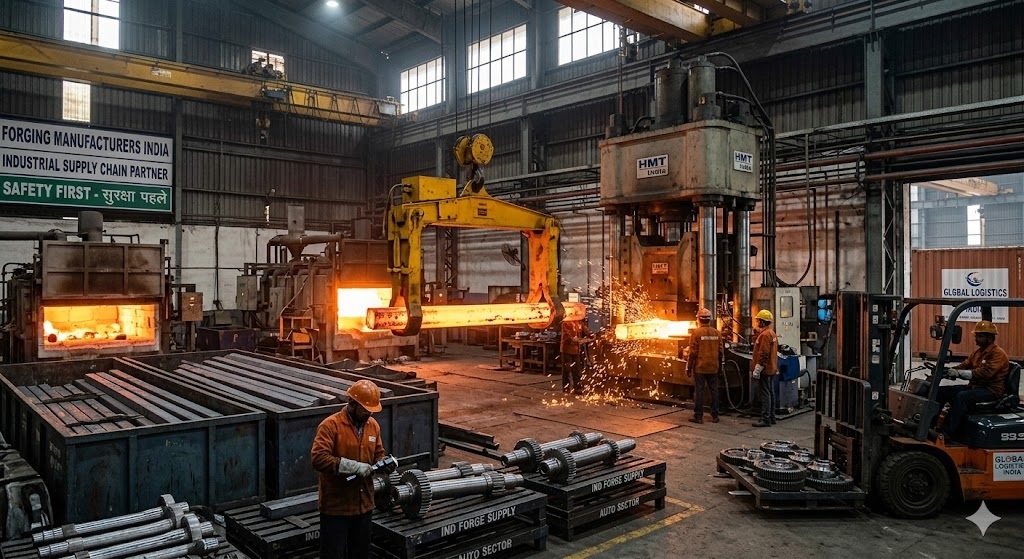
The moment a billet leaves the furnace, time starts working against the operator. Metal cools rapidly in open air. Delay too long and the billet loses plasticity. Therefore production lines inside facilities run by forging manufacturers India operate in a tight sequence: heat, transfer, forge, trim.
Hammer and Press Machines Do the Real Work
The dramatic part of forging happens under heavy machines.
Drop hammers deliver repeated impact blows onto the heated billet placed between shaped dies. Each strike pushes the metal deeper into the cavity. Sparks fly, scale flakes off, and the metal gradually fills the shape.
Press forging follows a different approach. Instead of fast impact, hydraulic presses apply slow but enormous pressure. Some industrial presses reach capacities above 2000 tons. The steady compression forces metal to flow into complex die cavities.
Closed-die forging appears frequently in automotive parts production. Dies contain impressions matching the shape of the finished component. Once pressure forces the hot metal inside, the form becomes visible almost instantly.
Production halls belonging to forging manufacturers India often contain multiple hammer and press lines operating simultaneously. The sound level inside such buildings remains intense. Steel striking steel produces a deep mechanical echo that travels across the shop floor.
Flash Formation and Trimming
During closed-die forging, excess metal escapes through narrow gaps between die halves. That thin layer around the edge of the part is called flash.
Flash actually helps the process. The resistance created by that thin metal forces internal pressure to rise inside the die cavity, ensuring that fine details fill properly.
Once forging completes, trimming presses remove the flash. The part passes through another die where a cutting edge shears away the excess material. Scrap flash usually returns to the steel recycling stream later.
Operators in plants managed by forging manufacturers India monitor this stage carefully. Poor trimming alignment can distort the forged component.
Cooling and Heat Treatment
Freshly forged parts come out extremely hot. Cooling must occur under controlled conditions.
Some forgings cool in open air on steel racks. Others require controlled furnace cooling to prevent internal stress.
Heat treatment often follows forging. Normalizing represents one common step. The forged component reheats to a specific temperature and then cools gradually. This process refines the grain structure created during forging.
For high-strength applications such as automotive crankshafts or heavy machinery shafts, quenching and tempering may occur. Rapid cooling hardens the metal, while tempering reduces brittleness.
Large industrial units among forging manufacturers India maintain separate heat treatment sections equipped with furnaces, quench tanks, and temperature recording systems.
Surface Cleaning Before Inspection
Forging leaves heavy oxide scale on the surface of steel parts. That scale forms while the metal remains exposed to oxygen at high temperature.
Before inspection or machining, the scale must disappear. Shot blasting handles this job effectively.
Inside shot blasting machines, steel shots strike the component surface at high velocity. The impact removes oxide layers and reveals clean metal beneath.
After cleaning, forged parts move toward inspection stations where technicians check for visible cracks, laps, or incomplete filling.
Quality control teams working within forging manufacturers India sometimes perform magnetic particle inspection on critical components. This method highlights small surface cracks that may not appear under normal lighting.
Machining Stage Brings Precision
Forging creates the rough form of a component, but dimensional accuracy still requires machining.
Forged parts therefore travel from forging shops to machining departments or external machining vendors. CNC lathes, milling machines, and drilling centers remove excess stock left intentionally during forging.
Crankshaft journals, flange faces, bolt holes, and bearing seats demand precise tolerances. Machining ensures proper alignment when these parts enter final assemblies.
Several forging manufacturers India maintain integrated machining capability inside the same facility. Combining forging and machining reduces transport delays and improves quality control.
Industrial Sectors Depending on Forgings
Forged components appear almost everywhere in heavy engineering.
Automotive manufacturing consumes massive quantities of forged parts. Connecting rods, crankshafts, axle components, and steering parts rely on forged steel because of fatigue strength requirements.
Construction equipment represents another major user. Excavators, bulldozers, and loaders operate under high mechanical stress. Structural joints and shafts therefore require forged construction.
Railway engineering also depends heavily on parts supplied by forging manufacturers India. Axle assemblies, couplers, brake system parts, and suspension elements often originate from forging shops.
Energy infrastructure forms another major sector. Power plants use forged flanges, valve bodies, and pressure fittings capable of handling high temperature and pressure cycles.
Oil and gas drilling equipment also uses heavy forgings due to the demanding mechanical conditions involved.
Export Market Activity
Forging plants across India increasingly supply overseas markets. Buyers from Europe, the Middle East, and Southeast Asia often source industrial forgings from Indian suppliers due to competitive manufacturing costs.
Export shipments typically include flanges, gear blanks, shafts, and custom-engineered components. International clients usually demand strict documentation including heat treatment records and material certificates.
To meet such requirements, export-oriented forging manufacturers India maintain traceability systems linking each forged batch back to raw material heat numbers.
Factory Floor Reality
A forging shop rarely resembles a quiet machining facility. Heat dominates the environment. Operators handle glowing billets using long tongs or automated manipulators. Furnaces roar continuously. Hammer strikes shake the building floor.
Protective clothing becomes mandatory. Face shields, heat-resistant gloves, and heavy boots protect workers from scale particles and radiant heat.
Despite the harsh environment, forging remains one of the most dependable methods for producing structural metal parts. Metal grain flows along the shape of the component, improving resistance to fatigue and fracture.
This mechanical advantage explains why industries continue to rely heavily on forged components.
Within that industrial landscape, forging manufacturers India perform the early stage transformation that converts plain steel bars into high-strength engineered parts ready for machining, assembly, and service inside demanding mechanical systems.