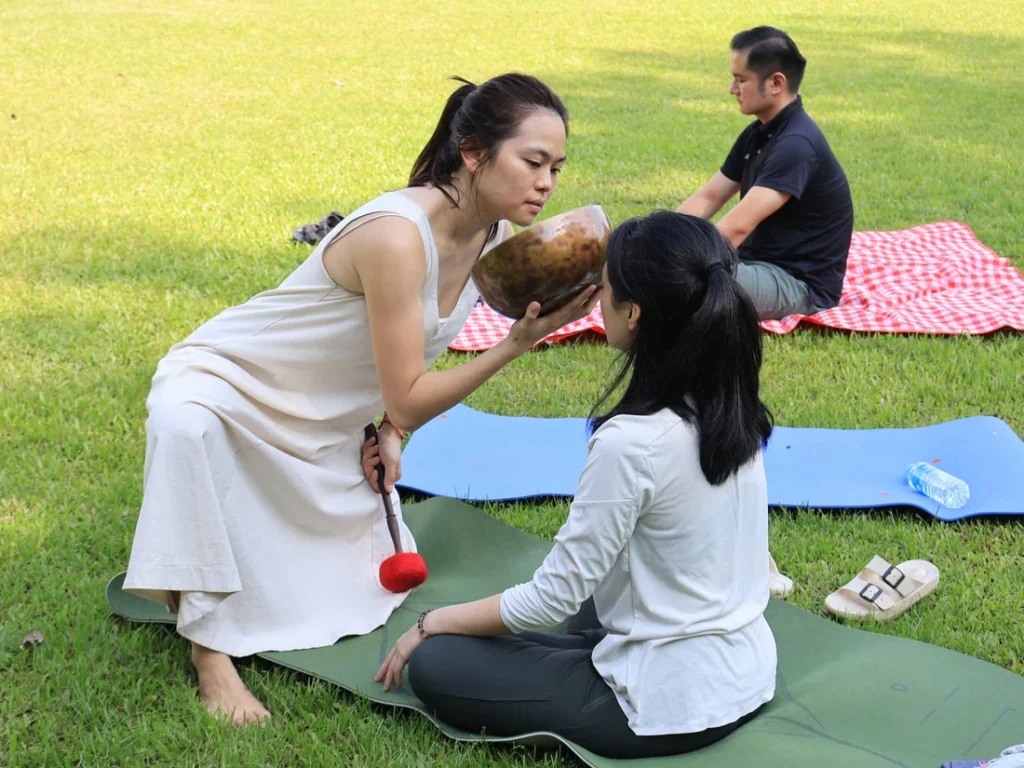
In 2024, a writer from CNA TODAY attended a sound bath session in Singapore to understand why sound healing was becoming popular. The session used singing bowls, chimes, and gentle instruments while participants lay quietly on yoga mats.
The writer described how the room slowly became silent as the sounds filled the space. Within minutes, some people drifted into sleep while others remained awake but felt deeply relaxed. After the session, the writer shared that the experience helped her unwind and sleep better that night, although she noted that the effects may differ from person to person.
Stories like this explain why sound healing sessions are gaining attention across Singapore. In a busy city where people often feel mentally overloaded, many are searching for ways to slow down and restore calm.
One practice that is drawing interest is immersive sound healing, where Himalayan singing bowls are placed directly on the body so participants can feel the vibration as well as hear the sound.
What Is Sound Healing?
Sound healing is a relaxation practice that uses sound frequencies and vibrations to help the body move into a calmer state.
Instead of trying to control thoughts like traditional meditation, sound healing uses instruments that naturally guide the brain toward relaxation. These instruments include singing bowls, gongs, chimes, and tuning forks.
When these instruments are played, they create sound waves that travel through the air and sometimes through the body.
Researchers from the Singapore Institute of Technology have explored how sound-based therapies such as music frequencies and binaural beats may influence anxiety and relaxation responses. Their findings suggest that certain sound patterns may help people feel calmer and less mentally tense.
This is one reason sound therapy is now used in many wellness programs and meditation studios.
The History of Himalayan Singing Bowls
Himalayan singing bowls have been used for centuries in meditation traditions across regions of Nepal, Tibet, and Northern India.
The bowls are made from metal alloys and produce a long resonant tone when struck or rubbed with a wooden mallet.
Unlike ordinary musical instruments, the sound produced by a singing bowl contains layered vibrations. These vibrations can last for several seconds and create a steady tone that many people find calming.
Over the last two decades, singing bowls have become widely used in wellness practices around the world.
Today they are commonly used in meditation sessions, yoga studios, and sound healing workshops.
What Research Says About Singing Bowl Meditation
Interest in singing bowl meditation has also grown among researchers.
One widely cited study published in the Journal of Evidence-Based Integrative Medicine examined the effects of Tibetan singing bowl meditation on participants.
The study reported that after a sound meditation session, participants experienced noticeable reductions in:
- tension
- anger
- fatigue
- depressed mood
Participants also reported feeling more relaxed and mentally clear after the session.
More recent reviews have reached similar conclusions.
A 2025 research review published in the journal Healthcare reported that singing bowl interventions may support stress reduction, sleep quality, and emotional well-being. The authors also noted that more controlled studies are still needed to understand the exact mechanisms behind these effects.
These findings suggest that sound meditation may support relaxation, although it should not be considered a medical treatment.
What Makes Immersive Sound Healing Different
Many sound bath sessions involve instruments being played around the room.
Immersive sound healing workshops take the experience further by placing singing bowls directly on the participant’s body.
The bowls may be positioned on areas such as:
- the stomach
- the back
- the hands
- the legs
Once the bowl is gently struck, the vibration travels through the body.
Instead of only hearing the sound, participants also feel the vibration moving through muscles and tissues.
Some people describe the sensation as a gentle pulsing or a warm vibration spreading through the body.
Research exploring Tibetan bowl meditation has documented sessions where bowls were placed on participants while other bowls were played nearby to create a layered sound environment.
This combination of sound and vibration is what makes the experience feel more immersive than a traditional sound bath.
What Happens During an Immersive Sound Healing Workshop
Most immersive sound healing workshops last between 1.5 and 2 hours.
The session typically includes several stages.
1. Arrival and relaxation
Participants lie comfortably on mats while the practitioner guides breathing exercises.
This helps the body transition from a busy mental state into a more relaxed one.
2. Surrounding sound bath
The facilitator begins playing singing bowls, chimes, and other instruments around the room.
These sounds create a calm atmosphere known as a sound bath.
The overlapping tones help slow mental activity and encourage relaxation.
3. Vibrational bowl placement
During the immersive stage, the practitioner gently places Himalayan bowls on different parts of the body.
The bowls are then activated with soft strikes that create vibration.
Participants often feel the vibration moving through their body like gentle waves.
4. Quiet integration
The session ends with a few minutes of silence so participants can slowly return to normal awareness.
Many people report feeling calm, refreshed, and mentally clear after the experience.
Real Experiences From Sound Healing Participants
Reports from sound healing events in Singapore often describe similar reactions.
A journalist from CNA Lifestyle attended a sound healing festival and observed that several participants fell asleep during the session.
Practitioners explained that this is common when the nervous system enters a deeply relaxed state.
Other wellness publications such as Vogue Singapore have reported that sound healing is becoming popular among city residents looking for ways to slow down and recover from mental fatigue.
These real experiences show that sound healing is not just a trend on social media. People are exploring it as a practical way to relax and recharge.
Why Vibration Matters in Sound Healing
The most unique aspect of immersive sound healing is vibration.
When a singing bowl is placed on the body, the vibration travels directly through tissues and muscles.
This sensation can create a grounding feeling that helps participants become more aware of their bodies.
Some practitioners explain that the vibration encourages the nervous system to move into the parasympathetic state. This is the body’s natural “rest and digest” mode, which slows heart rate and promotes relaxation.
Although scientific research on vibration therapy is still developing, many participants report that the experience feels deeply calming.
Exploring Sound Healing in Singapore
Interest in sound meditation continues to grow as more people discover wellness practices that support relaxation.
If you want to explore a guided session yourself, you can experience sound healing in singapore through immersive workshops where Himalayan bowls are placed on the body to create a full vibrational experience.
For many participants, discovering this practice begins after hours of research into mindfulness techniques, meditation methods, and holistic wellness practices that support stress relief.
These sessions combine traditional singing bowl techniques with guided relaxation so participants can experience both sound and vibration in a calm environment.
Who Can Benefit From Sound Healing Sessions
Sound healing workshops can be suitable for many people.
They are especially helpful for individuals who:
- feel mentally overwhelmed
- struggle to relax during meditation
- want a deeper mindfulness experience
- are exploring new wellness practices
Even people who have never tried meditation often find sound healing easier to follow because the sound naturally guides the experience.
In Singapore, these sessions are also becoming popular in workplace settings where companies want to support mental well-being and relaxation. Many organizations now include sound healing experiences as part of their corporate wellness programs, allowing teams to slow down and recharge together.
However, participants with certain medical conditions such as pacemakers or implants should speak with the practitioner before attending sessions where bowls are placed directly on the body.
Responsible facilitators will usually discuss safety guidelines before the workshop begins.
A Moment of Stillness in a Busy City
Singapore is known for its fast pace and high energy. While that environment creates opportunity and growth, it can also leave people feeling mentally exhausted.
Sound healing workshops offer something simple yet powerful.
A quiet room.
Resonant bowls.
Gentle vibrations moving through the body.
For many participants, that short pause provides a rare chance to disconnect from daily noise and reconnect with a sense of calm.
Sometimes relaxation does not require effort.
Sometimes it begins with listening.