Agentic AI
Artificial intelligence (AI) has become the buzzword of our time. It’s a term that often conjures images of robots and self-learning machines, but in reality, AI is a broad umbrella with many distinct subfields. Two of the most talked-about developments today are generative AI and agentic AI. The crucial thing to grasp is that they function in distinctly different ways. Understanding these differences is essential if we want to grasp how AI is reshaping our world—and how it will continue to do so.
Generative AI: The Creative Powerhouse
Generative AI is all about creation. Think of it as the imaginative side of artificial intelligence. These systems are designed to produce content—text, images, music, code, and even video. At its core, generative AI learns from existing data and uses that knowledge to generate new, original outputs that mimic human creativity.
The rise of tools like ChatGPT, DALL•E, and MidJourney has catapulted generative AI into the mainstream. These systems rely on advanced machine learning models, particularly neural networks, to analyze and replicate patterns in the data they are trained on.
But generative AI isn’t perfect. Its outputs are only as good as the data it’s trained on. Feed it biased or incomplete data, and it will reflect those flaws. Moreover, it doesn’t truly “understand” the content it creates. It’s simply predicting what might come next based on patterns it has seen before. Despite this limitation, generative AI is already revolutionizing industries, from marketing to entertainment.
Agentic AI: The Autonomous Problem-Solver
While generative AI focuses on creating, agentic AI services is all about doing. This type of AI is designed to act autonomously to achieve specific goals. Agentic AI systems don’t just generate outputs; they make decisions, take actions, and adapt to changing environments.
However, the autonomy of agentic AI also raises critical questions about ethics and accountability. Who’s responsible when an autonomous system makes a mistake? How do we ensure these systems act in ways aligned with human values? These are some of the challenges that need addressing as agentic AI development becomes more prevalent.
The Core Differences Between Generative And Agentic AI
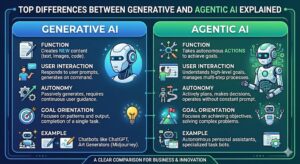
The easiest way to differentiate generative AI from agentic AI is to think of their primary functions. Generative AI is about producing something new, while agentic AI is about achieving something specific. One creates, and the other acts.
Generative AI is largely static. It produces outputs based on the data it has learned but doesn’t adapt in real-time or interact dynamically with the world. It operates within predefined boundaries. In contrast, agentic AI is dynamic. It’s constantly processing new information, learning from its environment, and adjusting its actions accordingly.
Another key distinction lies in the complexity of their objectives. Generative AI typically works on tasks that are narrow and well-defined, such as generating a paragraph of text or a digital painting. Agentic AI, on the other hand, often tackles broader, multi-step goals that require continuous decision-making and adaptation.