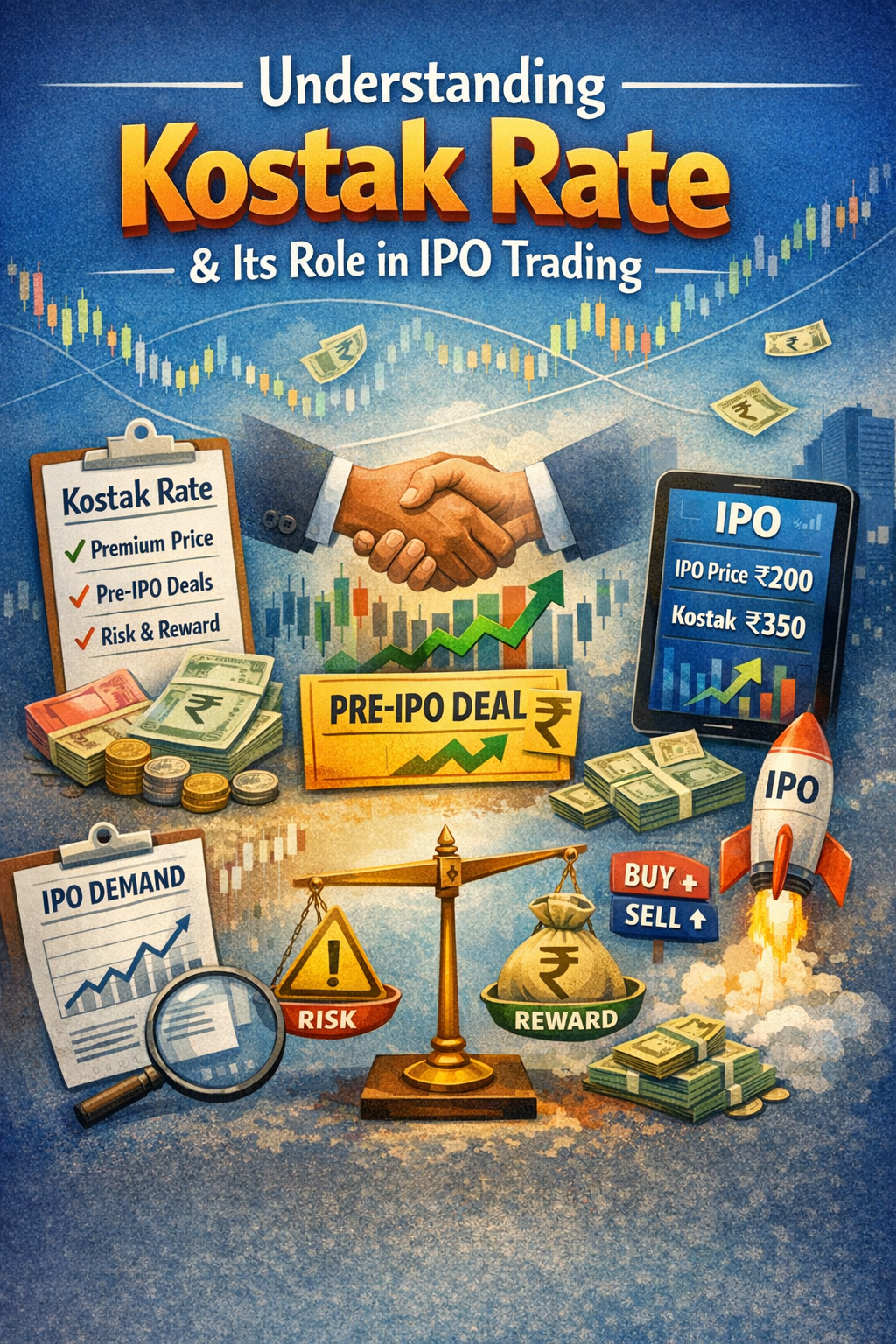
The Kostak Rate reflects investor confidence before an IPO hits the market — a fascinating intersection of risk, reward, and anticipation that shapes early trading sentiment.
1. Introduction
An ipo (Initial Public Offering) is one of the most popular ways for companies to raise capital from the public while giving investors an opportunity to participate early. For retail investors and traders, IPOs often attract attention due to potential listing gains and short-term opportunities.
Alongside official subscription data, many investors track unofficial indicators from the grey market. One such important metric is the Kostak Rate meaning, which plays a key role in understanding pre-listing demand.
The Kostak Rate in IPO helps traders estimate how much premium is being offered for an application in the grey market before listing. It acts as an early signal of demand, though it comes with its own risks and limitations. Understanding this concept is crucial for anyone exploring IPO grey market concepts.
2. What Is Kostak Rate?
Definition
The Kostak Rate meaning refers to the fixed amount at which an IPO application (not shares) is bought or sold in the grey market before allotment and listing.
Simple Explanation
- It is a fixed premium per application
- It does not depend on how many shares you receive
- The deal happens before allotment
Key Points
- The Kostak Rate in IPO is agreed between buyer and seller
- It represents the value of an IPO application itself
- It is part of broader IPO grey market concepts
3. How Kostak Rate Works in IPO Trading
Basic Working Mechanism
In the grey market:
- A seller agrees to sell their IPO application at a fixed Kostak Rate
- The buyer pays the agreed amount
- Regardless of allotment, the deal is honored
Example
- IPO application Kostak Rate = ₹500
- You sell your application
- You receive ₹500 even if you don’t get shares
Key Characteristics
- Fixed premium (unlike price-based trading)
- Independent of share allotment
- Common among active grey market participants
Connection to Grey Market
Kostak Rate operates alongside other elements like:
- IPO grey market premium (GMP)
- Subject to sauda IPO deals
Together, these form the foundation of grey market trends India.
4. Difference Between Kostak Rate and GMP
Understanding the difference between Kostak Rate and GMP is essential.
Kostak Rate vs GMP
| Factor | Kostak Rate | GMP |
| Basis | Application | Share price |
| Risk | Lower (fixed) | Higher (market dependent) |
| Payment | Fixed amount | Based on price movement |
| Dependency | Not on allotment | Depends on listing price |
Explanation
- Kostak Rate is application-based
- GMP is price-based
Investors often compare both to understand demand. For example, tracking ipo gmp alongside Kostak Rate gives a more complete picture of market sentiment.
5. Role of Grey Market in IPOs
The grey market is an unofficial marketplace where IPO-related deals happen before listing.
Key Functions
- Indicates demand for an IPO
- Reflects retail investor sentiment
- Acts as a pre listing indicator
Important Elements
- IPO grey market premium
- Kostak Rate
- Subject to sauda IPO
Why It Matters
Grey market activity helps traders:
- Estimate possible listing behavior
- Understand short-term demand
- Track grey market trends India
However, it is important to remember that this market is not regulated.
6. How Kostak Rate Reflects Investor Sentiment
The Kostak Rate in IPO can give insights into how investors perceive an issue.
High Kostak Rate
- Strong demand
- Positive sentiment
- Higher interest from traders
Low or Zero Kostak Rate
- Weak demand
- Lack of interest
- Uncertain listing expectations
Interpretation
- Rising Kostak Rate → Increasing confidence
- Falling Kostak Rate → Weakening sentiment
Still, it should not be viewed in isolation, as multiple factors influence IPO listing gains.
7. Comparing Kostak Rate with Other Indicators
While Kostak Rate is useful, it works best when combined with other tools.
Other Key Indicators
- Subscription data
- Institutional participation
- Market trends
Option Chain Analysis
One widely used tool is the sensex option chain, which helps traders understand:
- Market sentiment
- Support and resistance levels
- Broader trend direction
Why Combine Indicators?
Using Kostak Rate alone may be misleading. Combining it with:
- Option chain data
- Market indices
- Institutional flows
provides a more balanced view of pre listing indicators.
8. Risks and Limitations of Kostak Rate
Despite its usefulness, Kostak Rate has several limitations.
1. Unregulated Market
- No official oversight
- No legal protection
2. Possibility of Manipulation
- Rates can be artificially influenced
- Sentiment may not reflect reality
3. Limited Transparency
- No official data sources
- Depends on informal networks
4. Not Always Accurate
- High Kostak doesn’t guarantee strong listing
- Low Kostak doesn’t mean failure
Conclusion on Risks
Kostak Rate should be treated as an informational tool, not a decision-making base.
9. Should Investors Rely on Kostak Rate?
Balanced Approach
Investors should not rely solely on Kostak Rate. Instead, combine it with:
- Company fundamentals
- DRHP analysis
- Industry outlook
What to Focus On
- Revenue growth
- Profitability
- Business model
Role of Kostak Rate
- Useful for short-term sentiment
- Not reliable for long-term investment
Key Takeaway
Kostak Rate is just one part of broader IPO grey market concepts and should be used cautiously.
10. Practical Example
Let’s consider a hypothetical IPO.
Scenario
- Strong subscription from retail investors
- GMP rising steadily
- Kostak Rate increases from ₹200 to ₹600
Interpretation
- Growing demand in grey market
- Positive retail investor sentiment
Possible Outcome
- Better listing expectations
- But still dependent on market conditions
Reality Check
Even in such cases:
- Market volatility can impact listing
- External factors may override sentiment
11. Role of IPO in Overall Investment Strategy
An ipo can serve different purposes in an investor’s portfolio.
Short-Term Strategy
- Focus on listing gains
- Driven by sentiment indicators
Long-Term Strategy
- Invest based on fundamentals
- Ignore short-term noise
Risk vs Reward
| Strategy | Risk | Reward |
| Short-term | High | Uncertain |
| Long-term | Moderate | Based on fundamentals |
Conclusion
IPO investing should align with your overall strategy rather than relying only on grey market signals.
12. FAQ Section
1. What is Kostak Rate in IPO?
Kostak Rate is the fixed premium at which an IPO application is traded in the grey market before allotment.
2. How is Kostak Rate different from IPO GMP?
Kostak Rate is application-based, while GMP is based on expected share price movement.
3. Is Kostak Rate reliable?
It provides sentiment insights but is not fully reliable due to lack of regulation.
4. What role does sensex option chain play?
The sensex option chain helps analyze overall market sentiment and supports better interpretation of IPO indicators.
5. How to use ipo gmp with Kostak Rate?
Both should be used together to understand demand trends, but not as standalone decision tools.