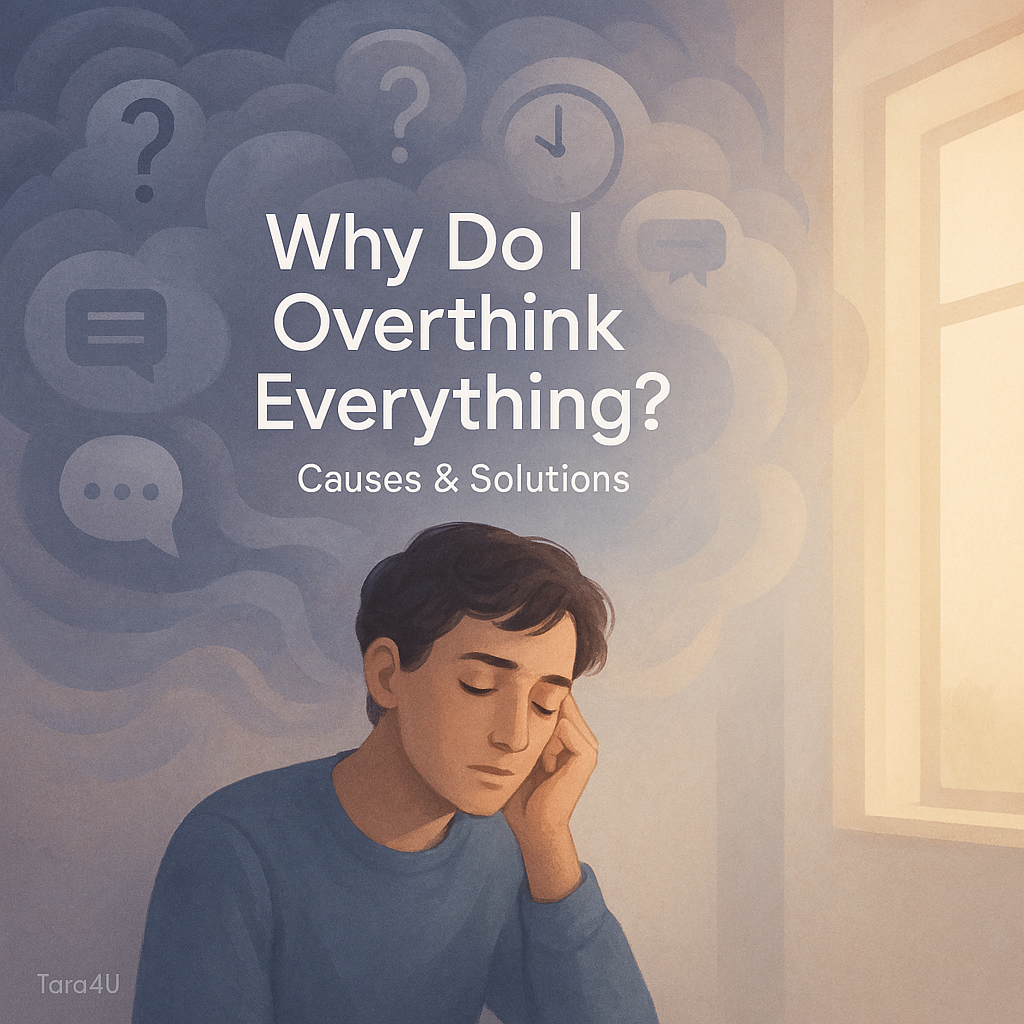
Ever feel like your mind won’t stop racing? This visual explores the emotional weight of overthinking—and the gentle clarity that follows when we understand its roots. Let’s talk about what drives it and how to ease it.
It’s 2:13 a.m. You’re exhausted, but your mind won’t stop. You replay that conversation from earlier. Did I say something wrong? Did they misunderstand me? Why did I phrase it like that? Suddenly, one small moment turns into a spiral of “what ifs.”
If you’ve ever asked yourself, “Why do I overthink everything?”, you’re not alone. Overthinking can feel like your brain refuses to switch off — analyzing the past, predicting worst-case scenarios, and second-guessing even simple decisions. It’s mentally draining and emotionally heavy.
The good news? Overthinking isn’t a life sentence. There are real psychological reasons behind it — and practical, compassionate solutions that can help you quiet the mental noise. Let’s gently unpack what’s happening inside your mind and what you can do about it.
What Does It Mean to Overthink?
Overthinking is more than just thinking deeply. It’s when your thoughts become repetitive, intrusive, and unproductive. Instead of leading to clarity, they create confusion and distress.
Healthy thinking helps you:
- Solve problems
- Reflect and learn
- Make thoughtful decisions
Overthinking, on the other hand:
- Replays situations endlessly
- Imagines worst-case outcomes
- Fixates on things outside your control
- Makes small issues feel overwhelming
Signs of Overthinking
Some common signs of overthinking include:
- Difficulty falling asleep due to racing thoughts
- Constantly seeking reassurance
- Replaying past conversations repeatedly
- Overanalyzing minor decisions
- Struggling to “let things go”
- Feeling mentally exhausted even without physical work
Overthinking often disguises itself as being “careful” or “responsible.” But in reality, it keeps you stuck in mental loops.
Why Do I Overthink Everything?
There isn’t just one reason. Overthinking usually stems from deeper emotional patterns. Let’s explore some of the most common causes.
Anxiety and Fear of Uncertainty
At its core, overthinking is often fueled by anxiety. When your brain senses uncertainty, it tries to regain control by analyzing every possible outcome.
An anxious mind believes:
“If I think about it enough, I’ll prevent something bad from happening.”
But instead of providing safety, it creates stress.
If anxiety is fueling your thoughts, read our guide on Overthinking and Anxiety to understand the deeper connection.
Past Trauma or Emotional Triggers
Sometimes overthinking develops as a survival mechanism. If you’ve experienced emotional pain, rejection, or trauma in the past, your brain may become hyper-alert.
It constantly scans for:
- Signs of conflict
- Rejection cues
- Potential mistakes
- Emotional danger
This isn’t weakness — it’s protection. But when that protection becomes constant, it turns into chronic over-analysis.
Building emotional awareness can help you recognize these triggers before they spiral. You may explore how Emotional Awareness helps reduce mental noise.
Low Self-Confidence and Self-Doubt
If you frequently question yourself, your mind may double-check everything.
Self-doubt sounds like:
- “What if I’m wrong?”
- “What if they don’t like me?”
- “I should’ve handled that better.”
Low self-confidence feeds overthinking because you don’t trust your initial instincts. So you replay situations, searching for reassurance.
The more you doubt yourself, the more your mind searches for certainty.
Perfectionism and Need for Control
Perfectionism often hides beneath overthinking.
You may think:
“If I analyze it perfectly, I won’t fail.”
But perfectionism sets unrealistic standards. It makes even minor flaws feel catastrophic.
For example:
- Sending a simple email turns into a 30-minute rewrite session.
- A small social mistake feels like social disaster.
- Decisions feel heavy because you fear making the “wrong” one.
Overthinking becomes an attempt to control the uncontrollable.
Is Overthinking a Mental Disorder?
Overthinking itself is not classified as a mental disorder. However, chronic overthinking is often linked to anxiety disorders, generalized anxiety disorder (GAD), depression, and OCD.
If you’re wondering, “Is overthinking a mental illness?” — the answer is no. But persistent rumination can be a symptom of underlying anxiety or emotional distress.
The key difference lies in intensity and impact. If overthinking:
- Disrupts your sleep
- Interferes with work or relationships
- Causes panic or physical symptoms
It may be time to look deeper.
How Overthinking Affects Your Mind and Body
Overthinking isn’t just mental — it affects your entire nervous system.
Mental Fatigue
Constant thinking consumes energy. Your brain stays in “problem-solving mode,” even when there’s nothing to solve.
This leads to:
- Brain fog
- Irritability
- Decision fatigue
- Emotional exhaustion
Sleep Disturbance
Nighttime often amplifies rumination. Without distractions, thoughts grow louder.
Chronic sleep disruption worsens anxiety — creating a vicious cycle.
Stress Hormones
Overthinking activates your stress response. Your body releases cortisol, increasing heart rate and tension.
Over time, this may cause:
- Headaches
- Digestive issues
- Muscle tightness
- Burnout
If left unchecked, mental rumination can slowly drain both your psychological and physical health.
Learn practical coping tools in our article on Stress, Burnout & Work Pressure to protect your energy.
How to Stop Overthinking (Practical Solutions)
You don’t eliminate overthinking by forcing your brain to “just stop.” Instead, you gently retrain it.
Here are evidence-based overthinking solutions that actually work:
1. Awareness Technique
Start by noticing the pattern.
Ask yourself:
- “Am I solving something — or looping?”
- “Is this helpful or harmful thinking?”
Label it: This is overthinking.
Naming it reduces its power.
2. The 5-5-5 Grounding Method
When thoughts spiral, ask:
- Will this matter in 5 days?
- 5 months?
- 5 years?
This creates perspective and interrupts catastrophic thinking.
3. Thought Journaling
Write down your thoughts instead of carrying them mentally.
Try this format:
- Situation
- What I’m thinking
- Evidence for it
- Evidence against it
- A balanced thought
This is a core cognitive reframing technique used in therapy.
4. Limit Rumination Time
Instead of suppressing thoughts, schedule them.
Set a 15-minute “worry window.”
When thoughts arise outside that window, gently tell yourself:
“I’ll think about this later.”
It sounds simple — but it builds mental discipline.
5. Breathing Techniques
Slow breathing calms your nervous system.
Try:
- Inhale for 4 seconds
- Hold for 4
- Exhale for 6
Repeat for 2–3 minutes.
When your body relaxes, your mind follows.
6. Cognitive Reframing
Challenge distorted thinking.
Instead of:
“I embarrassed myself.”
Try:
“Everyone makes small social mistakes. It’s human.”
Reframing isn’t toxic positivity — it’s balanced thinking.
If you’re searching for how to stop overthinking, remember: consistency matters more than perfection. Small daily practice leads to long-term calm.
When Should You Seek Professional Help?
If overthinking feels uncontrollable, persistent, or overwhelming — you don’t have to handle it alone.
Consider speaking to a mental health professional if:
- You experience panic attacks
- Sleep is severely disrupted
- You avoid situations due to fear
- Negative thoughts feel intrusive or constant
Therapy provides structured tools to manage anxiety and rumination. Seeking help isn’t weakness — it’s emotional strength.
Conclusion
If you’ve been asking, “Why do I overthink everything?”, understand this: your mind isn’t broken. It’s trying to protect you. Overthinking often develops from anxiety, past experiences, self-doubt, or perfectionism.
But protection doesn’t have to mean suffering.
With awareness, grounding techniques, journaling, and cognitive reframing, you can gently reduce mental noise. Over time, your thoughts become clearer, calmer, and more compassionate.
Be patient with yourself. Healing your thinking patterns is a process — not a switch.
And remember: you are not your thoughts. You are the observer of them. That awareness alone is powerful.