If you are shopping for HR software, you have probably hit a wall of acronyms. HRMS vs HCM vs HRIS is one of the most confusing comparisons in the HR technology world, partly because vendors use the three terms loosely and often interchangeably. Yet the difference between HRMS, HCM and HRIS is real, and choosing the wrong category can mean paying for features you do not need, or outgrowing a system within a year. This guide breaks down what each one means, how they overlap, and a simple way to decide which your business actually needs, whether you operate in India, the Gulf, Africa, or across all three. New to the topic? Start with our quick primer on what an HRMS is.
Quick Summary: Key Takeaways
- HRIS is your system of record: it stores core employee data.
- HRMS adds active workforce management: payroll, attendance, and leave.
- HCM is the strategic layer: talent management, learning, and analytics.
- In practice the categories overlap, so match the system to your stage, not the label.
HRMS vs HCM vs HRIS at a Glance
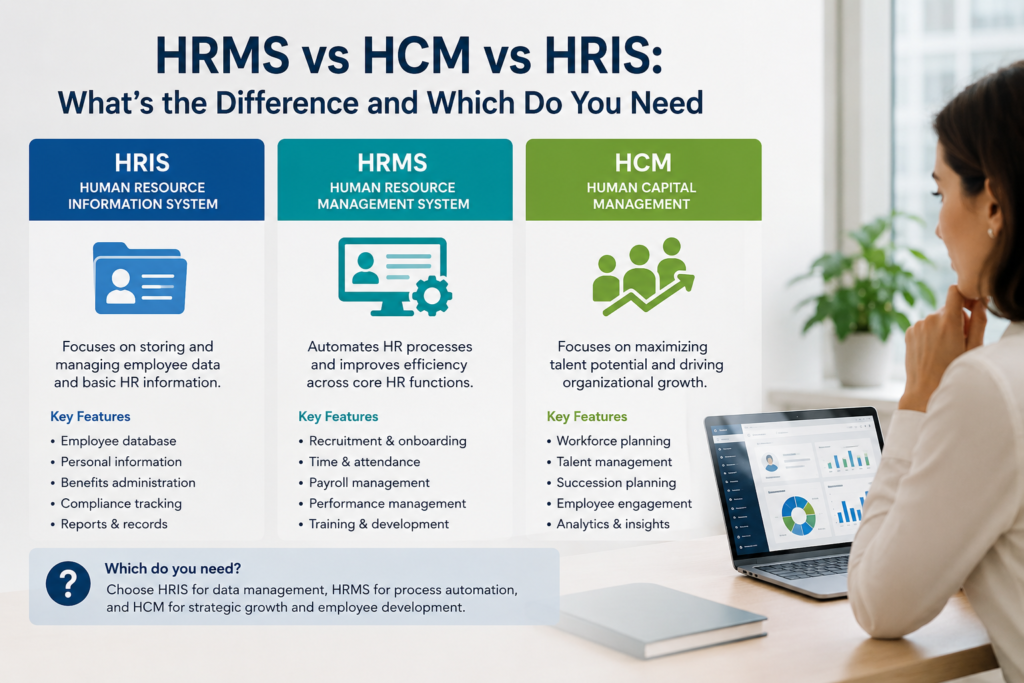
Before the deep dive, here is the difference between HRMS, HCM and HRIS in one view:
| System | Stands for | Core focus | Best suited for |
| HRIS | Human Resource Information System | Storing core employee data and records | Lean teams needing a reliable record |
| HRMS | Human Resource Management System | Records plus payroll, attendance, leave | Scaling firms automating daily HR |
| HCM | Human Capital Management | Full lifecycle, talent and strategy | Large or global enterprises |
What Is an HRIS?
An HRIS (Human Resource Information System) is the foundation. It is a database that holds your employee records: personal details, job history, org charts, and basic compliance documents. Think of it as the system of record, the single, trusted place where employee data lives. A pure HRIS is light on automation. It will store the fact that someone took leave, but it usually will not run the approval workflow or calculate the payroll impact. For very small teams, that is often enough.
What Is an HRMS?
An HRMS (Human Resource Management System) takes everything an HRIS does and adds active processes on top. At its core it is a complete employee management system, the place where stored records turn into daily action: running payroll, tracking time, and approving leave without spreadsheets. Where an HRIS simply notes that someone is on leave, an HRMS runs the approval, updates the balance, and reflects it in payroll automatically. For most growing businesses, the HRMS is the practical sweet spot between a bare database and a heavyweight enterprise suite.
What Is an HCM?
An HCM (human capital management) platform is the broadest of the three. It includes HRIS and HRMS capabilities, then layers on the strategic side of people management: talent management, learning and development, succession planning, and workforce analytics. Where an HRMS asks “how do we run HR efficiently?”, an HCM asks “how do we develop and retain our people over their whole employee lifecycle?” This strategic depth is why large and global enterprises gravitate toward HCM suites, and why smaller firms often find them heavier than they need.
HRMS vs HCM vs HRIS: The Key Differences
The clearest way to see the difference between HRMS, HCM and HRIS is by the job each one is built to do:
| Dimension | HRIS | HRMS | HCM |
| Primary role | System of record | System of operations | System of strategy |
| Typical modules | Employee data, org charts, reporting | Adds payroll, attendance, leave, self-service | Adds talent, learning, succession, analytics |
| Best for | Lean teams | Scaling SMBs and mid-market | Large and global enterprises |
Two points matter here. First, the categories are layered: every HRMS contains an HRIS, and every HCM contains an HRMS. Second, the labels are not policed. Many products marketed as an HRMS include light HCM features, and vice versa, so always check the actual module list rather than the acronym on the brochure.
Which One Does Your Business Need?
Forget the acronyms for a moment and match the system to where your company is today:
- Under ~25 employees: a clean HRIS or entry-level HRMS to keep records and basic compliance in order.
- Roughly 25 to 1,000 employees: an HRMS is usually the right call, automating payroll, attendance, and an hrms leave management system as the team scales.
- Large or multi-country enterprises: an HCM suite, where talent, learning, and multi-country payroll justify the added complexity.
A useful rule of thumb: if your main pain is “we cannot find or trust our data,” you need an HRIS or HRMS. If your pain is “we cannot grow, develop, and retain people at scale,” you are looking at HCM. Shortlist two or three platforms, run a demo against your real payroll and leave scenarios, and involve both HR and finance before deciding.
Why Compliance Matters Across All Three
Whichever category you choose, statutory compliance is non-negotiable, and it is where the right system earns its keep. The depth of compliance support often matters more than the acronym:
- In India, the system should automate Provident Fund, ESI, and TDS deductions and generate filing-ready reports. Contributions are governed by bodies such as the EPFO.
- In the Gulf, payroll must meet the Wage Protection System and local labour law. UAE wages, for example, are filed through channels overseen by the Ministry of Human Resources and Emiratisation, and a strong system calculates end-of-service benefits automatically.
For businesses running one workforce across several countries, this is the deciding factor. A platform with deep multi-country payroll and compliance built in will outperform a feature-rich tool that does not understand local rules, regardless of whether it is badged HRMS or HCM. Accurate inputs matter too: a reliable biometric attendance system feeds correct working hours into payroll, which keeps overtime and statutory deductions audit-ready.
Conclusion: Match the System to Your Stage
The HRMS vs HCM vs HRIS debate is less about which is best and more about which fits where your business is right now. HRIS keeps your data trustworthy, HRMS runs your daily operations, and HCM helps you grow and retain people at scale. Because the categories overlap and the labels are loosely applied, the smartest move is to ignore the acronym, list the outcomes you need, and check that compliance and payroll work in every country you operate in. Do that, and the right HR software choice becomes obvious.
Frequently Asked Questions
What is the main difference between HRMS, HCM and HRIS?
HRIS stores core employee data, an HRMS adds active processes like payroll, attendance, and leave, and an HCM adds strategic functions such as talent management and analytics. Each layer builds on the one before it.
Is HRMS better than HRIS?
Neither is objectively better; they suit different needs. An HRIS is ideal for storing and reporting on employee data, while an HRMS is better for automating day-to-day HR operations. Most growing companies need the broader HRMS.
Do small businesses need an HCM?
Usually not. HCM suites are built for large, complex workforces and can be heavier and costlier than a small team requires. Most small and mid-size businesses are better served by an HRMS.
Can one platform be an HRIS, HRMS and HCM at once?
Yes. Because the categories are layered, many modern platforms span all three. The label matters less than the actual modules, so always check the feature list against your needs.
Which system handles payroll and attendance?
An HRMS or HCM handles payroll and attendance, including leave and time tracking. A pure HRIS typically stores the data but does not run the calculations or workflows.
Which is best for companies operating in multiple countries?
An HCM or an enterprise HRMS with multi-country payroll is best, as it manages different currencies, pay cycles, and statutory rules from one dashboard while keeping records compliant in each market.