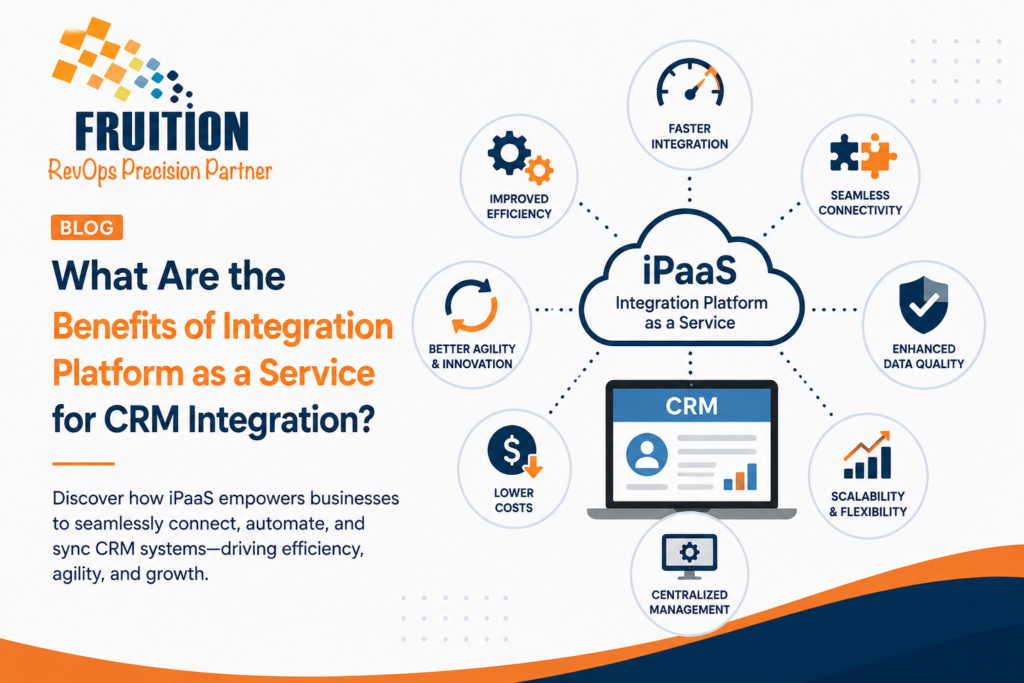
Integration Platform as a Service
Modern businesses utilize customer relationship management (CRM) systems to oversee their sales, marketing, and customer support operations. Yet, CRM systems yield positive results when they are integrated with other business applications. Many companies are left with duplicated data, manual processes, and inconsistent reporting, due to the separation of many business applications. This is where Integration Platform as a Service is significant for digital transformation.
At Fruition Revops, companies strive to build a connected business environment through intelligent integration. By linking CRM systems with finance, marketing, customer service, and operational systems, companies achieve a better view of their customer data and business operations. This also enhances interdepartmental collaboration and sets the groundwork for the successful ERP Implementation by creating a technology framework to support their business growth.
Understanding Integration Platform as a Service
Integration Platform as a Service is a middle-market cloud solution that connects different applications, databases, and software systems without complicated bespoke coding. It provides companies with the ability to automate the transfer of data from one system to another, and to do so without sacrificing data integrity and security. A centralized integration layer is created, which allows the different business units to stay informed.
In the case of CRM environments, data pertaining to customers is synced across marketing, finance, support, and operations systems. This ensures that sales staff are working with the most up-to-date data and helps management make informed data-driven decisions. An organization’s growth is supported by the connected infrastructure and helps simplify the communications of different systems for future ERP Implementation.
Why CRM Integration Matters for Modern Businesses?
CRM has the potential to store important information regarding customers, but its value increases significantly when it can connect with additional systems within a business. Without integration, employees input the same information into different applications, which becomes tedious and unproductive. Also, they don’t have an efficient way to transfer important customer information to different departments since they operate independently.
With Integration Platform as a Service, organizations are able to maintain a constant connection and communication to CRM systems and the other systems necessary for the business. Customer orders and invoices, service requests, and marketing campaigns become synchronized. This makes connected systems a valuable asset for your business and lessens the pain when considering future ERP Implementation initiatives.
Improving Data Accuracy Across Systems
When important, informed decisions are needed for the business, the quality of data becomes critical. With the large number of systems that contain customer data, if they are not connected, then the data becomes inconsistent. Employees suffer when they have to work with systems that have duplicate, old, and incomplete data. This also hinders the experience that businesses are trying to provide to their customers.
To combat this, Integration Platform as a Service keeps the customer data synchronized across the applications so that companies are able to access the same data and are forced to work with accurate data. Validation then becomes automatic, which improves reporting and forecasting. With such consistent data, migration during ERP Implementation becomes significantly less risky and allows the business to continue uninterrupted.
Increasing Operational Efficiency
The majority of a business’ workforce should not be occupied with the same administrative tasks; however, organizations tend to operate that way. Business processes become slow while employees transfer data between CRM, accounting, inventory, and marketing systems.
Using Integration Platform as a Service, companies automate many workflows that previously required manual intervention. Customer updates, order processing, invoice creation, and lead synchronization across various systems occur automatically. Automation fuels productivity and supports scalable business processes aligned with successful ERP Implementation.
Supporting Better Customer Experiences
Customers expect businesses to provide quick responses and complete communication. When different departments are unable to access the same set of records, service delays and inconsistent communication ultimately result in dissatisfied customers. Successful organizations today must have interconnected systems that provide a complete view of every customer.
Integration Platform as a Service combines CRM with marketing, finance, and support systems to create comprehensive customer profiles. Customer service teams communicate more effectively, resolve issues faster, and personalize interactions using complete customer histories. These capabilities remain valuable before, during, and after ERP Implementation.
Simplifying Business Growth and Scalability
As businesses grow and introduce new applications, the absence of proper integration increases complexity and creates additional data silos. Managing custom integrations eventually becomes expensive, time-consuming, and difficult to maintain.
Integration Platform as a Service provides a flexible integration framework that enables businesses to connect new applications using standardized methods. Existing business processes remain intact while organizations continue expanding their technology ecosystem. This flexibility supports innovation and simplifies future ERP Implementation projects.
Strengthening Security and Compliance
Business data includes sensitive financial, operational, and customer information that must remain protected. Compliance becomes increasingly difficult when organizations depend on manual data transfers and disconnected systems. Businesses require integration methods that strengthen governance and reduce security risks.
Integration Platform as a Service combines centralized monitoring, encrypted data transmission, and controlled access to connected applications. Organizations gain greater visibility into data movement while maintaining compliance with internal policies and industry regulations. These governance capabilities also strengthen every ERP Implementation by protecting enterprise information.
Why Do Businesses Choose Fruition Revops?
Integrating technology goes beyond simply connecting software applications. Organizations require a strategic approach that aligns technology with operational goals, customer experiences, and long-term business growth. Successful CRM integration depends on proper governance, planning, and scalable architecture.
Fruition Revops enables organizations to implement smartly integrated business systems. The combination of optimized CRM, Integration Platform as a Service, workflow automation, and enterprise architecture provides a competitive advantage while preparing businesses for successful ERP Implementation and long-term digital transformation.
Conclusion
Using disconnected systems results in operational inefficiencies, inconsistent customer data, and limited visibility across the organization. Integration Platform as a Service solves these problems by enabling seamless communication between CRM systems and enterprise applications. The result is increased operational efficiency, improved customer experiences, enhanced data quality, and a scalable technology architecture.
Modernization has made CRM integration with enterprise applications an essential requirement for staying competitive. Fruition Revops helps businesses leverage intelligent integration strategies that simplify ERP Implementation, improve productivity, strengthen collaboration, and support long-term business success.
Frequently Asked Questions
- What exactly is Integration Platform as a Service?
It is a cloud service that securely automates data sharing between business applications while reducing manual integration efforts. - What is the importance of CRM integration?
CRM integration keeps customer data consistent, improves workflows, and enables better collaboration across business departments. - What is the role of integration in ERP Implementation?
Integration simplifies data migration, improves accuracy, and minimizes operational disruptions during ERP Implementation. - Can Integration Platform as a Service enhance productivity?
Yes. It automates repetitive tasks, reduces manual work, and improves operational efficiency across connected business systems. - Why choose Fruition Revops for CRM integration?
Fruition Revops delivers scalable integration strategies that optimize CRM performance and support successful ERP Implementation.