sprinkler inspections
Quick question: when’s the last time anyone at your company actually looked at your sprinkler heads? Not glanced up while walking to a meeting, but really looked, tested, and documented? If you’re drawing a blank, you’re not alone. Most business owners think about their fire sprinkler system exactly twice: when it’s installed, and when it goes off, hopefully during a drill and not an actual fire. Everything in between tends to get forgotten, and that’s exactly where the problems start.
After years of walking commercial properties across Martinez, Oakland, Berkeley, and the wider Bay Area, our team has seen the same pattern play out again and again. Buildings that stick to a consistent schedule rarely have surprises. Buildings that don’t tend to find out the hard way, usually during a fire marshal visit or, worse, an actual emergency. Sprinklers work a lot like the seatbelt in your car. You don’t think about it until you need it, and by then it’s too late to find out it doesn’t work. That’s the entire idea behind a solid commercial fire sprinkler inspection frequency schedule: catching the small stuff before it becomes the reason your business makes the evening news for all the wrong reasons.
Why Sprinkler Inspections Aren’t Just Another Box to Check
Here’s the thing nobody tells you when you sign the lease on a commercial space: fire sprinklers aren’t “install it and forget it” equipment. They’re mechanical systems with moving parts, water pressure, valves, and electrical tie-ins to your alarm panel. Any one of those pieces can drift out of spec over time. A valve gets bumped shut during a renovation. Corrosion builds up inside old pipe. A sprinkler head gets painted over during a office refresh (yes, this really happens, and yes, it renders the head useless).
Regular inspections catch these problems while they’re still cheap fixes. Skip them, and you’re rolling the dice with something that’s supposed to be your last line of defense.
There’s also the compliance angle. The National Fire Protection Association sets the baseline standard, NFPA 25, that most jurisdictions, insurance carriers, and fire marshals lean on when they ask “when was this last inspected?” If your answer doesn’t match their expectations, you could be looking at fines, insurance headaches, or a failed occupancy inspection at the worst possible time. We’ve walked into buildings where the paperwork said one thing and the equipment told a different story entirely. That gap is usually what turns a routine inspection into a stressful, expensive week.
The Short Answer: Your Inspection Calendar Broken Down
If you want the quick version, here it is. NFPA 25 breaks sprinkler system maintenance into a layered schedule, and honestly, once you see it laid out, it’s not nearly as intimidating as it sounds.
Monthly Checks
Gauges on dry, pre-action, and deluge systems need a monthly glance to confirm they’re reading normal pressure. It sounds almost too simple, but a gauge sitting outside its normal range is often the first sign something’s wrong upstream.
Quarterly Checks
Every three months, someone should be checking things like waterflow alarm devices, verifying control valves are open and locked or supervised properly, and confirming there’s nothing blocking access to your fire department connections. Quarterly is also when hydraulic nameplate information gets reviewed to make sure it’s still legible and accurate.
Annual Checks
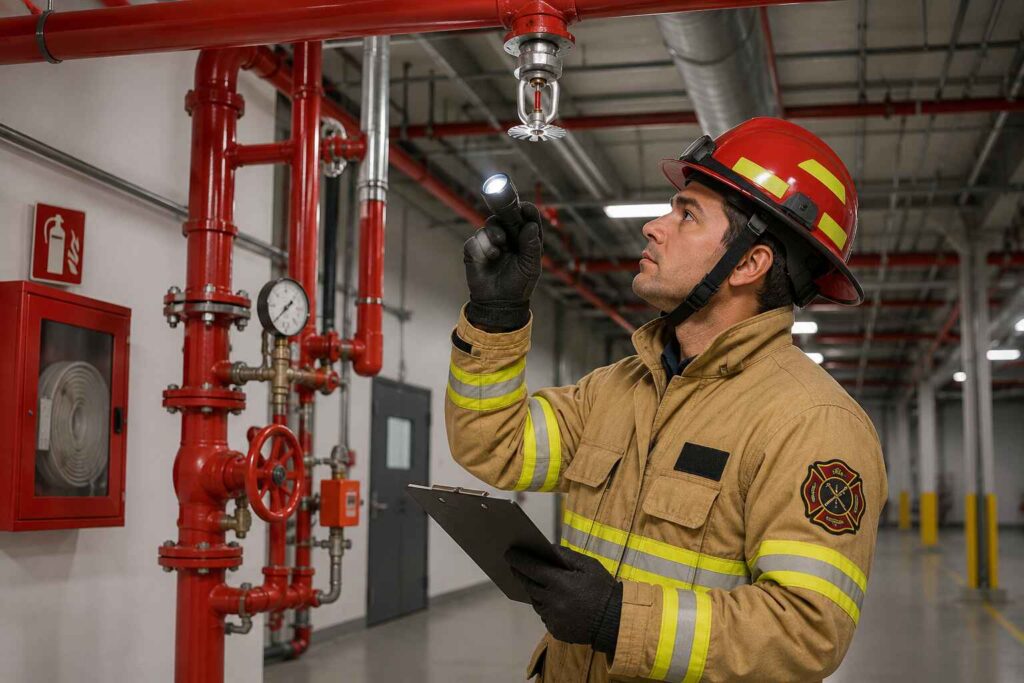
This is the big one most people picture when they think “sprinkler inspection.” A licensed technician does a full walkthrough, checking every visible sprinkler head for damage, corrosion, or paint buildup, testing alarm devices, flushing where needed, and inspecting pipe hangers and supports. This is also where obstruction investigations and internal gauge testing typically happen on their required cycles.
The 5-Year Internal Inspection
Every five years, the system needs an internal look, literally opening it up to check for internal corrosion, obstruction, or foreign material inside the piping. Sprinkler heads that are 50 years old or older (or certain older models flagged by the manufacturer) may also need to be sample-tested or replaced at this stage.
Stack all of that together and you get a rhythm: something small happening monthly, a bit more quarterly, a thorough review annually, and a deep internal check every five years. That layered approach is the real answer behind “how often should commercial fire sprinklers be inspected.” It isn’t one number, it’s a system of checkpoints, and that’s exactly why we build commercial fire sprinkler inspection frequency into a recurring calendar for every client instead of a single annual reminder.
What Actually Happens During a Commercial Fire Sprinkler Inspection
Visual Checks vs. Functional Testing
Not every inspection point is created equal. A visual check might mean confirming a valve is open or a gauge needle sits in the right zone. Functional testing goes further, actually triggering alarm devices, flow-testing water through the system, or verifying that a fire pump kicks on the way it’s supposed to. Both matter. A sprinkler head can look perfectly fine and still fail to activate when it counts, which is exactly why the layered inspection schedule exists instead of relying on a single once-a-year walkthrough.
Common Issues Techs Find
Painted-over heads, corroded pipe sections, blocked valves hidden behind stored inventory, missing or damaged escutcheons, and gauges reading outside normal range are some of the most frequent findings during routine visits. One of our techs once found a sprinkler head buried behind a stack of file boxes in a leased office suite, completely blocked from doing its job during a tenant move-in. None of these issues are dramatic on their own. Left alone long enough, though, they add up to a system that might not perform when a fire actually breaks out.
Why Commercial Fire Sprinkler Inspection Frequency Isn’t the Same for Everyone
Building Type and Occupancy
A quiet office building and a busy commercial kitchen don’t carry the same fire risk, so it makes sense their inspection needs differ slightly too. Hospitals, warehouses, and data centers often carry additional layers of scrutiny because of what’s stored inside or how critical uptime is to operations. Hotels see heavier foot traffic and more chances for a sprinkler head to get bumped or damaged. In our own service work across the Bay Area, warehouses with high-piled storage almost always need more frequent obstruction checks than a standard office suite, simply because pallets and racking shift the water spray pattern in ways a flat office ceiling never will. Every occupancy type has its own quirks worth factoring in.
Local Fire Marshal Requirements
NFPA 25 sets the national baseline, but local authorities having jurisdiction can add their own requirements on top of it. Some California cities require documentation to be filed annually with the fire department directly, and requirements can shift slightly between counties within the same Bay Area region. Ignoring the local layer because you’ve satisfied the national one is a common and avoidable mistake, and it’s the kind of detail an experienced local contractor tends to catch before it becomes a citation.
What Happens If You Skip Inspections
Beyond the obvious safety risk, skipped inspections tend to snowball into bigger problems. Insurance carriers can deny claims if they find out required inspections weren’t performed. Fire marshals can red-tag a building during a routine visit, which can mean a temporary shutdown while repairs happen. And frankly, the cost of a small fix caught early is nothing compared to replacing an entire section of corroded pipe after years of neglect. Prevention really is cheaper than the alternative here.
Pairing Sprinklers With Commercial Fire Alarm Services
Sprinklers rarely work in isolation. Most commercial buildings tie their sprinkler flow switches directly into the fire alarm panel, so when water starts moving, the alarm sounds and, often, a signal gets sent to the monitoring company or fire department. That means your sprinkler inspection schedule and your commercial fire alarm services schedule really need to move together. A perfectly maintained sprinkler system connected to a neglected alarm panel is still a gap in your protection.
We’ve been called out more than once to a building where the sprinkler system passed with flying colors, but the alarm panel hadn’t been tested in years and no longer communicated with the monitoring station. That’s not a hypothetical risk, it’s a real gap we see in the field. Coordinating commercial fire alarm services with sprinkler inspections closes that gap, and it’s why our own technicians handle both under one visit whenever possible instead of treating them as separate line items.
How to Choose the Right Fire Protection Partner
Look for a contractor who’s licensed, familiar with NFPA 25, and willing to walk you through findings in plain language instead of burying you in jargon. Ask about credentials directly: is the technician NICET-certified, is the company licensed under a C-16 classification, and can they show proof of insurance and bonding? Ask whether they handle both sprinkler inspections and commercial fire alarm services, since coordinating both under one team tends to catch more issues than juggling separate vendors. A good technician should leave you with a clear, itemized report, not just a checked box on an invoice.
Conclusion
At the end of the day, sprinkler inspections aren’t glamorous. Nobody’s excited to schedule them, and it’s easy to push them down the priority list when business is busy. But treating your inspection schedule seriously is one of the cheapest forms of insurance you’ll ever buy, both literally and figuratively. Staying consistent with your commercial fire sprinkler inspection frequency protects your people, your property, and your ability to keep the doors open after something goes wrong. Set the calendar reminders, work with a licensed, credentialed team, and don’t let a painted-over sprinkler head be the reason a small problem turns into a very expensive one. Our crews at Raptor Fire Protection have spent years building that kind of consistency for businesses across the Bay Area, and it’s a habit worth building for your own building too.
FAQs
- How often should commercial fire sprinklers be inspected by law?
Most jurisdictions follow NFPA 25, which requires monthly, quarterly, annual, and 5-year inspection cycles depending on the component. Local fire codes may add extra requirements on top of that baseline.
- Can I inspect my own sprinkler system, or does it need to be a licensed technician?
Basic monthly gauge checks can often be done by building staff, but functional testing and the annual inspection typically require a licensed fire protection contractor to meet code and insurance requirements.
- What’s the difference between a sprinkler inspection and a sprinkler test?
An inspection is largely visual, checking for damage, corrosion, or blockages. A test actually activates components, like flow switches or alarm devices, to confirm they function correctly under real conditions.
- Do commercial fire alarm services need to be scheduled separately from sprinkler inspections?
They can be scheduled together, and often should be, since flow switches and alarm panels are usually connected. Coordinating both with the same provider tends to reduce scheduling headaches and missed items.
- What happens if my building fails a sprinkler inspection?
The contractor will typically document the deficiencies and give you a timeline to correct them. Depending on severity, a fire marshal may require repairs before the building can pass its next compliance check.