Explore the complete guide to Loan Origination Systems for NBFCs, fintechs & banks. Learn LOS features, benefits, workflows, automation, integrations & more.
The lending industry is rapidly moving from manual, paperwork-heavy processes to automated and digital-first lending. Banks, Non-Banking Financial Companies (NBFCs), fintech companies, microfinance institutions, and other lenders increasingly need technology that can manage loan applications, customer onboarding, KYC, credit assessment, underwriting, approvals, documentation, and disbursement through a single, streamlined workflow.
This is where a Loan Origination System (LOS) becomes essential.
A Loan Origination System is a technology platform that automates and manages the loan journey from application submission to sanction and disbursement. Instead of relying on spreadsheets, emails, disconnected systems, and manual verification, an LOS creates a structured digital process that helps lenders improve speed, consistency, visibility, risk management, and customer experience.
For modern lenders, the right LOS can become the foundation for scalable digital lending operations.
What Is a Loan Origination System?
A Loan Origination System (LOS) is software designed to manage and automate the front-end process of lending.
It typically begins when a borrower submits a loan application and continues through:
- Customer onboarding
- Application capture
- KYC and identity verification
- Document collection
- Data validation
- Credit bureau checks
- Fraud checks
- Credit scoring
- Eligibility assessment
- Underwriting
- Rule-based decisioning
- Approval workflows
- Sanction
- Agreement generation
- E-signing
- Disbursement initiation
A modern LOS can integrate with credit bureaus, KYC providers, banking systems, payment gateways, CRMs, accounting platforms, analytics tools, and other third-party services through APIs.
For banks, NBFCs, and fintech companies, this creates a centralized digital lending workflow instead of multiple disconnected operational systems.
Why Do NBFCs, Fintechs and Banks Need an LOS?
Traditional lending processes often involve significant manual intervention. Loan officers may have to collect documents, verify information, perform credit checks, communicate with customers, obtain approvals, and update multiple systems.
As loan volumes increase, these processes can become difficult to manage.
A modern LOS helps lenders automate repetitive activities while creating standardized workflows.
1. Faster Loan Processing
Automation can reduce the time required to process applications by automatically collecting information, validating data, initiating verification checks, and routing applications to the appropriate decision-maker.
For digital lenders, faster processing can improve customer experience and reduce application drop-offs.
2. Automated Credit Assessment
An LOS can connect with credit bureaus and other data sources to support credit assessment.
Lenders can configure eligibility criteria, credit policies, scorecards, and decisioning rules according to their lending products and risk appetite.
3. Better Risk Management
A centralized origination platform can apply predefined credit policies consistently across applications.
Risk checks can include:
- Credit score
- Existing liabilities
- Income assessment
- Banking information
- Repayment capacity
- Customer profile
- Fraud indicators
- Internal risk policies
- Product-specific eligibility rules
This helps lenders create a more structured underwriting process.
4. Reduced Manual Errors
Manual data entry can lead to errors, duplicate records, missing documents, and inconsistent decisions.
An LOS can automate data capture, validation, workflow routing, and document management, reducing dependency on repetitive manual activities.
5. Improved Customer Experience
Customers increasingly expect lending experiences similar to other digital services.
A digital LOS can support:
- Online applications
- Mobile-friendly journeys
- Digital document submission
- eKYC integrations
- Real-time application status
- Digital agreements
- Faster decisions
- Digital communication
The result can be a simpler and more transparent borrowing journey.
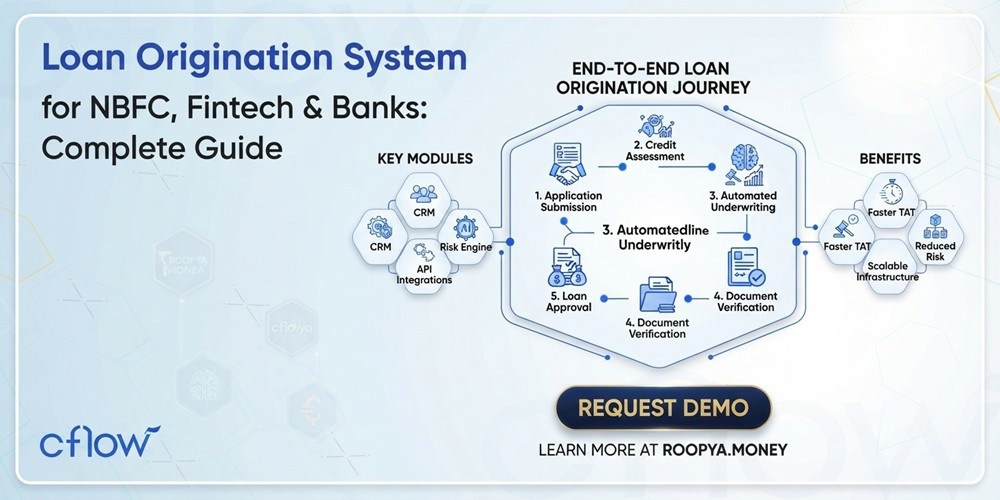
How Does a Loan Origination System Work?
A typical Loan Origination System follows a structured workflow.
Step 1: Customer Application
The borrower begins by submitting a loan application through a website, mobile application, branch interface, partner channel, DSA, or other acquisition channel.
The application may capture information such as:
- Name
- Contact information
- Address
- Employment details
- Income
- Business information
- Loan requirement
- Banking information
- Identity details
Step 2: Customer Onboarding
The LOS creates the customer profile and captures the information required for processing the application.
Depending on the lender’s workflow, the platform can initiate identity verification and KYC-related checks.
Step 3: KYC and Document Verification
The system can collect and verify required documents and information.
Depending on the product, documents may include:
- PAN
- Aadhaar-related information
- Address proof
- Income proof
- Bank statements
- GST information
- Business documents
- Property documents
- Other supporting documents
The exact requirements depend on the lender, product, borrower profile, and applicable regulations.
Step 4: Credit Bureau and Data Checks
The LOS can integrate with relevant credit bureaus and other approved data providers.
This allows lenders to retrieve information required for credit assessment and underwriting.
Step 5: Fraud Detection
Fraud prevention is an important part of modern digital lending.
An LOS can incorporate fraud rules and verification checks to identify potentially suspicious applications, duplicate identities, inconsistent information, unusual patterns, or other risk indicators.
Roopya highlights AI-powered fraud detection as part of its lending infrastructure.
Step 6: Credit Assessment
The system evaluates the application using configured credit policies.
Depending on the lender’s methodology, the assessment may consider:
- Credit history
- Income
- Existing obligations
- Repayment capacity
- Customer segment
- Loan amount
- Loan tenure
- Collateral
- Risk score
- Internal policies
Step 7: Automated Decisioning
A Business Rule Engine can evaluate applications against predefined lending policies.
For example:
If applicant meets all eligibility conditions → proceed to approval.
If application requires additional review → send to credit officer.
If application fails mandatory criteria → reject or refer.
This helps lenders standardize decisions while retaining appropriate human oversight.
Step 8: Underwriting and Approval
Applications requiring manual assessment can be routed to credit officers, underwriters, branch managers, or other authorized approvers.
Approval hierarchies can be configured according to:
- Loan amount
- Risk category
- Product
- Geography
- Customer type
- Credit score
- Collateral value
- Authority limits
Step 9: Sanction and Documentation
After approval, the lender can generate sanction-related documentation and loan agreements.
Digital workflows may also support e-signing and document storage where applicable.
Step 10: Disbursement
After all required conditions are fulfilled, the application moves toward disbursement.
The LOS can communicate with payment or banking infrastructure to support the lender’s disbursement workflow.
The loan can then transition into the Loan Management System (LMS) for servicing and portfolio management.
Key Features of a Loan Origination System
A modern LOS should provide more than a digital application form.
1. Digital Loan Application
The system should support configurable application forms for different loan products.
For example:
- Personal loans
- Business loans
- MSME loans
- Consumer loans
- Vehicle loans
- Microfinance loans
- Secured loans
- Working capital loans
2. KYC and Verification Integration
Integrations with relevant verification services can help lenders automate customer verification and reduce manual processes.
3. Credit Bureau Integration
A robust LOS should be capable of connecting with credit information providers and using relevant credit data within the lender’s underwriting workflow.
4. Business Rule Engine
A configurable Business Rule Engine is one of the most important components of an enterprise LOS.
It allows lenders to create policies without changing the underlying application every time a lending rule changes.
Roopya provides a no-code Business Rule Engine designed to allow lending teams to configure credit policies and approval workflows.
5. Automated Credit Decisioning
Automated decisioning can evaluate applications against predefined criteria and route them accordingly.
This can help lenders process high application volumes more efficiently.
6. Document Management
The LOS should allow lenders to collect, verify, store, and manage loan-related documents.
7. Workflow Management
Different loan products require different approval processes.
A configurable workflow engine allows lenders to create product-specific journeys.
8. Fraud Detection
Fraud detection tools can identify suspicious applications and help lenders strengthen controls before approval.
9. API Integrations
Modern lending depends on multiple technology providers.
An API-first LOS can connect with:
- Credit bureaus
- KYC providers
- Banking systems
- Payment gateways
- CRMs
- ERP systems
- Account aggregation ecosystems
- Verification providers
- Communication platforms
- Analytics systems
Roopya states that its platform includes 300+ pre-integrated APIs and an open REST API architecture.
10. Real-Time Decisioning
Real-time or near-real-time decisioning can significantly improve digital lending journeys where the necessary data and checks are available.
11. Audit Trail
An enterprise lending system should maintain appropriate records of application activity, decisions, approvals, changes, and user actions.
This can improve operational visibility and support internal controls and audit requirements.
12. Analytics and Reporting
Lenders need visibility into application volumes, approval rates, rejection reasons, turnaround times, disbursements, risk segments, and other operational metrics.
An LOS should therefore provide reporting and analytics capabilities or integrate with analytics platforms.
Loan Origination System for NBFCs
NBFCs operate across diverse lending segments, including consumer finance, MSME lending, vehicle finance, microfinance, business loans, secured lending, and other credit products.
An LOS can help NBFCs standardize and automate origination across multiple products and channels.
Benefits for NBFCs
- Faster application processing
- Configurable credit policies
- Automated verification
- Centralized application management
- Improved underwriting workflows
- Better fraud controls
- Reduced operational workload
- Multi-product support
- API-based integrations
- Better auditability
- Improved customer experience
- Scalable lending infrastructure
For growing NBFCs, the ability to launch or modify loan products without rebuilding technology infrastructure can be particularly valuable.
Loan Origination System for Fintech Companies
Fintech lenders typically operate in highly digital environments.
Their customers may expect a loan journey that takes minutes rather than days.
A fintech-focused LOS can support:
- Digital customer acquisition
- Mobile-first applications
- Automated verification
- Credit bureau integrations
- API-driven data processing
- Automated underwriting
- Rule-based decisioning
- Fraud detection
- Digital agreements
- Automated communication
- Disbursement workflows
An API-first architecture can also make it easier for fintech companies to integrate their lending stack with existing applications and third-party platforms.
Loan Origination System for Banks
Banks often operate complex technology environments involving core banking systems, CRM platforms, credit systems, document management platforms, payment infrastructure, and multiple internal departments.
An enterprise LOS should therefore be capable of integrating with existing banking infrastructure.
Important capabilities include:
- Multi-product lending
- Multi-level approval workflows
- Credit policy management
- Document management
- Integration capabilities
- Risk assessment
- Audit trails
- Reporting
- Security controls
- User and role management
- Branch and channel support
The objective is not simply to digitize applications but to create a connected lending workflow.
LOS vs LMS: What Is the Difference?
Loan Origination System and Loan Management System are related but different.
Loan Origination System
LOS manages the process of creating a loan.
It generally covers:
Application → Verification → Credit Assessment → Underwriting → Approval → Sanction → Disbursement
Loan Management System
LMS manages the loan after origination.
It can cover:
- Loan servicing
- EMI schedules
- Interest calculations
- Repayments
- Payments
- Account management
- Portfolio monitoring
- Customer servicing
- Delinquency management
- Collections
An integrated LOS + LMS environment allows lenders to manage the complete lending lifecycle.
Roopya positions itself as a unified lending infrastructure covering origination through collections.
LOS vs Manual Lending Process
| Manual Lending | Modern LOS |
|---|---|
| Paper-based applications | Digital applications |
| Manual verification | Automated verification |
| Spreadsheet-based tracking | Centralized workflow |
| Manual credit checks | Integrated credit checks |
| Email-based approvals | Configurable approval workflows |
| High dependency on employees | Process automation |
| Difficult to scale | Designed for scalability |
| Limited visibility | Real-time dashboards and reporting |
| Higher operational errors | Automated validation |
| Slow processing | Faster decisioning |
Benefits of Implementing a Loan Origination System
Faster Turnaround Time
Automation can reduce repetitive manual tasks and improve application processing speed.
Higher Operational Efficiency
Employees can focus on higher-value underwriting and customer activities instead of repetitive data entry.
Better Decision Consistency
Rules and policies can be standardized across applications.
Improved Risk Controls
Automated checks and configurable policies can strengthen the underwriting process.
Better Customer Experience
Digital onboarding and faster decisions can create a smoother borrower journey.
Easy Product Configuration
No-code or low-code platforms can allow business teams to configure workflows and policies more quickly.
Better Scalability
A centralized technology platform can help lenders manage increasing application volumes without proportionally increasing manual operations.
How to Choose the Right Loan Origination System
Before selecting an LOS, banks, NBFCs, and fintech companies should evaluate several factors.
1. Business Requirements
Identify the products, customer segments, channels, geographies, and loan volumes the system must support.
2. Configurability
The platform should allow business users to modify workflows, rules, forms, policies, and approval hierarchies without depending entirely on developers.
3. Integration Capabilities
Check whether the platform can integrate with your existing and required third-party systems.
4. Security and Data Governance
Because lending platforms process sensitive financial and identity information, security, access control, data governance, logging, and operational resilience should be evaluated carefully.
5. Scalability
The LOS should be able to handle increasing application volumes, additional products, and new lending channels.
6. Automation
Evaluate how much of the lending journey can actually be automated.
7. Analytics
The platform should provide meaningful operational and lending insights.
8. Compliance Readiness
The lender remains responsible for complying with applicable laws and regulatory requirements. Technology should support the lender’s compliance processes rather than be treated as a substitute for legal or regulatory review.
RBI’s regulatory framework has increasingly emphasized digital lending, customer protection, KFS requirements, responsible outsourcing/LSP arrangements, fraud controls, and data governance.
Why Roopya for Loan Origination?
Roopya positions its platform as a unified, no-code lending infrastructure for modern lenders.
Its platform includes capabilities such as:
- Loan Origination System
- Loan Management System
- Collections
- Lending Analytics
- Credit Risk Analytics
- Digital application forms
- Automated credit scoring
- Document verification
- Real-time decisioning
- AI-powered fraud detection
- No-code Business Rule Engine
- REST API architecture
- 300+ pre-integrated APIs
- 20+ pre-configured loan products
These capabilities are presented on Roopya’s current platform website.
The platform also highlights a plug-and-play approach, no-code configuration, pay-as-you-use pricing, and rapid implementation.
For lenders looking to modernize their origination infrastructure, this type of architecture can provide a foundation for launching, configuring, and scaling digital lending products.
The Future of Loan Origination
Loan origination is moving toward greater automation, intelligent decisioning, API-driven infrastructure, and real-time analytics.
Artificial intelligence is also becoming increasingly relevant to lending. In August 2026, RBI Governor Sanjay Malhotra highlighted the potential of AI to transform lending, while emphasizing that banks need to actively engage with AI and strengthen appropriate governance and safeguards.
Future-generation LOS platforms are therefore likely to combine:
- AI-assisted underwriting
- Automated fraud detection
- Intelligent document processing
- Predictive credit analytics
- Automated decisioning
- API-first architecture
- Real-time risk monitoring
- Personalized loan journeys
- Automated workflow orchestration
- Advanced portfolio analytics
However, automation should operate within appropriate credit policies, governance, security controls, regulatory requirements, and human oversight.
A Loan Origination System for NBFCs, fintech companies, and banks is more than software for collecting loan applications. It is a technology layer that can connect customer onboarding, KYC, verification, credit assessment, underwriting, decisioning, approval, documentation, and disbursement into a structured digital process.
For lenders looking to improve efficiency, reduce manual work, strengthen risk controls, accelerate loan processing, and scale digital lending, an LOS can become a critical part of the lending technology stack.
The ideal platform should combine automation, configurability, integrations, security, analytics, scalability, and compliance-supporting capabilities.
With its no-code lending infrastructure, configurable business rules, API ecosystem, automated decisioning, fraud detection, and broader lending lifecycle capabilities, Roopya is positioned as a platform for lenders looking to modernize their lending operations.
For banks, NBFCs, and fintech companies evaluating their next-generation lending infrastructure, the key question is no longer whether lending should be digitized, but how effectively the technology can support faster, smarter, safer, and more scalable lending.
Explore Roopya’s Loan Origination Platform and modernize your lending journey with configurable, automated lending infrastructure.
FAQ Content
1. What is a Loan Origination System?
A Loan Origination System (LOS) is software that automates and manages the loan application process from customer onboarding and verification through credit assessment, underwriting, approval, documentation, and disbursement.
2. Why do NBFCs need a Loan Origination System?
NBFCs use LOS platforms to automate lending workflows, improve processing efficiency, standardize credit policies, manage applications, integrate verification and credit services, and support scalable lending operations.
3. What is a Loan Origination System for banks?
A bank Loan Origination System is an enterprise lending platform that manages loan applications, credit assessment, underwriting, approval, documentation, and disbursement while integrating with banking and third-party systems.
4. How does an LOS help fintech companies?
A fintech LOS can automate digital applications, KYC workflows, credit checks, fraud detection, underwriting, decisioning, documentation, and disbursement workflows through APIs and configurable rules.
5. What are the main features of an LOS?
Important features include digital applications, KYC and verification, credit bureau integration, document management, credit scoring, Business Rule Engine, automated decisioning, underwriting workflows, fraud detection, approval management, APIs, reporting, and audit trails.
6. What is the difference between LOS and LMS?
LOS manages the process of creating and approving a loan, while LMS manages the loan after disbursement, including servicing, repayment schedules, payments, customer management, portfolio monitoring, and collections.
7. Can an LOS automate loan approval?
Yes. An LOS can evaluate applications against predefined credit policies and business rules and automatically approve, reject, or refer applications for manual review, subject to the lender’s configured policies and governance.
8. Can a Loan Origination System integrate with credit bureaus?
Yes. Modern LOS platforms can integrate with credit bureaus and other approved data providers through APIs to support credit assessment and underwriting.
9. Is a Loan Origination System useful for MSME lending?
Yes. An LOS can help MSME lenders automate application collection, business verification, financial assessment, credit checks, underwriting, approval workflows, documentation, and disbursement.
10. What is a no-code Loan Origination System?
A no-code LOS allows business users to configure forms, workflows, lending rules, approval processes, and other lending journeys through visual interfaces without requiring extensive software development.
11. What should lenders consider when choosing an LOS?
Lenders should evaluate configurability, integrations, automation, security, data governance, scalability, analytics, workflow management, fraud controls, implementation requirements, support, and compliance-related capabilities.
12. Is Roopya a Loan Origination System?
Roopya provides a lending infrastructure platform that includes Loan Origination System capabilities along with Loan Management, collections, lending analytics, credit risk analytics, configurable business rules, API integrations, and other lending capabilities.