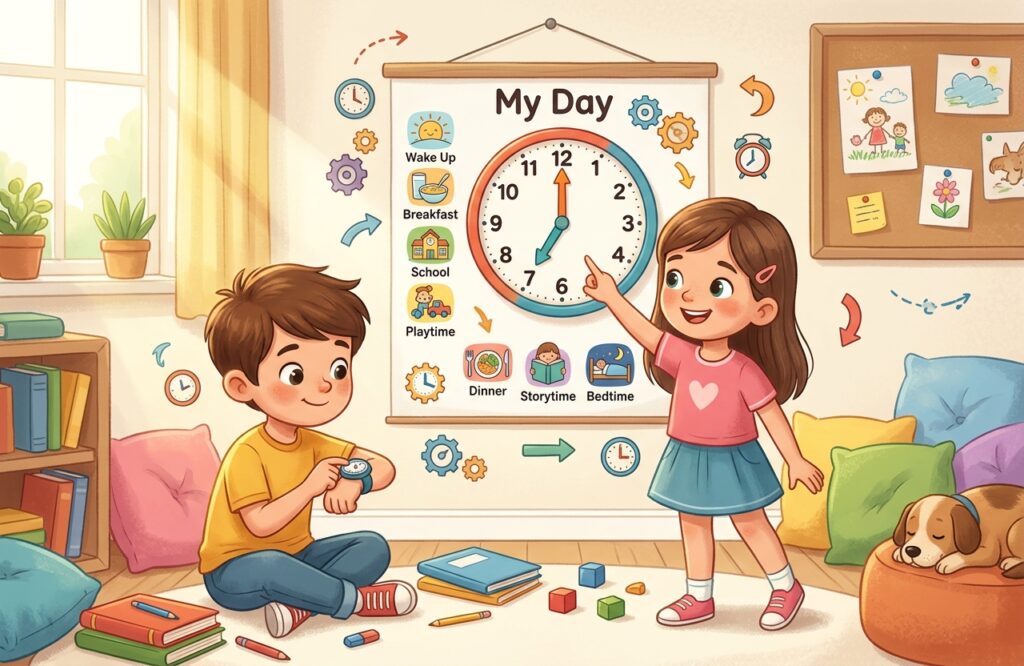
Learning to tell time is an important skill that helps children become more independent and understand how their day is organised. However, reading a clock can sometimes feel confusing for young learners. Instead of teaching time only through worksheets and numbers, parents and teachers can make the process easier by connecting it to familiar daily activities.
Using routines is one of the most practical ways to teach children about hours, minutes, morning, afternoon, and evening. When children regularly see how time relates to waking up, eating meals, going to school, playing, and going to bed, the concept becomes more meaningful. This article explains how to teach kids about telling time with routines using simple, engaging, and practical methods.
Why Are Routines Helpful for Teaching Time?
Children learn best when new concepts are connected to things they already understand. Daily routines provide natural examples of how time works.
For example, a child may know that breakfast happens before school and bedtime comes after dinner. Parents can use these familiar events to introduce specific times.
Instead of simply saying, “This is 7 o’clock,” you can say, “We usually eat breakfast at 7 o’clock.” This gives the number a real-life meaning.
Routines also allow children to notice patterns. They begin to understand that certain activities happen at approximately the same time each day.
Start With Familiar Daily Activities
The easiest way to begin teaching time is to focus on activities your child already does every day.
Create a simple routine such as:
- 7:00 – Wake up
- 7:30 – Eat breakfast
- 8:00 – Get ready for school
- 12:00 – Eat lunch
- 4:00 – Play
- 6:30 – Eat dinner
- 8:00 – Go to bed
Talk about the routine with your child and ask questions such as, “What do we do at 7 o’clock?” or “What happens after lunch?”
These questions help children connect clock times with everyday events.
Teach Hours Before Minutes
When children are first learning to tell time, it is usually easier to introduce whole hours before moving to minutes.
Start by showing an analogue clock and explaining that the short hand shows the hour. Practice simple examples such as 3:00, 5:00, and 8:00.
Connect each example to the child’s routine.
For instance, if bedtime is 8:00, show the clock and explain that the short hand points to 8 while the long hand points to 12.
Once the child becomes comfortable with whole hours, introduce half-hours and then quarter-hours. Eventually, you can introduce five-minute intervals and individual minutes.
Use a Visual Daily Schedule
A visual schedule can make learning about time much more interactive. Create a chart containing pictures or simple drawings of daily activities alongside their times.
For example:
7:00 – Wake up
8:00 – School
12:30 – Lunch
3:30 – Homework
5:00 – Playtime
8:00 – Bedtime
Place the schedule somewhere your child can easily see it.
Throughout the day, point to the schedule and ask your child to identify what activity is coming next. You can also ask, “What time is it?” and encourage the child to compare the actual clock with the schedule.
Turn Routine Activities Into Time Questions
Everyday moments provide opportunities for short lessons. You do not need to sit down for a formal lesson every time.
While preparing breakfast, ask, “What time do we usually have breakfast?”
Before leaving for school, ask, “Is it 7:30 or 8:00?”
During playtime, ask, “How long until dinner?”
These simple questions encourage children to think about time naturally. Repetition is especially useful because children gradually become more confident without feeling pressured.
Teach the Difference Between Morning and Evening
Young children may understand clock numbers but still struggle to understand when those times occur during the day.
Explain that the same number can represent different parts of the day. For example, 7:00 in the morning may be breakfast time, while 7:00 in the evening may be dinner or family time.
Use familiar activities to explain the difference between AM and PM.
You can create two sections on a routine chart:
Morning: Wake up, breakfast, school
Afternoon: Lunch, homework, play
Evening: Dinner, bath, bedtime
This helps children understand that time is not only about reading numbers on a clock but also about understanding where those numbers fit into the day.
Practice With an Analogue Clock
Digital clocks are easy to read because they display numbers directly, but analogue clocks help children understand how hours and minutes work.
Use a teaching clock with movable hands. Set it to times from the child’s daily routine and ask them to identify the time.
Then reverse the activity. Tell your child a routine activity and ask them to move the clock hands to the appropriate time.
For example:
“Bedtime is 8 o’clock. Can you set the clock?”
This makes practice more hands-on and helps reinforce the relationship between routines and clock positions.
Teach Time Through Games
Games can make repeated practice more enjoyable.
One simple activity is a “What Time Is It?” routine game. Write several daily activities on cards and place different times on other cards. Ask your child to match each activity with the correct time.
You can also play a sequencing game. Give your child cards showing waking up, breakfast, school, lunch, homework, dinner, and bedtime. Ask them to arrange the activities in the correct order and then add a time to each one.
Another useful activity is to deliberately make a mistake. For example, say, “We have breakfast at 8 PM.” Ask your child whether that sounds correct and why.
Introduce Time Duration
Once children understand basic clock reading, begin teaching them how long activities take.
For example, explain that:
- Breakfast takes about 20 minutes.
- A short play session may last 30 minutes.
- Homework may take one hour.
- Bedtime preparation may take 15 minutes.
Ask questions such as, “If we start homework at 4:00 and finish at 5:00, how long did it take?”
This builds an understanding of elapsed time and prepares children for more advanced time-related maths.
Be Patient and Consistent
Learning to tell time does not happen overnight. Some children may quickly recognise whole hours but struggle with minutes. Others may understand digital time before analogue clocks.
Keep practice short and consistent. Five to ten minutes of daily practice can be more effective than a long lesson once a week.
Avoid turning mistakes into a source of frustration. Correct the answer calmly and give the child another opportunity to try.
The goal is to help children understand time as part of everyday life rather than memorise clock positions without meaning.
How Can Parents Make Time Learning Part of Everyday Life?
Parents can reinforce learning simply by talking about time throughout the day. Mention the time when starting familiar activities and encourage children to check clocks independently.
For example, say, “It is nearly 6 o’clock, so we need to get ready for dinner.”
As children become more confident, encourage them to take responsibility for small parts of their routine. They might check the clock before starting homework or prepare for bedtime when they notice that the appropriate time is approaching.
This gives children a practical reason to use their time-telling skills.
Conclusion
Teaching children to tell time becomes easier when the skill is connected to activities they already understand. Daily routines provide meaningful examples that show children why time matters and how it helps organise their lives.
By starting with familiar activities, teaching whole hours before minutes, using visual schedules, practising with analogue clocks, and introducing simple time games, parents can make learning engaging and practical. Most importantly, regular practice and patience can help children gradually develop confidence.
When children learn how to teach kids about telling time with routines, they are not simply learning to read a clock. They are developing independence, organisation, and an understanding of how their day is structured.