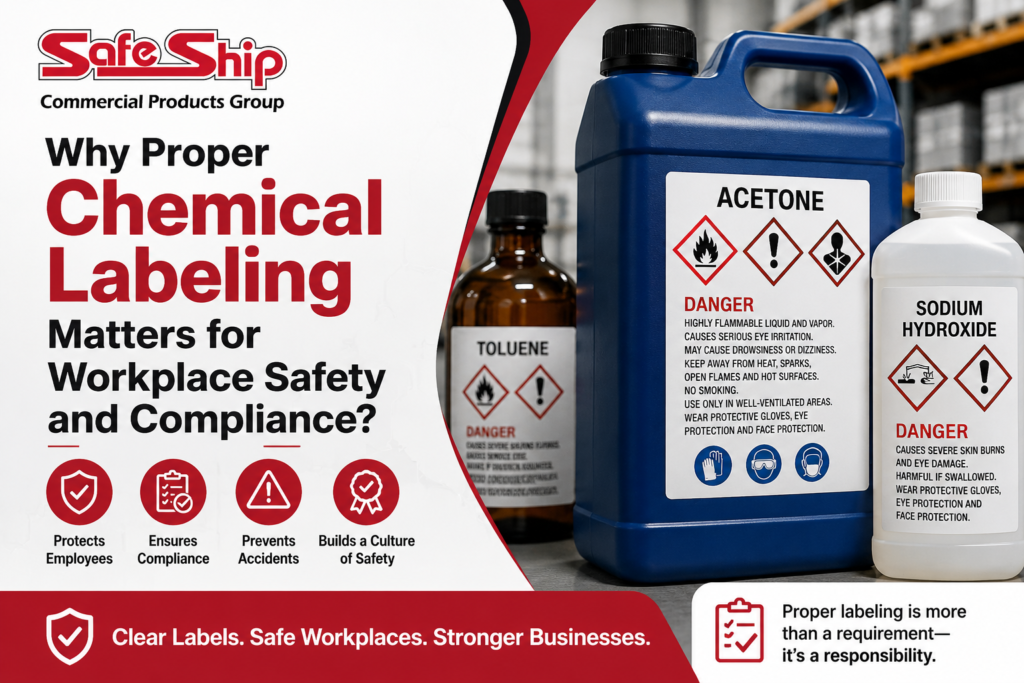
Chemical Labeling
Businesses that manufacture, store, transport, or use chemicals have a responsibility to ensure that important information remains clear and accessible. Employees need to know what materials they are handling, what hazards may be associated with them, and how those materials should be stored or handled.
Chemical labels play an important role in communicating this information.
A well-designed chemical label can identify a substance, communicate hazards, provide handling information, and help employees distinguish between different materials. In demanding industrial environments, however, chemical labeling also presents unique challenges because labels may be exposed to solvents, moisture, temperature changes, abrasion, and other harsh conditions.
For businesses working with chemicals, selecting an appropriate labeling solution is therefore about much more than printing a name on a container.
Why Chemical Labeling Is Important
Chemical containers can look very similar, particularly when multiple substances are stored in the same facility.
Without clear identification, employees may have difficulty determining exactly what a container holds.
Proper labeling can help communicate information such as:
- Chemical name
- Product identification
- Hazard information
- Handling precautions
- Storage requirements
- Warning symbols
- Manufacturer information
- Batch or lot information
Clear identification helps employees understand what they are dealing with before handling or moving a material.
Chemical Labels Support Workplace Safety
Workplace safety depends partly on employees having access to accurate information.
When hazardous materials are properly identified, employees can more easily recognize potential risks and follow established workplace procedures.
Chemical labels can help communicate hazards involving:
- Flammability
- Toxicity
- Corrosiveness
- Reactivity
- Irritation
- Environmental hazards
- Other chemical risks
Labels are not a replacement for employee training or established safety procedures, but they are an important part of communicating information at the point where materials are stored or used.
Clear Identification Reduces Confusion
Imagine a storage area containing dozens of containers.
Some may contain cleaning chemicals. Others may contain solvents, industrial fluids, raw materials, or finished chemical products.
If containers aren’t clearly identified, employees may need to spend additional time checking records or asking supervisors before moving or using a material.
Clear labeling provides immediate identification.
This can improve workflow while reducing the possibility of selecting the wrong container.
Chemical Labels Need to Remain Readable
A chemical label isn’t useful if the information disappears after exposure to the environment.
Industrial chemical containers may encounter:
- Solvents
- Oils
- Acids
- Cleaning agents
- Water
- Humidity
- Temperature changes
- Abrasion
- Frequent handling
These conditions can cause ordinary labels to fade, smear, peel, or deteriorate.
For chemical applications, businesses should therefore consider label durability from the beginning.
Choosing the Right Label Material
The correct label material depends on the chemical environment.
A label that performs well on a dry storage shelf may not be suitable for a container that is regularly exposed to chemicals or cleaning processes.
Businesses should consider:
Chemical Exposure
What chemicals might come into contact with the label?
Temperature
Will the container be exposed to high or low temperatures?
Moisture
Will the label encounter water, humidity, condensation, or washing?
Handling
Will employees frequently move or handle the container?
Outdoor Exposure
Will the chemical container be stored outside and exposed to sunlight?
Lifespan
Does the label need to remain in place for weeks, months, or years?
Answering these questions can help determine the appropriate label construction.
Adhesive Performance Is Equally Important
Chemical labeling isn’t just about the face material.
The adhesive needs to remain attached to the container under the expected conditions.
Adhesive performance can be affected by:
- Container material
- Surface texture
- Temperature
- Moisture
- Chemical exposure
- Curvature
- Surface contamination
For example, an adhesive that works well on clean, smooth plastic may perform differently on a textured or metal container.
The surface should therefore be considered when developing a chemical labeling solution.
Chemical Labels for Different Container Types
Businesses may need to label a wide variety of containers, including:
- Bottles
- Drums
- Barrels
- Tanks
- Pails
- Carboys
- Industrial containers
- Shipping containers
Each container can present different labeling requirements.
Size, shape, surface material, curvature, and expected handling conditions may all influence the label design.
Labels Can Support Chemical Inventory Management
Chemical labels can also help businesses manage their inventory.
Identification information can be connected to inventory records, allowing employees to understand:
- What chemical is stored
- How much is available
- Where it is located
- Which batch it belongs to
- When it was received
- When it was produced
When chemical identification is standardized, inventory management can become more organized.
Supporting Lot and Batch Identification
Manufacturers may need to track chemicals by lot or batch.
A label can provide a physical connection between a container and the corresponding production or inventory record.
This can support:
- Quality control
- Production tracking
- Inventory management
- Product identification
- Traceability
- Investigation of manufacturing issues
Accurate labeling becomes particularly valuable when businesses need to identify specific groups of products or materials.
Chemical Labeling and Supply Chain Operations
Chemical products often move through multiple stages before reaching their final destination.
For example:
Production → Storage → Warehouse → Shipping → Distribution → Customer
At each stage, the material needs to remain properly identified.
Labels can help maintain that identification as containers move between facilities or organizations.
Durable labels are particularly important when containers experience repeated handling during transportation.
Chemical Labels Need to Survive Transportation
Shipping environments can expose chemical containers to considerable movement.
Packages may experience:
- Vibration
- Friction
- Temperature changes
- Moisture
- Handling
- Stacking
A poorly constructed label can become damaged during transportation.
If important identification information becomes unreadable, receiving personnel may have difficulty determining what the container contains.
For this reason, chemical shipping applications require consideration of both label durability and readability.
Chemical Label Design Should Prioritize Readability
A chemical label needs to communicate information quickly.
Design should therefore consider:
- Font size
- Contrast
- Information hierarchy
- Symbol placement
- Label size
- Barcode readability
- Required information
Too much information packed into a small area can make a label difficult to read.
The goal is to present necessary information in a clear and organized format.
Barcodes and Chemical Labels
Chemical labels can also incorporate barcodes when businesses need to connect physical containers with digital records.
A barcode may be used to reference:
- Product information
- Batch numbers
- Inventory records
- Shipping details
- Production information
- Container identification
Scanning the label can reduce manual data entry and help employees retrieve information more efficiently.
For businesses with large chemical inventories, this can provide an additional layer of organization.
Chemical Labeling Can Support Traceability
Traceability allows businesses to understand where products and materials came from and where they went.
Chemical labels can help connect physical containers with digital records.
For example, a container may be associated with a specific:
- Production batch
- Lot number
- Manufacturing date
- Inventory location
- Shipment
- Customer order
This information can become valuable when investigating quality issues or tracking materials through the supply chain.
Common Chemical Labeling Problems
Businesses can experience labeling problems when the application isn’t properly evaluated.
Fading
Sunlight, chemicals, or environmental exposure can affect printed information.
Smearing
Poor printing or unsuitable materials may cause information to become difficult to read.
Peeling
Incompatible adhesives or poor surface preparation can cause labels to detach.
Chemical Damage
Certain substances can attack label materials or adhesives.
Incorrect Identification
Human errors during labeling can result in the wrong information being placed on a container.
Poor Placement
A label may become difficult to see if it is placed on an unsuitable area of the container.
Why Standardization Matters
Businesses handling large quantities of chemicals can benefit from consistent labeling practices.
Standardization can help employees recognize information more quickly.
Businesses can establish consistent approaches for:
- Product identification
- Hazard information
- Batch numbers
- Barcodes
- Storage information
- Container identification
A standardized system can make chemical management more predictable across departments and facilities.
Compliance Is More Than a Label
Chemical labeling can be an important part of workplace safety and regulatory compliance, but businesses should not treat labels as the only compliance requirement.
Organizations may also need appropriate:
- Safety documentation
- Employee training
- Storage procedures
- Handling procedures
- Hazard communication practices
- Transportation procedures
Specific requirements can vary based on the chemicals involved, industry, location, and application.
Businesses should ensure that their labeling processes are developed alongside their broader safety and compliance programs.
How to Develop a Better Chemical Labeling Strategy
A practical chemical labeling process can begin with an assessment of the actual application.
Step 1: Identify the Chemical
Determine what substance or product is being labeled.
Step 2: Understand the Environment
Identify potential exposure to chemicals, heat, moisture, sunlight, and abrasion.
Step 3: Evaluate the Container
Consider the container’s material, shape, texture, and size.
Step 4: Determine Required Information
Identify what information employees, warehouse teams, shipping personnel, and other users need.
Step 5: Choose Appropriate Materials
Select label materials and adhesives that match the environment.
Step 6: Consider Barcodes
If digital tracking is required, determine whether barcode identification should be incorporated.
Step 7: Test the Labels
Testing labels in actual operating conditions can help identify durability or adhesion problems before full implementation.
Why Custom Chemical Labels Can Be Better
Chemical manufacturers and industrial businesses often have specialized requirements.
An off-the-shelf label may not provide the right combination of:
- Material
- Adhesive
- Size
- Shape
- Printing
- Durability
- Chemical resistance
- Information
Custom chemical labels allow businesses to develop solutions around the actual container and environment.
This can help ensure that labels remain functional and readable for the intended application.
Why Choose SSCPID for Custom Chemical Labeling Solutions?
SSCPID provides Custom Chemical Labeling Solutions for Businesses designed to support the identification and management requirements of chemical and industrial applications.
Chemical labeling requires careful consideration of the material being labeled, container surface, environmental exposure, required information, and expected lifespan.
A durable label can help businesses maintain clear identification through storage, handling, manufacturing, and shipping processes.
Whether chemical labels are needed for containers, drums, bottles, industrial products, inventory management, or shipping applications, SSCPID can help businesses develop labeling solutions around their specific requirements.
Frequently Asked Questions
- Why is chemical labeling important?
Chemical labels help identify materials and communicate important information about their contents and potential hazards. They can also support inventory management and traceability.
- What can damage chemical labels?
Chemicals, solvents, moisture, heat, sunlight, abrasion, and frequent handling can all affect label performance depending on the material and construction.
- Can chemical labels be customized?
Yes. Chemical labels can be customized based on container size, material, shape, required information, environmental conditions, and durability requirements.
- Can chemical labels include barcodes?
Yes. Barcodes can be incorporated into chemical labels to connect physical containers with inventory, production, shipping, or tracking systems.
- What should businesses consider when choosing chemical labels?
Businesses should consider chemical exposure, temperature, moisture, container material, surface texture, handling conditions, label lifespan, and required information.
- Are chemical labels part of workplace safety?
Yes. Clear chemical identification can support workplace safety by helping employees recognize materials and access important hazards and handling information. However, labeling should be used as part of a broader safety and hazard communication program.
Creating a Safer and More Organized Chemical Handling Process
Chemical labeling is a small but important part of industrial operations.
A clearly identified container helps employees understand what they are handling, supports inventory organization, and provides a physical connection between products and digital records.
However, chemical environments can be demanding. Labels may encounter substances, temperatures, moisture, abrasion, and transportation conditions that ordinary labels cannot withstand.
That is why businesses should select chemical labeling solutions based on the actual application.
For companies looking for Custom Chemical Labeling Solutions for Businesses, SSCPID can help develop labels designed around the specific requirements of the product, container, environment, and operational process.
With appropriate materials, adhesives, printing, identification information, and durability, businesses can create chemical labeling systems that remain clear and functional throughout storage, handling, manufacturing, and shipping.
Safe Ship Commercial Products Group
Address: 7753 Cox Ln, West Chester Township, OH 45069, United States