I didn’t run this test because I was curious. I ran it because my own site was doing everything the playbook said — regular posts, optimised pages, decent rankings — and enquiries had gone flat. Something had changed, and I wanted to see it with my own eyes instead of guessing.
So I typed 1,000 real search queries into Google, one at a time, logged out, in US English. For each one I wrote down whether an AI Overview appeared, and every source it cited inside the answer text. Not the panel on the side. The citations inside the words people actually read.
992 of the 1,000 showed an AI Overview. That number alone ended the argument for me. This isn’t a feature rolling out slowly. It’s the default now.
One thing about how I counted, because it matters: I only counted citations inside the overview text itself, in the order shown, repeats kept. The “show all” panel on the side is a different list and I treated it as secondary. And exactly one overview in the whole thousand cited nothing at all. One. Every other answer pointed somewhere.
Most citations aren’t websites at all
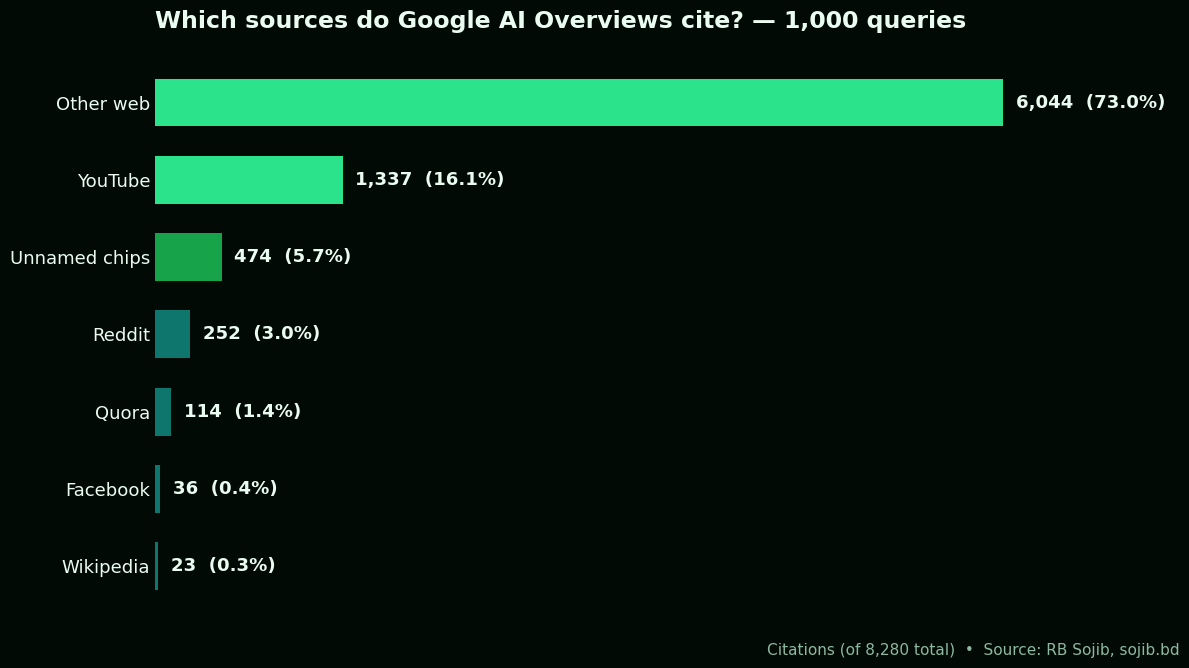
Across the 992 overviews I counted 8,280 citations. Nearly three quarters of them — 6,044 — pointed to ordinary web pages, the kind of result you’d expect. But the single biggest named source wasn’t a website. It was YouTube, with 1,337 citations. About one in six.
That surprised me. I write articles for a living, and I’d assumed text would dominate. It doesn’t. When Google’s AI answers a question, it leans on video more than on any single publisher. Other studies found the same thing — Ahrefs put YouTube at 24.5% of its citations in November, and an independent 1,274-run panel put it at 25.2%. My number is lower, but the order is the same. If you make how-to content and you’ve never turned it into a video, that’s a gap now, not a nice-to-have.
Reddit showed up 252 times. Quora 114. Wikipedia 23. Facebook 36. Read that again before you believe the next post claiming Reddit runs AI search. In my data it doesn’t. It’s a small slice. The loudest claims about AI search usually come from people who ran ten queries and wrote a thread about it. I ran a thousand.
474 of the citations had no name on them at all — just a link icon. The AI cited something and didn’t even say what it was. That’s worth remembering next time someone tells you brand mentions are enough. Sometimes the citation doesn’t carry your name anywhere.
One more pattern worth knowing: in 480 of the 992 overviews, a single source got cited three or more times. The AI picks a favourite and leans on it. Being the source it trusts matters more than being one of ten sources it mentions once.
The answers don’t stay still
I checked the same questions again nine days later. The answers had moved. Only 39 of 262 sources from the first round were still cited, and 22 of the 50 queries shared no sources at all with the first check. Same question, different answer, nine days apart.
That’s the part nobody selling an “AI visibility” package wants to dwell on. You can’t optimise once and hold a citation the way you hold a ranking. The model decides fresh each time. What you can do is be the clearest, most quotable answer on the page, so that when it decides, you’re the easy pick. That’s a different job from ranking, and most sites aren’t doing it yet.
Local searches are the shock
Here’s the part that should worry every local business owner. Of the 300 local queries I tested — “best plumber in Dallas”, that kind of search — 243 of the overviews cited no website domain at all. 81%.
The overview still names businesses. It shows ratings, sometimes. It just doesn’t link to their websites. A customer can read the answer, pick a business, and never touch a website. Your Google Business Profile is doing the selling now, whether you maintain it or not. Most of the ones I see on audits are half finished — wrong hours, two photos from 2019, no posts. That’s the page to fix first, before you write another blog post.
Ranking still helps — in that same follow-up test, only 41% of the pages ranking in the top ten got cited at all, and position one got cited in 33 of 44 overviews that had one. But ranking alone doesn’t guarantee the AI will use you.
So what do you actually do
Write answers the model can lift word for word. One question, answered in the first 40 to 60 words, in a plain sentence. That’s the whole job of the page, as far as I can tell from the data. Long introductions about your company history don’t get cited. Specific numbers, steps and comparisons do.
Put the same answer on video if you can. YouTube is the biggest single source in these answers, and a short video saying the same thing doubles your chances.
And if you’re a local business, stop treating your Google profile as admin work. It’s the page the AI reads when it decides whether to name you. Fill it in properly, keep the hours right, add real photos. It takes an afternoon and it counts more than the next five blog posts.
I published the full study with every query and the complete dataset here: AI overview citation study. Check it against your own searches. Type in your service and your city, read what the overview says about businesses like yours, and fix that page first. That’s where your next customer is reading about you right now.