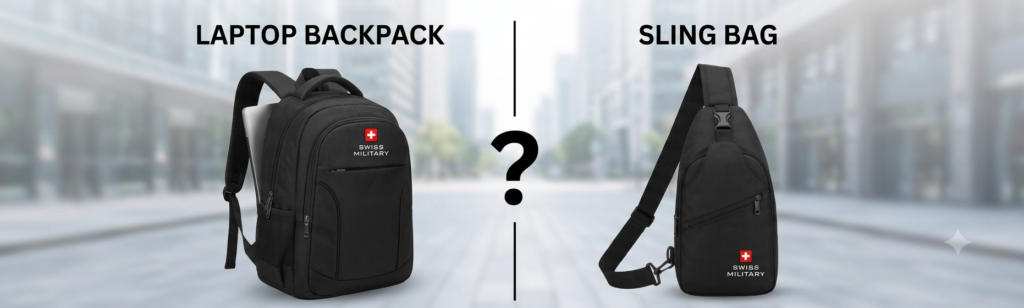
Every morning, the same choice. You’re heading out—office, campus, coffee shop, airport. Your laptop needs to come. And then you stand in front of your closet wondering: should I go backpack or sling bag today?
If this sounds familiar, you’re not alone. The laptop bag debate has been quietly heating up for years, especially as work culture shifted. Remote work days mixed with office ones. Business travel blended with city exploration. The simple answer—just pick one—doesn’t cut it anymore. You might need both. Or you might need to finally understand which one actually solves your problem.
Let’s settle this.
The Backpack Advantage: Built for Balance
A laptop backpack distributes weight across both shoulders. This matters more than it sounds. When you’re carrying 3-5 kilos of laptop, cables, documents, and daily essentials, that load spreading becomes the difference between a comfortable commute and a sore back by noon.
Backpacks also offer something sling bags simply can’t: symmetry. Your shoulders stay level. Your posture stays neutral. Over time—especially for people who commute daily—this protection matters. Office workers who spend eight hours at a desk, then walk fifteen minutes to transit, then sit another thirty minutes on a train, notice the difference quickly.
The capacity angle is huge too. A good laptop backpack gives you 20-35 liters of space. That’s room for your laptop, a tablet, multiple charging cables, a water bottle, snacks, documents, and still have breathing room. You’re not playing Tetris with your belongings. Everything has a place. Multiple pockets mean organization without digging through a single main compartment.
Then there’s the hands-free element. Shoulders carry the load, which frees your hands for a coffee, a phone, a door handle, whatever you need. On packed transit or in crowded office lobbies, having both hands available is genuinely convenient. You can take a call while walking. You can pull out your wallet without setting the bag down.
But here’s the trade-off nobody talks about: backpacks are less accessible. Need your laptop for a quick fifteen-minute meeting? You’re taking the whole thing off, opening it up, fishing around. Need to grab a specific document? Same process. For people who unpack and repack frequently throughout the day, this becomes exhausting.
And aesthetically? A backpack reads as casual. Professional backpacks exist, absolutely, but the form factor itself carries college vibes. If you’re walking into a client presentation or a board meeting and image matters, the backpack might work against you.
The Sling Bag Reality: Access Meets Style
A sling bag slings across your body—usually chest-oriented or positioned at your hip. You’re wearing it like a messenger bag’s more modern cousin. And that positioning changes everything.
The primary advantage is access. Reach down, open the main compartment, grab what you need. No taking the bag off. No gymnastics. This is why journalists, photographers, and anyone who needs frequent access to gear prefers sling bags. You live faster with a sling bag.
The aesthetic factor flips too. A well-designed sling bag reads as intentional. Professional. Urban. If you’re meeting clients or navigating formal settings, the sling bag carries authority backpacks don’t. It’s the bag of someone who knows what they’re doing—traveling, consulting, working. There’s confidence in that form.
Capacity is the obvious compromise. Sling bags typically hold 10-20 liters. Enough for a laptop, tablet, cables, and essentials. Enough for a business day. But you’re not packing a week’s worth of gym clothes and lunch containers. You’re packing efficiently.
Weight distribution matters here too. A sling bag puts load on one shoulder. For people carrying 3-5 kilos regularly, this creates asymmetry. Your body compensates. Your shoulder rides higher on one side. Posture shifts. Over years, this can become a real issue. People with existing shoulder problems often can’t wear sling bags comfortably for extended periods.
The surprise benefit? Sling bags are actually more secure in crowded environments. The bag sits at your chest level, under your arm, harder to access without you noticing. In packed transit or busy streets, you have eyes on your gear. Backpacks? Someone could unzip a side pocket and you’d never know.
The Real Difference: Your Actual Commute
This decision isn’t theoretical. It’s practical. And it depends entirely on how you move through your day.
Choose a laptop backpack if:
You commute via public transit more than twenty minutes daily. The weight distribution matters. Your shoulders will thank you.
You visit multiple locations daily. You need to carry a lot without digging through layers. You appreciate hands-free movement.
You’re in education or tech environments where backpack aesthetics don’t work against you. Nobody’s judging your form factor.
You spend more time moving (walking, commuting, traveling) than stationary (in meetings, at desks).
You have a history of shoulder or back issues. The two-shoulder load distribution is therapeutic.
Choose a sling bag if:
You need frequent access to your laptop during the day. Fifteen-minute unpacking cycles would drive you insane.
You move between short-distance locations. You’re not on transit for hours. You’re on the street for minutes.
Image matters in your professional environment. Clients, customers, or formal settings are regular. The sling bag aesthetic serves you.
You travel light. Your daily load is genuinely minimal—laptop, wallet, phone, maybe a tablet.
You want one-handed operation. You might hold coffee, papers, or a child in your other hand regularly.
What Everyone Gets Wrong
People assume a sling bag is lighter to carry. It’s not. A 3kg load on one shoulder is harder than on two, period. Physics doesn’t negotiate.
People assume a backpack takes longer to access. This depends on design. Quality backpacks with front pockets and quick-access compartments are nearly as fast as sling bags for common items.
People assume you have to choose just one. You probably don’t. Many professionals own both—a sling bag for short urban commutes and meetings, a backpack for full workdays and travel.
The Underrated Factor: Daily Ritual
Here’s something nobody mentions: how your bag makes you feel affects your day.
A backpack is settling in. It’s commitment. You put it on, and you’re prepared for the day. There’s something grounding about that weight on both shoulders, the solid structure supporting you.
A sling bag is mobile. It’s ready. It’s a signal to yourself that you’re moving, responding, going places. Literally lighter on one side, which some people interpret as freedom.
Neither feeling is objectively correct. But if your daily mood matters to your productivity—and it does—this intangible element is worth considering.
Hybrid Options Exist
Most people don’t realize this: companies make convertible laptop bags now. Backpacks with removable slings. Sling bags with back-panel designs that distribute weight across shoulders when packed heavy. These options give you flexibility.
There are also laptop backpacks with quick-access side pockets and angled designs that let you grab your laptop without removing the pack fully. Or sling bags with structured, padded compartments that protect like a backpack despite being compact.
If you genuinely can’t decide, these hybrid designs solve the problem.
Final Thought
The “best” laptop bag is the one you’ll actually use comfortably every single day. Comfort isn’t just physical—it’s mental. It’s aesthetic. It’s how the bag makes you feel when you sling it on.
If you try a backpack and feel weighted down, psychologically, a sling bag might be the shift you need even if the weight distribution is “worse” on paper. If a sling bag makes your shoulder hurt, no amount of style will offset chronic pain.
Test both if you can. Borrow from a friend. Visit a store and try them on loaded. Walk around. Sit down. Reach for items. Notice how your body and mind respond. The answer will become obvious.
The right laptop bag doesn’t just carry your gear. It carries your day. Make sure it’s actually designed for how you live.
Ready to find your perfect fit? Explore premium laptop bags and backpacks designed for professionals, students, and travelers who demand both functionality and style. Whether you prefer the balance of a backpack or the accessibility of a sling, quality matters.