P & J HVAC Philadelphia: Smart Heating, Cooling, and Efficiency Choices for Your Property
P & J HVAC Philadelphia helps property owners make better comfort decisions with less guesswork and fewer surprise bills. We are a local heating and cooling contractor based at 1132 Market St, Philadelphia, PA 19107, and we work across the city every day. From a furnace that quits on a January night to an AC that wheezes through August humidity, the right call at the right moment protects both your comfort and your wallet. That is the whole point of this article.
Key Takeaways
- Right-sizing beats guessing. A properly measured system runs cheaper and lasts longer than an oversized one that short-cycles.
- Repair or replace is a numbers decision. Age, repair cost, safety, and efficiency together tell you which way to go.
- Maintenance is the cheapest fix you will ever buy. Two tune-ups a year prevent most emergency calls we see.
Who We Are
We are the team at P & J HVAC Philadelphia, and we do one contractor, both seasons. That means air conditioning in summer, furnaces and heat pumps in winter, plus the ductwork and thermostats that tie everything together. You do not need one company in June and a different one in December.
Our approach is simple. We explain problems in plain language, we show you the realistic options, and we let the decision stay yours. Reviewers keep mentioning two things: our crews clean up the work site, and our technicians answer questions instead of rushing off. That is the reputation we work to keep. You can learn more about how we operate at P & J HVAC Philadelphia.
Service Area and Hours
We are based in Center City and serve the wider Philadelphia metro. Our address is real, our phone is answered, and our hours cover evenings and weekends.
| Detail | Information |
| Address | 1132 Market St, Philadelphia, PA 19107 |
| Phone | (215) 330-2456 |
| Mon–Sat | 7:00 AM – 8:00 PM |
| Sunday | 8:00 AM – 8:00 PM |
| Core areas | Center City, Fishtown, Manayunk, and surrounding neighborhoods |
Being local matters here. We know 1920s rowhome layouts, the tight mechanical closets in Fishtown conversions, and the mixed-use buildings around Market Street. Local means local, not a territory covered from two counties away.
Our Core Services
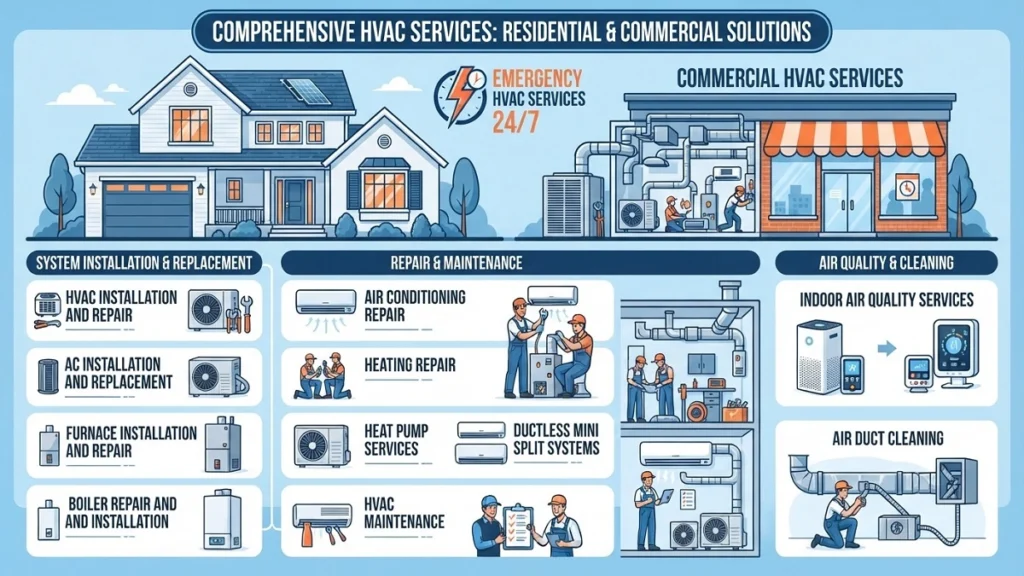
P and J HVAC Philadelphia covers the full range of residential and commercial work. Whether you need a quick diagnostic or a full system replacement, we start with the actual cause rather than the obvious symptom.
| Service | What It Covers |
| Air conditioning | Repair, installation, replacement, and tune-ups for central and ductless systems |
| Heating | Furnaces, boilers, and heat pumps; ignition, blower, and control faults |
| Heat pumps | Year-round heating and cooling from one unit; defrost and reversing valve service |
| Ductless mini-splits | Room-by-room comfort where ductwork is impractical |
| Ductwork & thermostats | Duct sealing, airflow balancing, thermostat wiring and programming |
| Indoor air quality | Filtration, humidity control, ventilation upgrades |
| Maintenance | Spring cooling and autumn heating tune-ups |
| Commercial HVAC | Offices, retail units, and rooftop or split systems |
Common AC and Heating Problems We See in Philadelphia
Philadelphia’s weather is hard on equipment. Humid summers push cooling systems to their limit, and freezing winters expose every weak furnace part. Here are the calls our crews handle most.
Cooling problems
- AC runs but never reaches the setting. Often a dirty filter or coil, low refrigerant, or a failing compressor. On recent service calls in Center City, we have traced this to blocked condenser coils packed with street dust.
- Water near the indoor unit. Usually a clogged condensate drain or a coil that froze and thawed.
- Short-cycling. The system starts and stops every few minutes, which wastes energy and wears parts fast. Oversized equipment is a frequent culprit.
Heating problems
- Furnace blows cold air. The blower runs while the burner does not fire. Igniters, flame sensors, and limit switches top the list.
- Repeated lockouts. After failed ignition attempts, the unit shuts down to protect itself. This is a safety feature, not a breakdown.
- Uneven heat between floors. Our technicians frequently see this in older Philly rowhomes, where duct sizing and return air paths matter more than the equipment.
Anything involving gas valves, flues, or heat exchangers should never be a DIY project. Call us and let a trained technician handle the gas train safely.
Repair vs. Replace: A Numbers Decision
There is no magic age at which a system must go. We look at condition, repair cost, safety, and efficiency together. Here is the framework we use with customers.
| Factor | Lean Toward Repair | Lean Toward Replace |
| Equipment age | Under 10 years | Over 12–15 years |
| Repair cost | Under one-third of a new system | Half or more of replacement |
| Repair history | First real fault | Frequent calls in recent seasons |
| Fault type | Wear item (capacitor, igniter) | Cracked heat exchanger, failed compressor |
| Efficiency | Close to modern ratings | Far below current standards |
| Safety | No safety risk | Combustion or electrical hazard |
A cracked heat exchanger or a dead compressor usually tips the scale toward replacement. A failed capacitor on an otherwise healthy unit almost never does. We give you both numbers and let you choose.
HVAC Efficiency Ratings, Explained Simply
Efficiency labels look like alphabet soup, so here is what actually matters when you compare systems. Higher numbers mean lower running costs.
| Rating | What It Measures | Applies To | Higher Number Means |
| SEER2 | Seasonal cooling efficiency | AC and heat pump cooling | Cheaper cooling season |
| EER2 | Cooling efficiency at peak heat | AC and heat pumps | Better performance on the hottest days |
| AFUE | Fuel burned that becomes heat | Gas furnaces | Less wasted fuel |
| HSPF2 | Seasonal heating efficiency | Heat pump heating | Cheaper winter heating |
A furnace with a 95% AFUE turns almost all its fuel into heat. A modern heat pump with a strong HSPF2 can heat efficiently well into Philadelphia’s cold snaps. If you have spent a winter in Philadelphia, this heating strategy makes complete sense: a right-sized, high-efficiency system carries the load without draining your budget. For product comparisons and certified efficiency data, ENERGY STAR is a reliable, non-commercial starting point.
Indoor Air Quality and Humidity Control
Comfort is not just temperature. Humidity, filtration, and ventilation shape how a room actually feels. The EPA notes that we spend roughly 90% of our time indoors, which makes indoor air quality worth taking seriously. You can read more at the EPA Indoor Air Quality resource.
For thermal comfort, ASHRAE recommends indoor relative humidity roughly between 35% and 55%. You can review the underlying guidance in ASHRAE’s work on comfort and humidity. Too much moisture feels sticky and breeds mold; too little dries out the air and your sinuses.
| IAQ Solution | Problem It Solves | Best For |
| Upgraded filtration | Dust and airborne particles | Homes near busy streets |
| Air purification | Odors and fine particles | Pet owners, allergy sufferers |
| Whole-home humidifier | Dry winter air | Older rowhomes with radiators |
| Dehumidifier | Sticky, muggy summer air | Basements and lower floors |
| Ventilation upgrade | Stale, stuffy air | Tight, well-sealed properties |
Seasonal Maintenance Checklists
Maintenance is the cheapest fix you will ever buy. Most emergency calls we run trace back to a step on this list that got skipped. General guidance from resources like the U.S. Department of Energy supports the same routine.
Spring cooling tune-up
- Clean or replace the air filter
- Wash the condenser and evaporator coils
- Check refrigerant charge and pressures
- Clear the condensate drain
- Test thermostat calibration and controls
Autumn heating tune-up
- Inspect the igniter and flame sensor
- Check the heat exchanger for cracks
- Test safety and limit switches
- Verify blower operation and airflow
- Confirm carbon monoxide safety
| System Type | Recommended Frequency |
| Air conditioning | Once a year (spring) |
| Furnace or boiler | Once a year (autumn) |
| Heat pump | Twice a year (heats and cools) |
When It Is an Emergency
Some problems can wait for a scheduled visit. Others cannot. We keep extended hours seven days a week for exactly these situations.
- Complete loss of heat or cooling in extreme weather
- Active water leaks near the indoor unit
- Tripped breakers that keep resetting
- Repeated system shutdowns
- Heat pump or furnace failure overnight
One safety note: if you ever smell gas, leave the building and call your gas utility first, then call us. No repair is worth a safety risk.
Commercial HVAC Considerations
For offices, retail units, and mixed-use buildings, downtime costs money. Our P & J HVAC Services Philadelphia team schedules around how a building is actually used, so work does not land during your busiest hours.
| Commercial Need | How We Handle It |
| Preventive maintenance | Planned visits to cut surprise breakdowns |
| Rooftop and split systems | Repair, replacement, and tune-ups |
| Off-hours scheduling | Service outside peak business times |
| Property manager support | Clear reporting and straight answers |
On recent service calls to Market Street buildings, planned maintenance has kept tenants comfortable and avoided the kind of failure that empties a storefront on a hot afternoon. That is the value of P & J HVAC Service Philadelphia on a maintenance plan rather than a crisis basis.
FAQS:
1.What services does P & J HVAC Philadelphia provide?
AC repair and installation, furnace service, heat pumps, ductless mini-splits, ductwork, thermostats, indoor air quality solutions, and maintenance for both homes and businesses.
2.How often should I maintain my system?
Once a year for each function. Cooling in spring, heating in autumn. Heat pumps get checked twice a year because they do both jobs.
3.How do I know if my AC needs repair?
Watch for weak cooling, constant running, poor airflow, water pooling, new noises, short-cycling, or a jump in bills. Any one is worth a diagnostic.
4.Why is my furnace blowing cold air?
Usually the blower runs while the burner does not. Causes include a failed igniter, dirty flame sensor, tripped limit switch, or a thermostat set to “fan on.” These are technician-level checks.
5.When should I replace instead of repair?
When the system is old, the repair is costly, or the fault is a safety issue like a cracked heat exchanger. We show you both numbers.
6.Which areas do you serve?
Center City, Fishtown, Manayunk, and the surrounding Philadelphia metro. Call to confirm your address.
7.How do I book service?
Call (215) 330-2456 or submit a request online. Calling is faster for urgent problems.
Ready When You Are
Comfort decisions get easier when someone explains the trade-offs honestly. That is what PJ HVAC Philadelphia aims to do on every call, from a spring tune-up to a full replacement. Reach the team at P & J HVAC Philadelphia at (215) 330-2456, or stop by 1132 Market St, Philadelphia, PA 19107. We are open seven days a week, and we are ready to help your property run cooler in summer, warmer in winter, and cheaper all year.