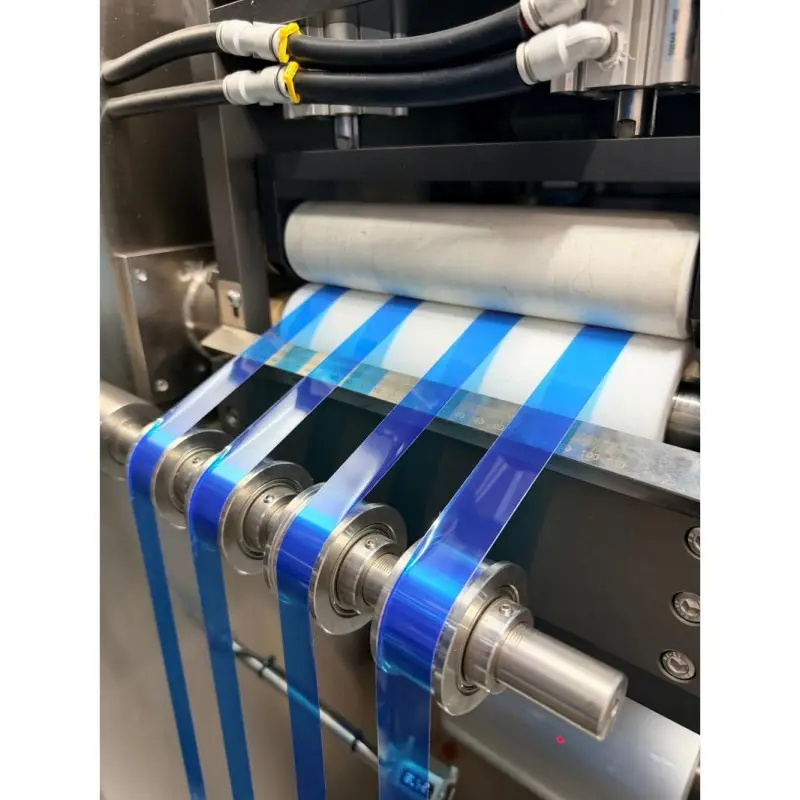
Purchasing packaging equipment is a significant production decision. The right machine needs to work effectively with the intended film, product formulation, pouch format, production volume, and operating environment.
Before investing in a Water Soluble Film Packaging Machine, manufacturers should evaluate more than the machine’s advertised production speed. A detailed assessment of technical specifications, compatibility, maintenance requirements, and supplier support can help ensure that the equipment fits the actual production process.
Confirm Film Compatibility
The first consideration should be whether the machine is compatible with the water-soluble film intended for production. Different films can have varying thicknesses, dissolution characteristics, mechanical properties, and processing requirements.
Ask the equipment supplier which film specifications the machine is designed to handle. If a particular film has already been selected, its technical data should be compared with the machine’s operating range.
Evaluate Product Compatibility
The product being packaged has a direct effect on machine configuration. Liquid, powder, granular, and viscous formulations can require different filling and dosing systems.
Consider the product’s viscosity, density, flowability, moisture sensitivity, particle size, and other relevant characteristics. The filling equipment should be designed to deliver the required quantity consistently without interfering with the sealing process.
Define the Required Pouch Format
Before purchasing equipment, determine the desired pouch dimensions and structure. Manufacturers may require single-compartment pouches, multi-compartment designs, small-dose packages, or other configurations.
Pouch dimensions can influence forming, filling, sealing, and cutting requirements. Clearly defining the intended format makes it easier to determine whether a particular machine configuration is suitable.
Check Production Capacity
Production requirements should be expressed in practical output rather than relying only on a machine’s maximum theoretical speed.
Consider:
- Required pouches per minute
- Operating hours per shift
- Number of shifts
- Expected production volume
- Planned future capacity
- Allowance for cleaning and changeovers
The machine should provide sufficient practical capacity for current requirements while leaving reasonable room for future production needs.
Examine Filling Accuracy
Consistent dosing is essential for maintaining product quality and controlling material usage. Filling accuracy should be evaluated using the actual product or a representative formulation.
Ask how the dosing system handles variations in product flow characteristics. Production trials can help determine whether the machine can achieve the required fill-weight or volume tolerance.
Review Sealing Performance
Seal quality directly affects pouch integrity. The machine should provide appropriate control over sealing temperature, pressure, and dwell time where applicable.
Manufacturers should evaluate seal strength and consistency using the intended film and product. It is particularly important to determine how the machine performs when product is being produced at the required operating speed.
Consider Temperature Control
Temperature stability can affect film behavior and sealing consistency. Before purchasing, ask how heating elements, sensors, and temperature controllers are configured.
The control system should allow operators to monitor relevant temperatures and maintain established process parameters. Temperature requirements should be evaluated together with film specifications rather than treated as a standalone machine feature.
Inspect Automation and Controls
Automation can influence production consistency, operator workload, and changeover efficiency. Review the machine’s control interface and determine which functions are automated.
Useful features may include:
- Digital parameter settings
- Automatic film positioning
- Sensor-based monitoring
- Alarm notifications
- Production data displays
- Recipe or parameter storage
The control system should be practical for the operators who will use the machine every day.
Assess Changeover Requirements
Production environments often package different products or pouch sizes. If frequent changes are expected, examine how easily the machine can be adjusted between formats.
Ask about tooling changes, parameter adjustments, cleaning requirements, and typical changeover procedures. A machine that accommodates the required formats without unnecessarily complicated adjustments can support more flexible production planning.
Check Machine Construction and Components
The construction quality of the machine can affect long-term reliability. Review the materials used for important machine structures and product-contact components.
Components exposed to product should be suitable for the formulation being packaged. Mechanical parts, electrical systems, sensors, and pneumatic components should also be selected for the expected production environment.
Review Maintenance Requirements
Maintenance should be considered before purchase rather than after installation. Ask which components require regular cleaning, lubrication, inspection, or replacement.
Find out whether routine maintenance can be performed by the plant’s own technicians and which tasks require specialized service. Clear maintenance documentation can make ongoing equipment management easier.
Evaluate Safety Features
Automated packaging equipment should include appropriate safety systems for its intended operation. Check emergency stops, protective guards, access controls, alarms, and other relevant safety features.
Operators should also receive clear instructions covering machine startup, operation, cleaning, adjustment, and shutdown procedures.
Consider Factory Conditions
The production environment can affect machine performance. Before purchase, evaluate available floor space, electrical supply, compressed air requirements, ventilation, temperature, humidity, and other site conditions.
Water-soluble film may also require controlled storage and handling conditions. The machine installation plan should account for both equipment requirements and material-management practices.
Ask About Spare Parts
Availability of replacement components can affect maintenance response times and production continuity. Ask the supplier which parts are considered consumable or wear components.
It is also useful to understand typical lead times and whether commonly needed spare parts can be stocked locally or supplied quickly.
Evaluate Technical Support
Technical support can be important during installation, commissioning, operator training, and troubleshooting. Ask what support is included with the equipment and what services are available after installation.
Clarify whether the supplier provides manuals, training, remote assistance, installation support, and service options. These details can be particularly important for manufacturers introducing water-soluble film packaging for the first time.
Request a Production Trial
A production trial can provide valuable information that specifications alone cannot show. Whenever possible, test the machine with the intended film and product.
The trial should evaluate pouch dimensions, filling accuracy, seal quality, production speed, film handling, and machine stability. Results can then be compared with the actual production requirements.
Compare Total Ownership Costs
The purchase price is only one part of the overall investment. Manufacturers should consider operating and maintenance costs throughout the expected service life of the equipment.
Relevant factors include energy consumption, film utilization, labor requirements, spare parts, maintenance, cleaning time, changeovers, and potential downtime.
Create a Purchase Checklist
Before making a final decision, summarize the requirements in a documented checklist. Important questions include:
- Is the machine compatible with the selected film?
- Can it handle the intended product formulation?
- Does it support the required pouch formats?
- Is practical production capacity sufficient?
- Can filling accuracy meet specifications?
- Are sealing parameters adequately controlled?
- Is the control system suitable for operators?
- Are maintenance and spare parts manageable?
- Does the equipment meet applicable safety requirements?
- Is technical support available after installation?
Using the same checklist for each machine under consideration can make technical comparisons more consistent.
Consider the Supplier’s Experience
The equipment supplier’s experience with water-soluble film applications can also be relevant. Manufacturers should review the supplier’s technical capabilities, machine configurations, testing procedures, and support resources.
POLYVA provides water-soluble film packaging equipment for applications requiring automated forming, filling, and sealing processes. The specific machine configuration should be selected according to the product, film, pouch design, and production requirements.
Conclusion
Choosing packaging equipment requires careful evaluation of both technical specifications and practical production needs. Film compatibility, product characteristics, pouch format, filling accuracy, sealing performance, automation, maintenance, safety, and technical support should all be reviewed before purchase.
A production trial using the intended materials can provide additional confidence that the selected equipment will perform as required. By defining requirements in advance and comparing machines against clear criteria, manufacturers can make a more informed packaging equipment investment.