1.Introduction
For most of the past two decades, building for the web meant designing pages: flat layouts, forms, menus and buttons arranged on a screen. In 2026, that model is stretching. Users now expect digital products that respond to them, adapt to context and, increasingly, let them step inside an experience rather than scroll past it. Web applications are moving beyond traditional websites and two-dimensional interfaces, and immersive technology is a big reason why.
Augmented reality (AR) and virtual reality (VR) AR and VR in Web Application Development make online experiences more interactive, more spatial and more memorable. AR places digital objects into a person’s real surroundings, while VR transports them into a fully computer-generated environment. Both can now be reached, in many cases, through a browser.
Businesses across the USA are paying attention. Retailers want shoppers to see a product in their own space before buying. Real estate firms want buyers to tour properties from another city. Training teams want employees to practice procedures without risking equipment or safety, and distributed companies want collaboration that feels closer to being in the same room.
Several other technologies make this practical. Artificial intelligence supports personalization and conversational guidance, cloud computing handles heavy data and rendering needs, and browser-based standards reduce the need for specialized downloads.
The central argument of this article is simple: AR and VR in web application development are creating new opportunities for businesses by making web applications more interactive and experience-driven. The sections below explain how the technology works, where it delivers value, what it takes to build, and what to watch out for.
2.Understanding AR and VR in Modern Web Applications
What Is Augmented Reality in Web Applications?
Augmented reality overlays digital information, animations and 3D objects onto a user’s view of the physical environment, usually through a smartphone or tablet camera. In a web context, this powers browser-based product visualization, virtual furniture placement and interactive product demonstrations. A shopper can point a phone at a living room and see how a sofa might look in that exact corner.
WebAR can also reduce friction. Because certain experiences run in a browser, users can reach them from a link or QR code without installing a dedicated app, which lowers the barrier to trying something new.
What Is Virtual Reality in Web Applications?
Virtual reality creates immersive, computer-generated environments that surround the user. Common business uses include virtual showrooms, training environments, interactive simulations and collaboration spaces where remote participants meet in a shared digital room. Browser-based VR can make these environments reachable through compatible devices, from headsets to, in simplified form, ordinary desktop screens.
AR vs. VR: Understanding the Difference
The distinction comes down to the relationship with the physical world. AR blends digital elements into the real environment, so it suits tasks tied to a user’s actual surroundings, such as previewing a product at home. VR replaces the environment entirely, which suits scenarios where the real setting is impractical, expensive or unsafe, such as equipment training or remote tours.
Businesses should choose based on their objectives, their audience and the devices that audience actually owns. Many successful projects start with AR on smartphones precisely because the hardware is already in customers’ pockets.
The Role of WebXR and AI
WebXR is a browser technology that supports compatible AR and VR experiences, giving developers a common way to reach immersive hardware and sensors. AI complements it by enabling personalization, conversational interfaces, content adaptation and interactive digital assistance inside the experience.
It is worth being clear that capabilities depend on browser support, device compatibility and implementation quality. Planning around those realities from the start prevents disappointment later.
3.How AR and VR Are Creating New Opportunities for Businesses
Enhanced Customer Engagement
Immersive experiences encourage active exploration instead of passive browsing. Rather than reading a description, a visitor can rotate a 3D product, walk through a virtual tour or try an interactive demo at their own pace. That sense of control tends to hold attention longer and makes the brand experience more memorable. Interactive product demos, virtual tours and 3D previews give people a reason to stay, explore and return.
Better Product Visualization and Purchase Confidence
Online shopping has always carried an element of uncertainty. Will the table fit the room? Does the color match? Will the equipment suit the workspace? AR and 3D viewers let customers visualize furniture, accessories, machinery and other products in context before purchasing. When 3D models are accurate and paired with clear product information such as dimensions, materials and specifications, shoppers can make informed decisions with greater confidence, which can also help reduce avoidable returns.
Personalized and Interactive Digital Experiences
Combining AR, VR and AI allows businesses to tailor product demonstrations and guided journeys to individual needs. A visitor might see configurations relevant to their project, receive conversational help while exploring, or follow a path matched to their experience level.
Personalization, however, depends on trust. Businesses should obtain consent, collect only the data they need, explain how it is used and make personalization transparent. Experiences that feel helpful rather than intrusive build stronger long-term relationships.
Remote Collaboration and Virtual Training
Immersive environments can support distributed teams in ways video calls struggle to match. Colleagues can examine a 3D prototype together, walk through a product design or rehearse a practical procedure in a simulated setting. For organizations with remote or geographically dispersed workforces, this can reduce travel needs and make hands-on training more consistent and repeatable across locations.
New Digital Products and Revenue Opportunities
Beyond improving existing channels, immersive technology opens entirely new offerings: virtual showrooms that operate around the clock, immersive learning platforms, interactive brand experiences and subscription-based digital services. These let businesses test new service models at modest scale, learn what customers value and differentiate themselves in crowded markets. A well-chosen pilot can reveal demand before a larger investment is made.
4.Key Industries Benefiting From Immersive Web Experiences
E-commerce and Retail
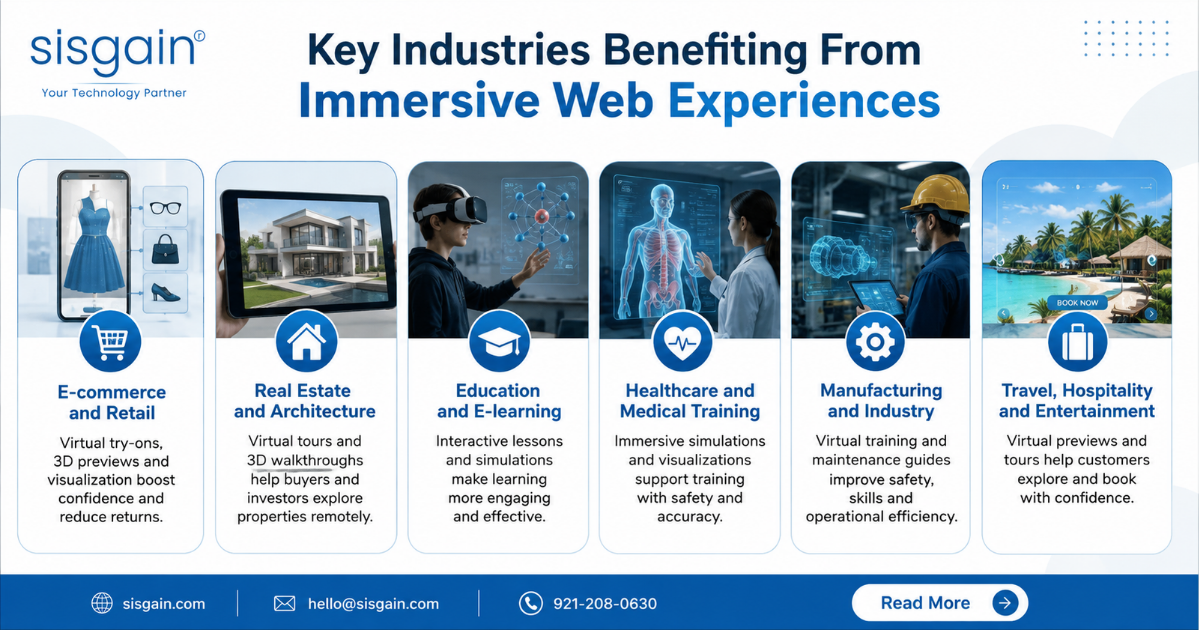
Virtual try-ons, 3D product previews and room visualization are among the most established uses. They help shoppers understand scale, fit and appearance, reducing uncertainty at the moment of decision. Retailers selling furniture, eyewear, home decor, apparel and accessories have the most obvious opportunities.
Real Estate and Architecture
Interactive property tours and virtual walkthroughs let prospective buyers and tenants explore spaces remotely, which is valuable for out-of-town clients and early-stage shortlisting. Architects and developers can also present unbuilt designs in immersive form, helping stakeholders understand a project before construction begins.
Education and E-learning
Immersive lessons, virtual laboratories and interactive simulations support experiential learning. Students can examine a historical site, explore a molecule or practice a lab procedure through compatible devices, often in ways that would be costly or impractical in a physical classroom.
Healthcare and Medical Training
Interactive anatomical visualization, educational simulations and selected training scenarios are promising applications. Because the stakes are high, these projects call for clinical validation, strong privacy protections, accessibility and appropriate professional oversight. Immersive tools should support, not replace, qualified training and judgment.
Manufacturing and Industrial Operations
Interactive equipment demonstrations, maintenance guidance and virtual training help workers learn complex machinery safely. Connected devices and real-time data can complement these applications, allowing a technician to see live equipment status alongside step-by-step guidance.
Travel, Hospitality and Entertainment
Virtual destination previews, hotel tours and immersive entertainment let customers explore services before booking or participating. Seeing a resort room, a cruise cabin or an event venue in advance helps set realistic expectations and encourages more confident booking decisions.
5.The Role of Web App Development in AR/VR Integration
Immersive features only deliver value when the underlying application is well built. Success with AR and VR in web application development depends on engineering fundamentals as much as creative vision. Choosing an experienced web application development company can help businesses align immersive features with architecture, performance goals and long-term maintenance.
Building Responsive and Cross-Device Experiences
Users will arrive on desktops, smartphones, tablets and, in some cases, compatible headsets. Responsive interfaces should adapt gracefully to each. Just as important are fallback experiences: when a device cannot support an immersive feature, the application should offer a sensible alternative, such as a standard 3D viewer or image gallery, rather than a broken page.
Integrating 3D Content and WebXR
Browser-based 3D rendering, asset optimization and WebXR integration form the technical core. Developers must evaluate device support, performance budgets and the interaction methods users will rely on, whether touch, controllers, gestures or gaze. Early testing on representative hardware prevents costly surprises.
Connecting AR/VR With APIs, Cloud Platforms and IoT
Immersive experiences become far more useful when connected to business systems. Integrations with product catalogs, customer databases and analytics platforms allow a virtual showroom to display current inventory and pricing, or let a configurator feed orders directly into fulfillment.
IoT data adds another dimension in industrial settings. Live sensor readings can appear inside an interactive equipment view, helping teams monitor machinery and plan maintenance. Organizations pursuing connected industrial experiences often work with an experienced iot app development company to manage device connectivity, real-time data streams and secure communication alongside the immersive layer.
Security, Performance and Accessibility
Secure APIs, privacy-conscious analytics, optimized 3D assets and fast loading are baseline requirements. Accessibility deserves equal attention: support keyboard navigation, provide captions, offer alternative interaction methods and always include a non-immersive path so everyone can reach the same information.
6.Challenges and Considerations for AR/VR Web Applications
Device and Browser Compatibility
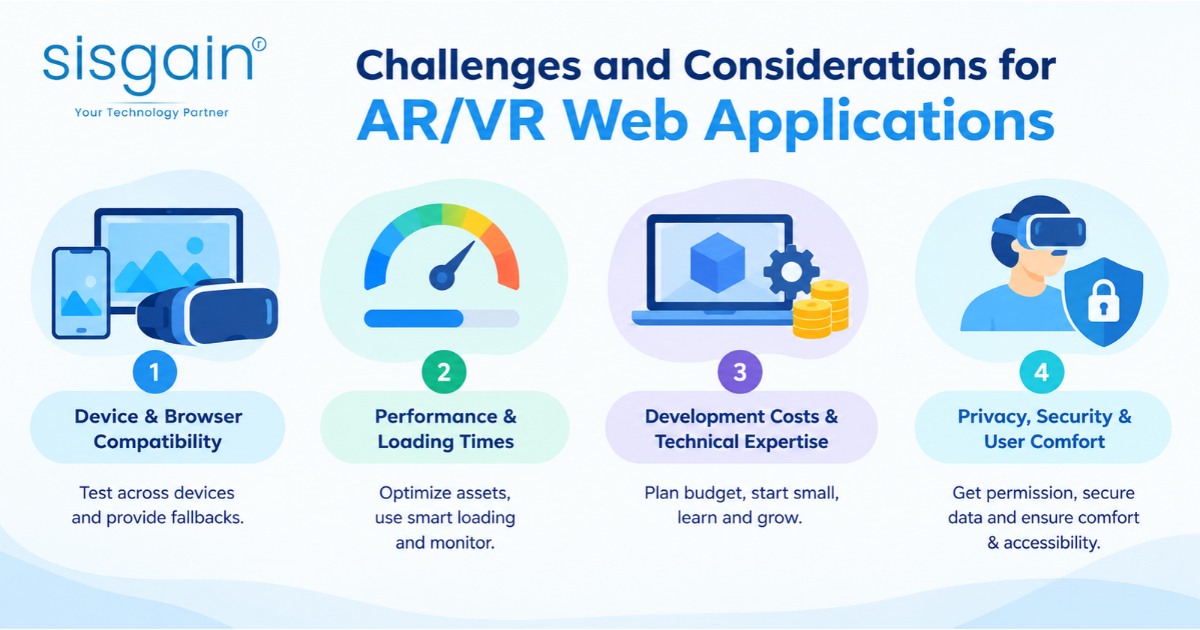
Device capabilities, browsers, operating systems and immersive hardware vary widely. A feature that works smoothly on one phone may be unavailable on another. Teams should test across a representative set of devices and provide suitable fallbacks so no user is left behind.
Performance and Loading Times
Large 3D assets, demanding rendering and inconsistent network conditions can cause slow loads and latency, which quickly frustrate users. Compression, progressive loading, efficient rendering techniques and ongoing performance monitoring keep experiences responsive.
Development Costs and Technical Expertise
Immersive projects involve 3D modeling, interaction design, thorough testing and continuing maintenance, so budgets and timelines need realistic planning. A sound approach is to begin with one focused use case, learn from real user feedback and expand deliberately. Specialist expertise in immersive design, 3D development and implementation matters here, and many businesses turn to dedicated ar/vr development services to fill those skill gaps.
Privacy, Security and User Comfort
AR often requires camera access, and some experiences handle sensitive information, so permissions must be requested transparently and data handled responsibly. Integrations should be secured. Comfort matters too: poorly tuned VR can cause motion discomfort, and every experience should consider accessibility for users with different needs.
7.Future Trends in AR/VR and Web Application Development
AI-Powered Immersive Experiences
AI-assisted product guidance, conversational interfaces and adaptive environments will make immersive applications feel more responsive. Because AI-generated information and recommendations can be imperfect, they should be tested and monitored continuously.
More Accessible Browser-Based Experiences
Improvements in WebXR support, device capabilities and browser-based 3D rendering should make immersive content easier to reach. Compatibility and accessibility will remain decisive factors in how quickly businesses and customers adopt it.
Digital Twins and Connected Environments
Combining 3D representations with live operational data and IoT-connected systems points toward digital twins: virtual counterparts of physical assets. Potential applications include manufacturing lines, facilities management and equipment monitoring.
Immersive Commerce and Entertainment
Virtual product demonstrations, interactive brand experiences and immersive media will continue to grow. Streaming and media platforms are especially likely to experiment with interactive viewing, and a capable ott app development company can help bring immersive entertainment and the evolution of digital media experiences to audiences across devices.
Conclusion:
Augmented and virtual reality are expanding what web applications can do. They help customers visualize products, engage more deeply with brands, train more effectively and collaborate across distances. Yet the strongest results come from getting the fundamentals right: usability, performance, security, accessibility and outcomes that can actually be measured.
For most businesses, the smartest path is to begin with a practical use case, such as a 3D product viewer or a virtual walkthrough, and validate it with real users before scaling. Learning from that first release makes every later investment better informed.
As browsers, devices and AI continue to mature, immersive technology will move from novelty to expectation. Businesses that start learning now will be better placed to deliver the interactive, experience-driven applications their customers will soon take for granted.
Frequently Asked Questions
Q1. How are AR and VR used in web application development?
AR overlays digital content onto the physical environment, while VR creates immersive digital environments, both accessible through compatible devices.
Q2. What is WebXR in web development?
WebXR is a web technology that enables supported browsers to deliver compatible AR and VR experiences.
Q3. Which industries benefit most from AR and VR web applications?
Retail, real estate, education, healthcare, manufacturing, travel and entertainment, depending on the use case.
Q4. Are AR and VR web applications expensive to develop?
Costs depend on complexity, 3D assets, integrations, supported devices and maintenance requirements.
Q5. Can AR and VR work on mobile devices?
Some AR and immersive experiences work on compatible smartphones and browsers, though functionality varies by device and platform.
Q6. How can businesses get started with AR/VR web application development?
Identify a business problem, choose a focused use case, assess device compatibility, build a prototype and measure user outcomes.