ISO 14001 Malaysia: Strengthen Environmental Management and Build a Sustainable Business
In today’s competitive business environment, environmental responsibility has become an important priority for organizations across industries. Businesses in Malaysia are increasingly focusing on sustainable practices, pollution prevention, and efficient resource management. Implementing an Environmental Management System (EMS) based on ISO 14001 helps organizations manage their environmental responsibilities systematically while improving operational performance. ISO 14001 Malaysia is an important consideration for companies aiming to demonstrate their commitment to environmental protection and sustainable growth.
Understanding ISO 14001 Certification
ISO 14001 is an internationally recognized standard that provides a framework for establishing, implementing, maintaining, and continually improving an Environmental Management System. It helps organizations identify environmental aspects, evaluate potential impacts, comply with applicable environmental regulations, and establish measurable environmental objectives.
With ISO 14001 Malaysia, organizations can develop structured environmental management practices that support responsible business operations. The standard is suitable for businesses of all sizes, including manufacturing companies, construction organizations, service providers, logistics businesses, and other industrial sectors.
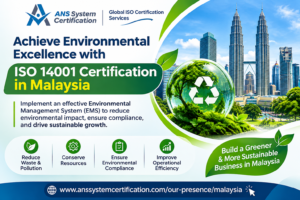
Importance of ISO 14001 Certification in Malaysia
Malaysia has a growing industrial and commercial sector, making environmental management increasingly important. Organizations must pay attention to waste management, energy consumption, pollution control, and the responsible use of natural resources.
Achieving ISO 14001 Malaysia certification offers several advantages:
- Improved Environmental Performance: Helps organizations identify and reduce negative environmental impacts.
- Regulatory Compliance: Supports the identification and management of applicable environmental legal requirements.
- Better Resource Efficiency: Encourages responsible use of energy, water, and raw materials.
- Enhanced Business Reputation: Demonstrates commitment to environmental responsibility and sustainability.
- Customer Confidence: Builds trust among customers, suppliers, business partners, and stakeholders.
- Continuous Improvement: Promotes regular monitoring, evaluation, and improvement of environmental processes.
ISO 14001 Certification Process
Organizations planning to obtain ISO 14001 Malaysia certification should follow a structured implementation process.
- Initial Assessment: Evaluate existing environmental practices and identify areas requiring improvement.
- Gap Analysis: Compare current environmental management procedures with ISO 14001 requirements.
- Documentation: Develop environmental policies, procedures, objectives, and necessary records.
- Implementation: Apply the Environmental Management System across relevant business operations.
- Internal Audit: Review the effectiveness of the implemented system and identify nonconformities.
- Certification Audit: Undergo an independent audit by an appropriately accredited certification body.
- Certification and Improvement: After successful completion of the audit, certification is granted, followed by periodic surveillance audits.
Choose ANS System Certification for ISO 14001
Selecting the right certification partner is an important step in the certification journey. ANS System Certification supports organizations seeking to strengthen their management systems and demonstrate conformity with international standards.
Businesses looking for ISO 14001 Malaysia can explore the services and country-specific information available through ANS System Certification.
Conclusion
Environmental sustainability is no longer optional for businesses seeking long-term success. Implementing ISO 14001 helps Malaysian organizations improve environmental performance, manage compliance obligations, optimize resources, and build stakeholder confidence. By pursuing ISO 14001 Malaysia certification, companies can take a positive step towards sustainable operations, responsible growth, and stronger business credibility.