Short answer: the chatbot handles the conversation, generative AI interprets what the customer needs and drafts a response, and custom software connects that response to real business data and workflows. Together they can answer a question, check an order, and complete a task in one exchange, without a human rekeying information between systems.
Why Are Businesses Moving Toward Integrated AI Solutions?
Most companies already use some form of automation. A website has a chat widget, a CRM stores customer records, and an ERP tracks inventory. The problem is that these tools rarely share information well. A customer asks about an order, the chatbot can only say “let me transfer you,” and an agent then spends five minutes switching between screens.
Integrated AI solves this by connecting the front-end conversation to the back-end systems where the answers actually live. For businesses in the UAE, where customers expect fast service in both Arabic and English and where many sectors run on tight regulatory requirements, that connection is becoming a practical necessity rather than a experiment.
ALSO READ – AI Is the New Oil: How the UAE and Saudi Arabia Are Building a GCC AI Superpowe
What Are the Three Technologies Doing?
It helps to separate the roles before looking at how they fit together.
What Are AI Chatbots?
I chatbots are conversational interfaces that answer questions, guide users through tasks, and hand off to a human when needed. Modern chatbots understand free-form language rather than rigid menu options, allowing customers to ask questions naturally. With AI Chatbot Development Services Dubai, businesses can implement intelligent chatbot solutions that handle repetitive queries around the clock, maintain conversation context, and route complex issues to the right team with the full conversation attached.
What Is Generative AI?
Generative AI models produce text, summaries, recommendations, and structured outputs based on patterns learned from large datasets. In a business setting, they do three jobs well: they interpret what a person means, they draft a response in a suitable tone, and they summarize information from larger documents or records.
Generative AI is powerful, but it does not know your company’s current data on its own. That gap is where custom software comes in.
What Is Custom Software Development?
Custom software is built around a specific business’s workflows, data structures, and rules. Off-the-shelf tools handle common tasks, but a company with unusual pricing, multi-branch operations, or industry-specific compliance often needs applications designed for its own processes.
In an integrated system, custom software acts as the connective layer. It manages access permissions, retrieves the right records, enforces business rules, and logs what happened.
What Happens When These Technologies Work as One System?
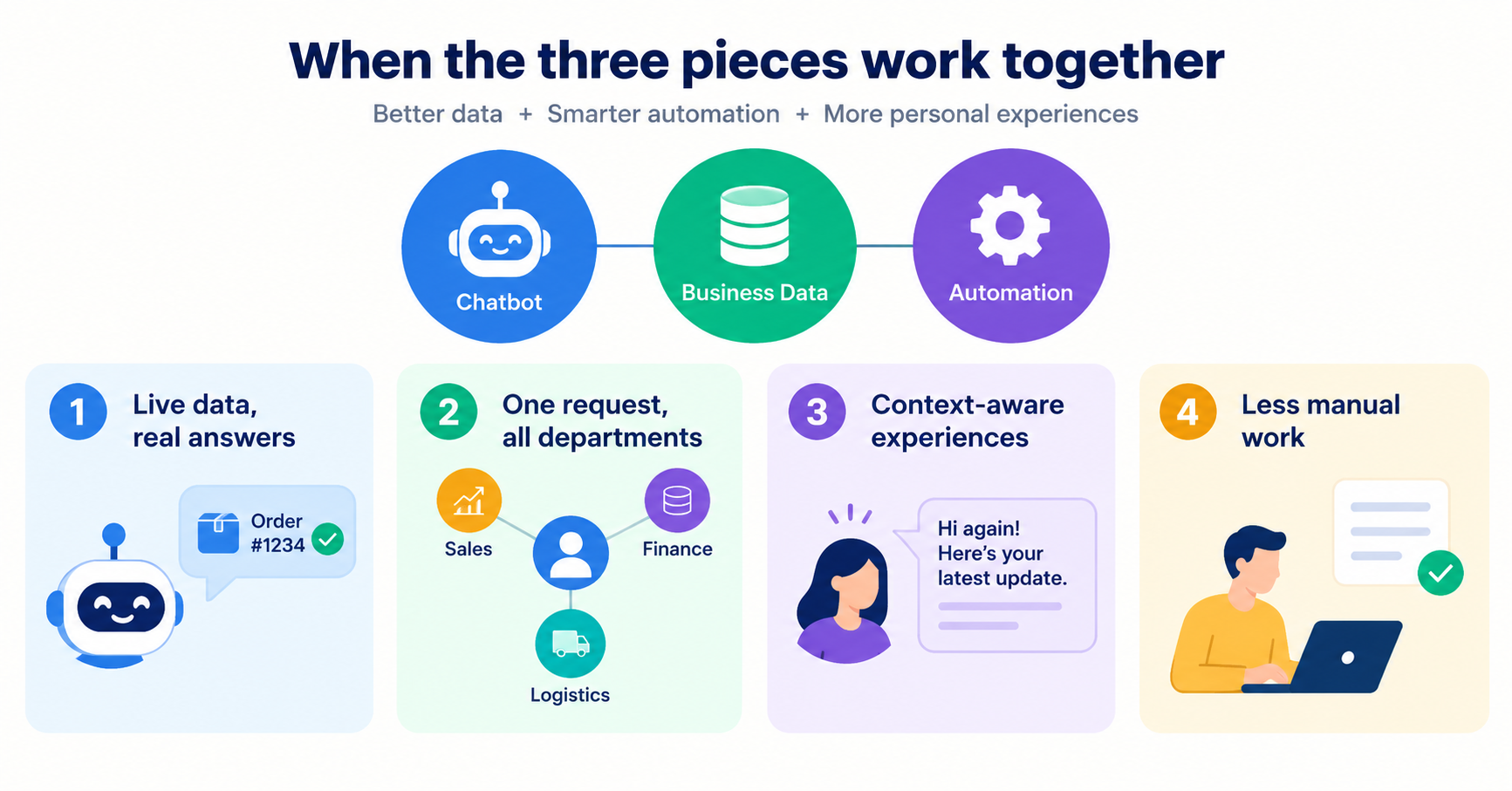
When the three pieces are designed to work together, several things change at once:
- Customer interactions connect to live business data. The chatbot can check an order status or account balance instead of guessing.
- Automation spans departments. A single request can trigger actions in sales, finance, and logistics without manual handoffs.
- Experiences become context-aware. The system remembers the customer’s history and tailors its answers accordingly.
- Manual work drops. Staff spend time on exceptions and judgment calls instead of copying data between tools.
How Do AI Chatbots, Generative AI, and Custom Software Work Together?
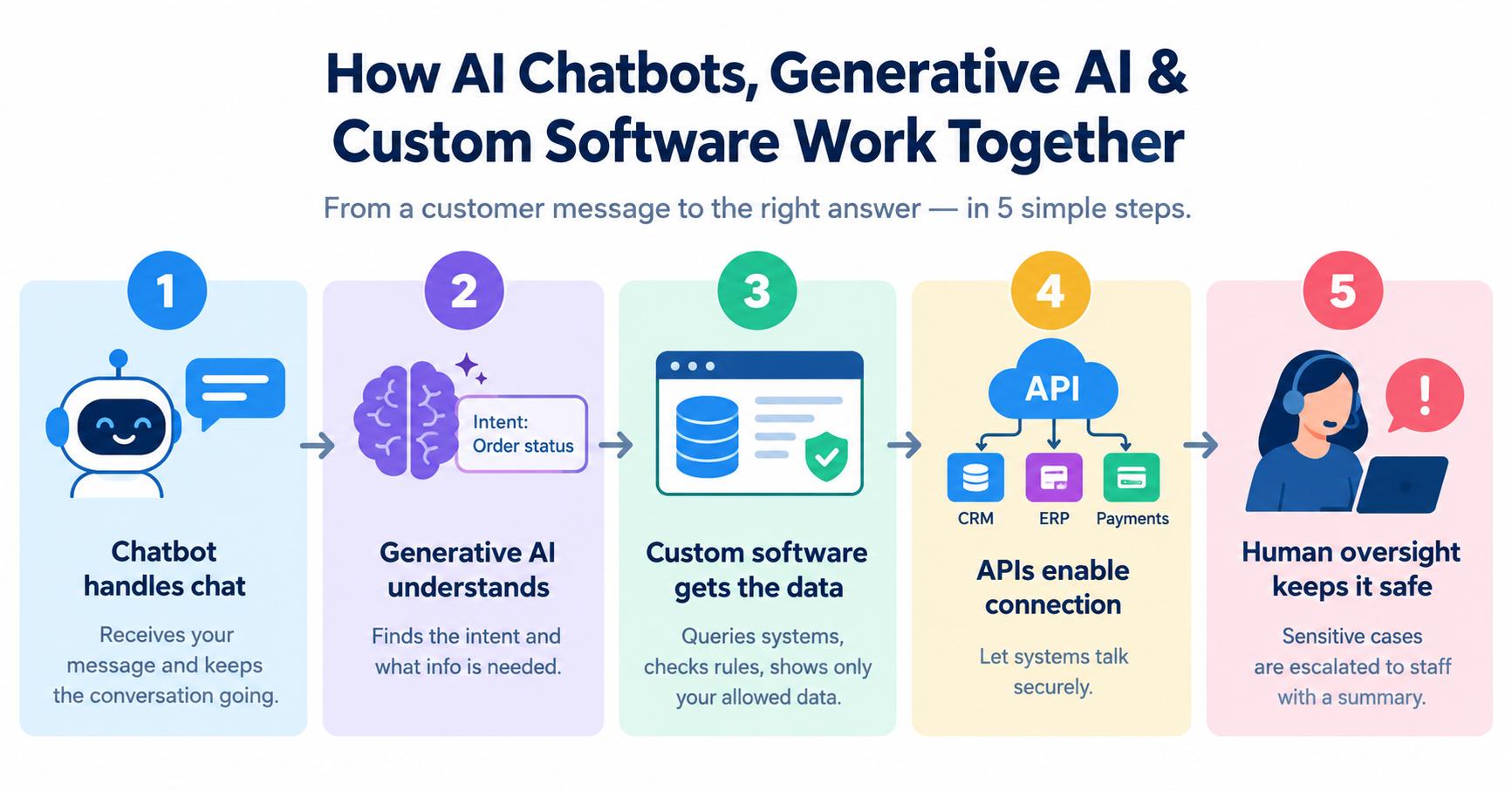
Here is the typical flow inside a well-designed system.
The chatbot handles the interaction. It receives the customer’s message on a website, app, or messaging channel and manages the conversation, including follow-up questions.
Generative AI interprets the request. It identifies the intent, such as “where is my order” or “I want to change my appointment,” and decides which information is needed to answer.
Custom software connects to business systems. It queries the relevant databases or applications, applies the company’s rules, and returns only the data that the current user is authorized to see.
APIs enable the data exchange. Application programming interfaces let the systems talk to each other securely, whether the source is a CRM, a payments platform, or an internal ERP.
Human oversight keeps the system accountable. Sensitive decisions, refunds above a set limit, or unclear cases are escalated to staff, with a summary already prepared.
READ MORE – AI Software Development Company: Services, Solutions, Use Cases, Cost & Trends in 2026
What Are the Key Business Benefits of an Integrated AI System?
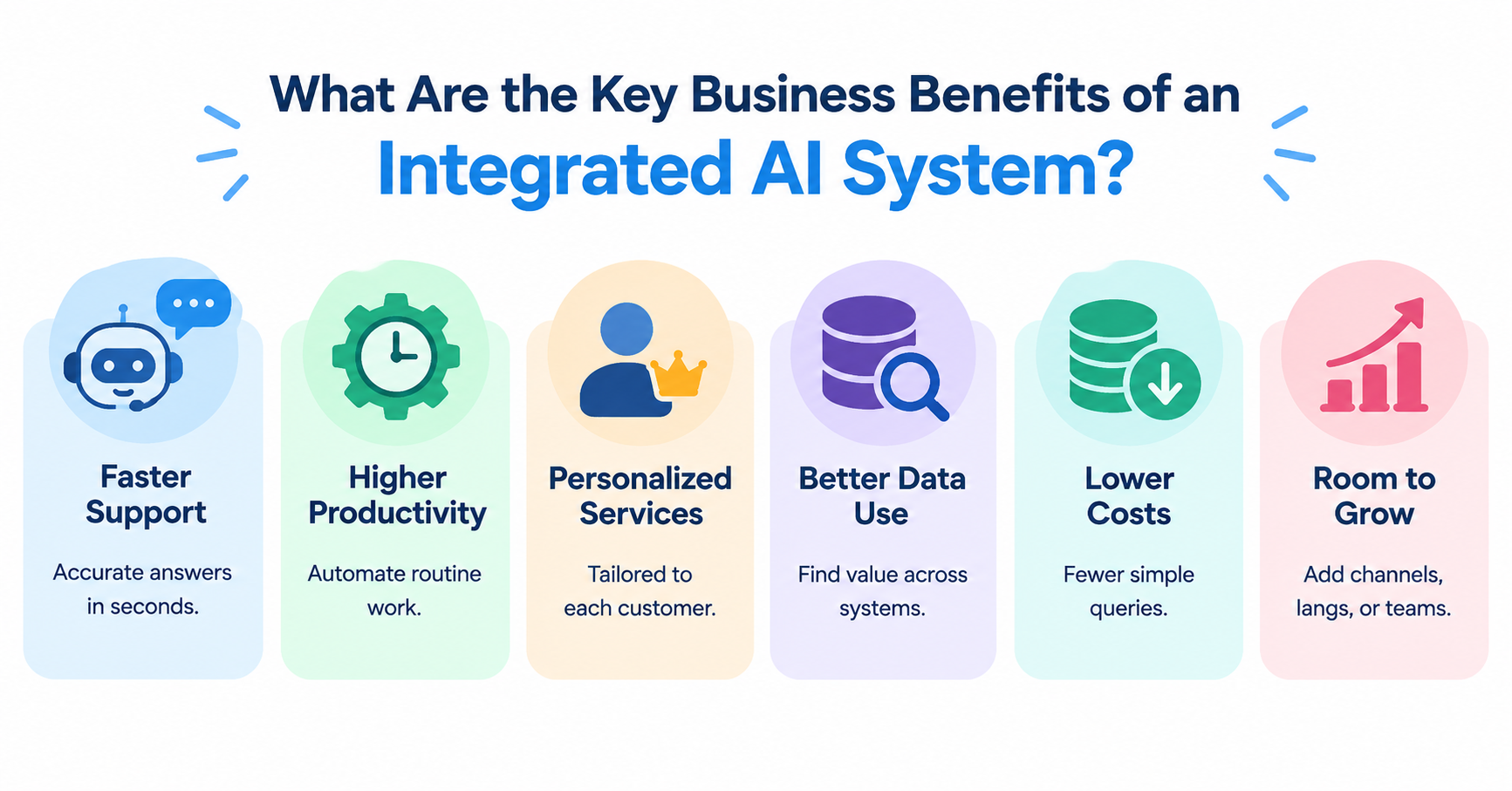
Faster, better customer support. Customers get accurate answers in seconds, and complex cases reach the right person with context already attached.
Higher productivity. Automating routine workflows frees staff for work that needs judgment, empathy, or negotiation.
Personalized services. Recommendations and responses can reflect what the business already knows about each customer, provided that data use is handled responsibly.
Better use of existing data. Information sitting in separate systems becomes useful when it can be accessed in the context of a conversation.
Lower repetitive costs. Fewer tickets for simple questions means support teams can scale without growing at the same rate.
Room to grow. A well-architected system can add new channels, languages, or departments without being rebuilt from scratch.
Real-World Use Cases Across Industries
Healthcare. Clinics and hospitals use conversational tools for appointment scheduling, reminders, and general patient information. AI can help patients find the right department or understand preparation instructions, while clinical decisions remain with qualified staff.
E-commerce and retail. Online stores use integrated systems for personalized product recommendations, order tracking, return requests, and stock questions. The chatbot can pull live inventory data rather than relying on a static FAQ.
Banking and financial services. Banks use AI to handle common queries such as card status, transaction disputes, and account information, with strict authentication and audit trails behind every action. Financial workflows often require careful compliance design, so these systems are typically built with close oversight.
Education. Institutions deploy AI learning assistants that answer course questions, suggest study resources, and adapt practice material to a student’s progress. Teachers remain responsible for assessment and feedback.
Enterprise operations. Internal knowledge assistants help employees find policies, HR information, and technical documentation quickly. Workflow automation can route approvals and requests without email chains.
EXPLORE NOW – How to Build an AI Chatbot Like U-Ask: Cost & Features
A Practical Example: How an Integrated AI System Works
Imagine a customer of an online electronics retailer asking, “My order was supposed to arrive yesterday. Where is it?”
- The customer submits the query through the website chatbot.
- Generative AI interprets the request as an order-tracking question and identifies that it needs the customer’s order number or verified account.
- The custom software verifies the customer and retrieves the shipment status from the logistics system.
- The chatbot responds clearly: the parcel left the regional hub this morning and is due tomorrow, with a tracking link.
- If the delivery is delayed beyond the agreed window, the system opens a compensation workflow for a human agent to review, or applies a credit automatically if the policy allows it.
Every step uses data the business already owns. Nothing is invented, and the customer gets a specific answer rather than a generic apology.
What Challenges Should You Consider Before Integrating?
Integration brings real risks, and they should be planned for from the start.
Data privacy and security. Connecting AI to business systems expands the attack surface. UAE organizations must consider the federal data protection law and sector-specific rules from regulators such as the Central Bank for financial services. Access should be limited to what each user and process needs.
AI inaccuracies and hallucinations. Generative models can produce confident but wrong answers. Grounding responses in verified system data, restricting what the model can say about policies or prices, and testing thoroughly all reduce this risk.
Legacy systems. Older software may lack modern APIs, which can make integration slower and more expensive. A realistic assessment of existing systems should come first.
Data quality. AI is only as useful as the records behind it. Duplicate customers, outdated product data, and inconsistent naming will show up immediately in customer-facing answers.
Cost and maintenance. Initial development is only part of the budget. Models, hosting, monitoring, and updates need ongoing funding and ownership.
Human supervision. Responsible AI use means defining clearly which decisions the system can make alone and which require a person.
What Are the Best Practices for Building an Integrated AI Solution?
- Define clear business objectives. Start with a specific problem, such as reducing average response time for order queries, rather than a general wish to “use AI.”
- Choose suitable AI models and chatbot technology. Select tools based on language support (including Arabic), accuracy requirements, and data residency needs.
- Develop secure and scalable custom software. Design for growth from day one, with clean architecture and documented interfaces.
- Integrate APIs and business databases carefully. Map data flows, limit access, and log every connection.
- Implement access controls and data protection. Apply role-based permissions, encryption, and retention policies.
- Test for performance, accuracy, and user experience. Include real customer scenarios and edge cases, not just ideal conversations.
- Monitor results and improve continuously. Review transcripts (with privacy safeguards), track escalation rates, and refine the system based on what actually happens.
Many businesses choose to work with a specialist partner for this process. When evaluating providers, look for a team with proven delivery in your sector, experience integrating with your existing systems, and clear practices for security and governance. Companies searching for an artificial intelligence development company in Dubai or a custom AI software development company in UAE should ask for references, case studies, and a clear explanation of how the system will be tested and maintained.
What Does the Future of Integrated AI Systems Look Like?
Several trends are taking shape:
- More autonomous workflows. Systems will increasingly complete multi-step tasks, such as rescheduling a delivery and notifying the customer, with human approval at key points.
- AI agents working alongside chatbots. Agents that can use several business tools will extend what chatbots can do, from booking to purchasing to reporting.
- Deeper personalization. As connected data becomes richer, experiences will adapt more precisely to each customer’s needs and history.
- A growing role for custom software. The more AI interacts with business systems, the more important well-designed, secure applications become.
Conclusion
Combining AI chatbots, generative AI, and custom software turns separate tools into a system that understands customer requests, retrieves accurate information, and acts on it within clear rules. The result is faster support, less repetitive work, and services that reflect what the business actually knows.
The right approach depends on your goals, your existing systems, and the level of risk your industry can tolerate. Start with one well-defined use case, measure the results, and expand from there. Businesses looking for a generative AI development company in Dubai or a generative AI development company in UAE should begin with a clear problem statement and an honest assessment of their data, because that is where successful integration starts.
Frequently Asked Questions
What happens when AI chatbots and generative AI work together?
The chatbot manages the conversation, while generative AI interprets what the user wants and drafts an appropriate response. When connected to business data, the answer can be both natural and accurate.
Why is custom software important for AI integration?
Custom software connects AI to your specific systems, enforces your business rules, and controls who can access what. Without it, AI tools have no reliable way to use your real data.
How can businesses integrate AI chatbots with existing software?
Integration typically uses APIs or middleware to link the chatbot to systems such as CRM, ERP, or order management platforms. The process begins with mapping the data each system holds and deciding which information the chatbot needs.
What are the benefits of combining these technologies?
Combined systems deliver faster and more accurate customer support, reduce manual work, make better use of existing data, and scale more easily than separate tools.
Which industries can benefit from integrated AI systems?
Healthcare, retail and e-commerce, banking and financial services, education, and enterprise operations all have strong use cases, provided that privacy and compliance requirements are built into the design.
Is it expensive to build an AI-powered custom software solution?
Costs vary widely depending on scope, integrations, and data readiness. A focused pilot on one use case is usually the most practical way to start, with budget planned for ongoing maintenance.
How can businesses ensure security and accuracy in integrated AI systems?
Use role-based access controls, encrypt data, limit what the AI can access, ground responses in verified data, test extensively, and keep human oversight for sensitive decisions.