Here’s the finding that should reshape how any business thinks about this problem: the same AI model scored 2.1% hallucination on one respected benchmark and 94% hallucination on another, measuring the exact same model during the exact same time period. That’s not a measurement error; it’s two different tools measuring two entirely different failure modes, and it’s a genuinely important lesson before trusting any single “hallucination rate” statistic you see cited about a model you’re considering. Understanding what actually reduces hallucination risk in a real business application, rather than chasing a single benchmark number, is exactly the kind of grounded technical work worth doing with a web development company New York businesses trust before you deploy an AI feature customers or employees will actually rely on.
No Model Is Hallucination-Free, and That’s the Correct Starting Assumption
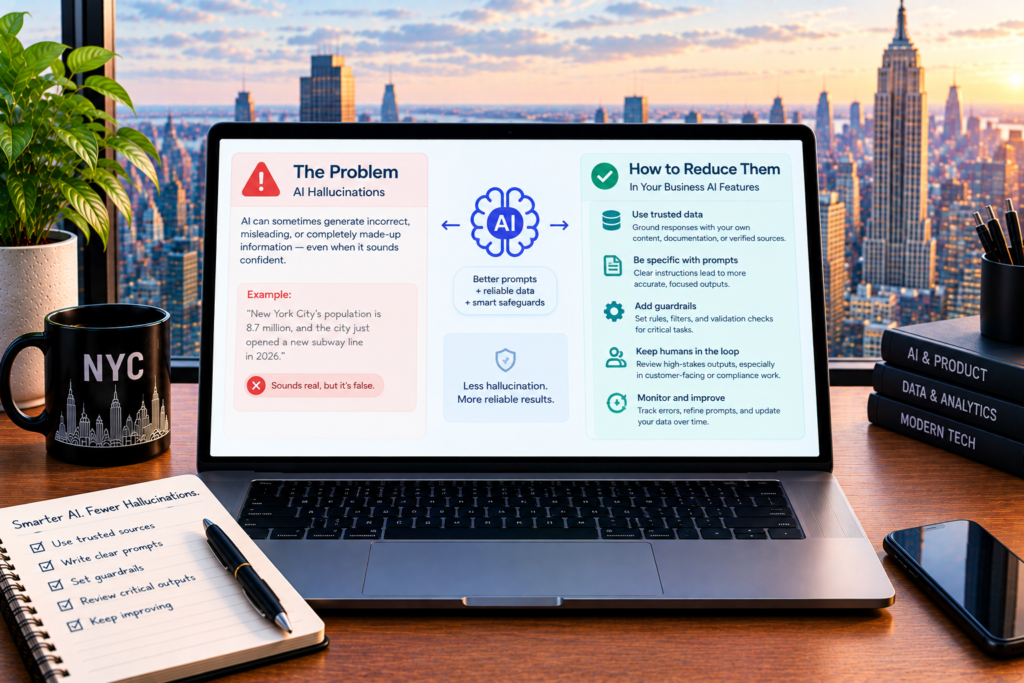
Every major AI model hallucinates; this is a structural characteristic of how these systems generate language, not a bug specific to any one provider that a future update will simply eliminate. The responsible framing, consistently emphasized across current research, isn’t “which model never hallucinates”, it’s “how do we build verification into the workflow so a hallucination gets caught before it reaches a real decision, not after.” Businesses that treat hallucination prevention as a single tool or a one-time prompt trick are missing the actual shape of the problem.
The Genuinely Dangerous Hallucination Isn’t the Obvious One
Here’s the point worth taking most seriously before building anything customer-facing: the most dangerous hallucination isn’t a response that’s obviously wrong; it’s the plausible one. A real-looking citation that doesn’t actually exist. A confident summary that subtly misrepresents the source. A believable statistic that was never actually reported anywhere. A legal case reference that sounds familiar but isn’t real. A medical explanation delivered in a genuinely professional, authoritative tone. These pass through a workflow unnoticed precisely because nothing about their surface presentation signals a problem, which is exactly why layered verification matters more than trying to make the underlying model itself simply more careful.
What Actually Works, Ranked by How Directly It Addresses the Problem
- Retrieval-Augmented Generation (RAG) remains the single most effective, well-documented mitigation available for factual accuracy specifically. By grounding a model’s response in retrieved, current, verifiable source material rather than relying purely on what it learned during training, RAG directly attacks the root cause of most factual hallucination: a model confidently generating something plausible-sounding because it genuinely doesn’t have access to the real, current answer. This is worth pairing with citation requirements specifically: prompting the system to cite exactly which retrieved source supports each claim gives you a genuine, checkable audit trail rather than an unverifiable assertion.
- Reasoning-enabled models with “thinking mode” active show dramatic, documented improvement over earlier generations for complex tasks specifically; one clinical benchmark found a leading model’s hallucination rate dropping from double digits to under 2% simply by enabling extended reasoning before the final answer was generated, compared to the same underlying model family without that reasoning step. This suggests that for genuinely complex, high-stakes queries, using a model’s reasoning capability rather than its fastest, most immediate response mode is a real, meaningful lever.
- Structured mitigation prompting, explicitly instructing a model to express uncertainty, decline to answer when it lacks sufficient information, and distinguish between what it’s confident about versus what it’s inferring, has been shown in controlled testing to meaningfully reduce hallucination rates compared to a plain, unmitigated prompt, though it doesn’t eliminate the problem entirely on its own.
- Multi-model cross-verification is a genuinely useful, currently underused technique worth knowing about: running the same query through more than one model and checking where their answers agree versus diverge. Recent analysis found that a meaningful share of one model’s high-confidence answers were directly contradicted by a second model, a clear, practical demonstration that confidence expressed by a model is not the same thing as accuracy, and that disagreement between independent models is itself a useful, actionable signal for exactly where extra human scrutiny belongs.
- Human-in-the-loop review at defined checkpoints remains, across every serious survey of mitigation strategies, one of the most consistently cited approaches specifically for high-stakes applications, not because it’s technically sophisticated, but because no current automated technique reliably catches every plausible-sounding error, and a human reviewing output at the right checkpoint genuinely does.
Why Benchmark Shopping Is a Genuine Trap Worth Avoiding
Before trusting any vendor’s cited hallucination statistic, it’s worth knowing that some widely-referenced benchmarks have become partially saturated in ways that make their scores less meaningful than they appear; one commonly cited benchmark can reportedly be beaten by a simple decision tree that never even reads the actual question, and another can be gamed by a length-based classifier that simply flags longer answers as more likely to be hallucinations. Citing these specific benchmarks for current-generation models is genuinely misleading, even when the citation itself is technically accurate. The practical lesson: ask what specifically a cited benchmark measures- grounded factual accuracy, citation reliability, summarization faithfulness- before assuming a single number tells you what you need to know about a model’s real-world reliability for your specific use case.
Building This Into a Genuine Quality System, Not a One-Time Check
The organizations getting real, durable value from AI in 2026 are consistently the ones that built verification directly into their workflow as a standing practice, not the ones that ran a single accuracy check during initial deployment and considered the problem solved. This looks practically like: RAG grounding for any factually-dependent feature, citation requirements that create a genuine audit trail, reasoning mode enabled for complex or high-stakes queries, and human review specifically concentrated at the points where an error carries real consequences, not spread thin and shallow across every single output regardless of stakes.
A Practical Way to Decide
- Use RAG for any AI feature where factual accuracy genuinely matters, given how directly it addresses the root cause of most hallucinations by grounding responses in retrieved, verifiable source material.
- Enable reasoning or “thinking” modes for complex, high-stakes queries specifically, given the documented, substantial accuracy improvement this provides over faster, non-reasoning response modes.
- Don’t trust a single hallucination benchmark at face value; check what it actually measures, and be skeptical of any benchmark that’s been publicly shown to be gameable by trivial, non-reading strategies.
- Concentrate human review specifically at your highest-stakes checkpoints, rather than spreading limited review capacity evenly and thinly across every single AI-generated output regardless of consequence.
FAQs
Is there a model that genuinely doesn’t hallucinate?
No, every major AI model hallucinates to some degree, since this is a structural characteristic of how these systems generate language rather than a solvable bug specific to one provider. The realistic goal is layered mitigation and verification, not finding a hallucination-free model.
Why do different hallucination benchmarks give wildly different results for the same model?
Because they measure genuinely different failure modes, one benchmark might measure summarization faithfulness while another measures citation accuracy, and a model can score well on one while scoring poorly on the other, since these aren’t testing the same underlying capability.
Does RAG actually eliminate hallucinations, or just reduce them?
It significantly reduces factual hallucination by grounding responses in retrieved, current source material, but it doesn’t eliminate the risk entirely; a model can still misinterpret or misrepresent even accurately retrieved information, which is why citation requirements and human review remain valuable additional layers.
Should I trust a vendor’s stated hallucination rate for their AI product?
Approach it with genuine skepticism and ask specifically what benchmark it’s based on. Some widely cited benchmarks have known gameability issues that make their scores less meaningful than they appear, and the right question is what failure mode the number actually measures, not just the headline percentage.
How much does enabling “reasoning mode” actually help with accuracy?
Documented improvement can be substantial for complex tasks specifically; one clinical benchmark showed a leading model’s hallucination rate dropping from roughly 16% to under 2% with reasoning mode active, though this benefit is most pronounced for genuinely complex queries, not simple factual lookups.
Bottom Line
AI hallucination isn’t a problem any single model update or clever prompt eliminates; it’s a structural characteristic requiring ongoing, layered mitigation: retrieval grounding, reasoning-enabled processing for complex queries, honest skepticism toward benchmark claims, and human review concentrated where errors genuinely matter. This is exactly the kind of durable, quality-system thinking worth building into your AI features with a web development company New York businesses trust, rather than treating accuracy as a one-time check you can mark complete and move on from.