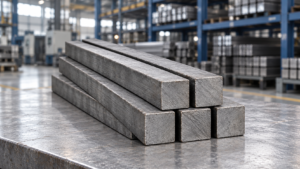
Choosing the right steel material is an important decision for manufacturers, engineering companies and industrial procurement professionals. The quality of the raw material directly affects component performance, machining efficiency, production costs and long-term reliability. Among the various steel products available for industrial use, Alloy Steel Square Bars are widely considered for applications that demand specific mechanical properties and dependable material quality.
These bars feature a square cross-section and are available in different grades and material conditions depending on manufacturing requirements. Understanding their characteristics, applications and purchasing considerations can help businesses select the right material for their projects while maintaining quality and operational efficiency.
Understanding Alloy Steel Square Bars
Alloy steel square bars are solid steel products manufactured with controlled quantities of alloying elements such as chromium, molybdenum, nickel, manganese and vanadium. Depending on the composition and processing method, these elements can influence strength, hardenability, toughness, wear resistance and other mechanical characteristics.
The square profile makes these products useful for manufacturing components that require flat surfaces, square-section stock or specific machining operations. Their suitability depends on the intended application, the selected grade and any heat treatment performed before or after machining.
Industries searching for material suitable for engineering and manufacturing applications can explore Alloy Steel Square Bars to review sourcing options and discuss their requirements with a supplier.
Why Are Alloy Steel Square Bars Important in Modern Manufacturing?
Industrial components frequently operate under varying loads, mechanical stress and demanding service conditions. Selecting an appropriate steel grade helps manufacturers meet design requirements while maintaining consistent production quality.
One important advantage of alloy steel is the ability to tailor its properties through grade selection and heat treatment. Certain grades can offer high strength and improved hardenability, while others are selected for their balance of toughness and machinability.
The square shape can also simplify material preparation for specific components. When buyers select appropriate dimensions and lengths, they may reduce unnecessary material removal and improve production planning.
However, no single alloy steel grade is suitable for every application. Engineers should evaluate operating loads, component geometry, service temperature, wear conditions and manufacturing processes before choosing a material.
Factors to Consider Before Purchasing Alloy Steel Square Bars
Industrial buyers should evaluate technical specifications and supplier capabilities before placing an order.
- Grade and applicable standard
Identify the required grade from the engineering drawing or purchase specification. Confirm the applicable national or international standard and avoid substituting grades without technical approval.
- Dimensions and dimensional accuracy
Specify the square cross-section, bar length, tolerances and any special corner requirements. These details help ensure compatibility with machining operations and component designs.
- Material condition and heat treatment
Determine whether the application requires an annealed, normalised, quenched-and-tempered or other specified condition. Material condition can significantly influence hardness, machinability and mechanical performance.
- Mechanical property requirements
Review the required tensile strength, hardness, impact properties and other relevant criteria. Verify that the selected grade and supply condition meet the engineering requirements.
- Certification and traceability
Request the appropriate Mill Test Certificate and confirm that the documentation identifies the supplied grade and relevant heat or batch number. Additional testing should be arranged when required by the purchase specification.
Selecting Dependable Alloy Steel Square Bars Suppliers
Working with experienced Alloy Steel Square Bars Suppliers can help procurement teams source suitable materials more efficiently. Beyond price, buyers should evaluate a supplier’s ability to understand technical requirements, communicate material availability and provide relevant quality documentation.
A dependable supplier should clarify grade options, available dimensions, material conditions and expected lead times. Where necessary, buyers should also ask about cutting services, dimensional inspection and additional testing options.
Steel Exchange supports steel sourcing requirements for industrial and engineering customers. Buyers can contact the company to discuss specifications, quantities, certification needs and delivery expectations. Availability and order-specific services should be confirmed directly before purchase.
Comparing quotations on an equivalent technical basis is also important. A lower-priced material may not represent better value if the grade, condition, dimensions or documentation differ from the original requirement.
The Role of Quality Control in Steel Procurement
Quality control begins with a clearly defined purchase specification. Before accepting material, buyers should compare the supplied product and its documentation against the order requirements.
Chemical composition reports help establish whether the material meets the specified grade. Mechanical test results provide information about relevant properties, while dimensional inspections verify compliance with required sizes and tolerances.
For applications where internal defects or surface discontinuities are a concern, additional non-destructive testing may be specified. Ultrasonic testing and magnetic particle testing have different capabilities and should be selected according to the material, component and applicable acceptance criteria.
Maintaining traceability records and inspection documentation helps manufacturers manage incoming material quality and support internal audits. These practices are particularly valuable when steel components form part of safety-critical or tightly controlled production processes.
Frequently Asked Questions
What industries commonly use alloy steel square bars?
They are used in engineering, machinery manufacturing, forging, selected automotive applications, industrial equipment and agricultural machinery. The appropriate grade depends on the component’s intended function and performance requirements.
Are alloy steel square bars suitable for machining?
Yes, suitable grades can be machined into a variety of industrial components. Machinability depends on chemical composition, hardness, heat-treatment condition, tooling and machining parameters.
What documents should buyers request when purchasing alloy steel square bars?
Buyers should request the applicable material certificate, such as a Mill Test Certificate, along with any required chemical analysis, mechanical test results and inspection reports. Documentation should match the supplied material and purchase specification.
How can businesses obtain an accurate quotation?
Provide the required grade, dimensions, length, quantity, material condition, applicable standard, certification requirements and delivery location. Detailed specifications help suppliers assess the requirement and provide a more comparable quotation.
Conclusion
Alloy steel square bars offer manufacturers a versatile starting material for a wide range of engineering and industrial applications. Their performance depends on the correct grade, material condition, dimensional accuracy and suitability for the intended operating environment.
For industrial buyers, a structured procurement process that includes specification verification, quality documentation and supplier evaluation can improve purchasing decisions and reduce material-related risks. Businesses exploring sourcing options can visit Steel Exchange’s Alloy Steel Square Bars product page to discuss their requirements and request further information.