Anyone who has watched a paper sack split open under a modest load has seen, without realising it, the exact failure mode a bursting strength tester is designed to predict before it happens on a factory floor. The instrument exists to answer a fairly narrow but commercially important question: how much pressure can a sheet of paper, board, or corrugated material withstand before it ruptures.
What is a bursting strength tester
A bursting strength tester is a laboratory instrument that measures the maximum hydraulic or pneumatic pressure a material can bear before it bursts. The result is expressed in units such as kPa or kgf/cm², and it is one of the earliest and still most widely relied upon indicators of paper bursting strength across packaging, printing, and paper manufacturing industries. Unlike tensile testing, which pulls a sample apart in one direction, bursting strength testing applies pressure evenly across an area, which mimics how a bag, carton, or sack actually fails when overloaded or dropped.
Working principle
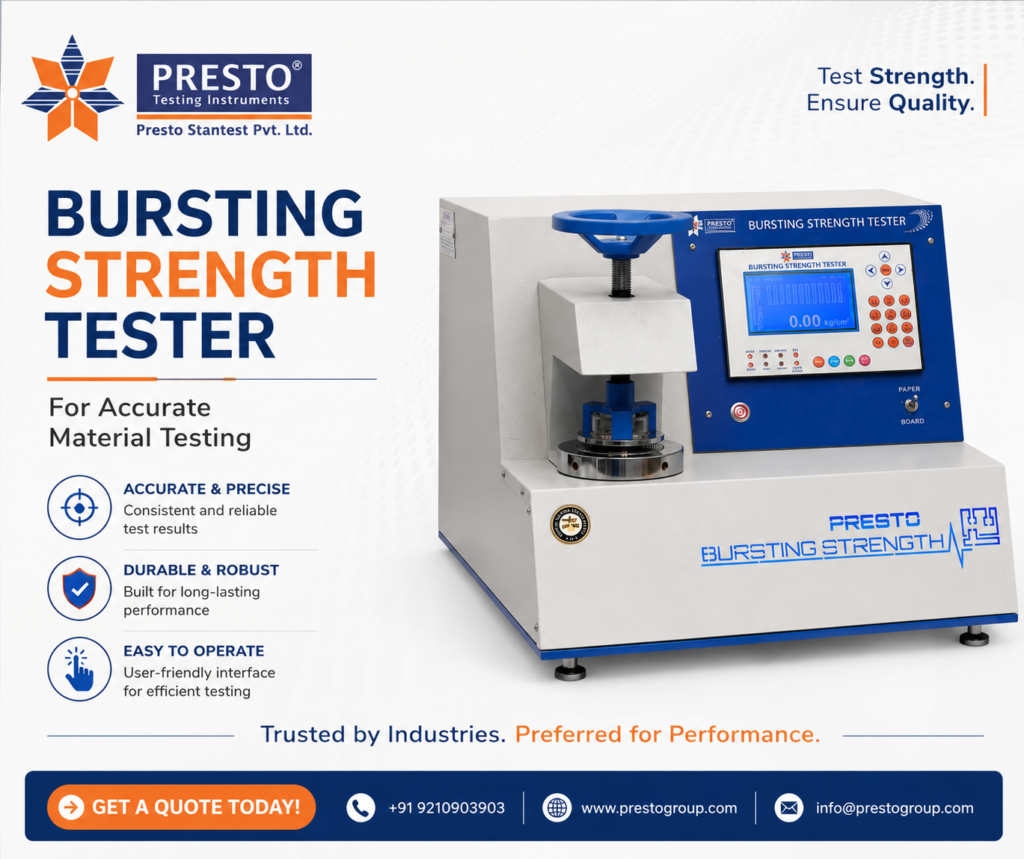
The bursting strength tester principle rests on a simple mechanical idea. A circular sample of the material is clamped firmly between two rings so no slippage occurs at the edges. Below the sample sits a rubber diaphragm connected to a hydraulic or pneumatic pumping system. As the operator activates the test, fluid or air pressure is pumped steadily behind the diaphragm, which expands upward and pushes against the clamped sheet. The pressure increases at a controlled, standardised rate until the diaphragm ruptures the material. A calibrated gauge or digital sensor captures the exact pressure at the moment of failure, and that reading becomes the bursting strength value for the sample.
How the diagram maps to the process
A typical schematic shows the clamping ring at the top holding the test specimen flat, the rubber diaphragm directly beneath it connected to a pump chamber, and a pressure gauge wired to the chamber to record real-time readings. Digital versions replace the analogue gauge with a load transducer feeding a display or printer, but the mechanical path from pump to diaphragm to ruptured sheet stays identical across both designs.
Types of bursting strength testers
Manual hydraulic testers are still common in smaller labs and rely on a hand pump along with a dial gauge, which keeps costs low but introduces some reading variability between operators. Motorised or computerised testers automate the pressure ramp and capture peak values digitally, cutting operator error and generating printable test reports. A third category, often used specifically for corrugated board, includes a clamping mechanism sized for thicker multi-ply samples rather than single sheets of paper.
Standards that govern the test
Buyers and quality teams rarely accept a bursting strength figure without knowing which standard it was tested against. ASTM D774 and ASTM D3786 cover paper and paperboard bursting strength in the United States, while ISO 2758 and ISO 2759 serve the same purpose internationally, the latter specifically addressing corrugated board. TAPPI T403 is another commonly referenced standard in pulp and paper testing. A compliant tester should allow the pressure ramp rate and clamping specifications to be adjusted to match whichever of these standards the buyer’s export market or client audit requires.
Where the test is applied
Paper mills use bursting strength data to grade output before it ships to converters. Corrugated box manufacturers rely on it to validate that fluting and liner combinations will hold up during palletised transport. Printing and packaging companies test finished cartons and sacks to confirm they meet the specifications promised to retail or export buyers, and quality labs use it as a routine incoming-material check before approving a paper roll for production.
Frequently asked questions
Is bursting strength the same as tensile strength? No, tensile strength measures resistance to pulling force in one direction, while bursting strength measures resistance to multidirectional pressure across an area.
What sample size does the test require? Most standards call for a clamped circular area with a fixed diameter, typically around 30.5 mm, though corrugated board testing uses a larger clamping area to accommodate thickness.
Can one machine test both paper and corrugated board? Some models support both with an interchangeable clamping assembly, though dedicated corrugated testers generally handle thicker board more reliably.
Test your material against the standard your buyers expect
Presto’s bursting strength testers are available in manual and computerised formats, calibrated to ASTM, ISO, and TAPPI standards, with clamping assemblies suited to both paper and corrugated board. Get Bursting Strength Tester Pricing →